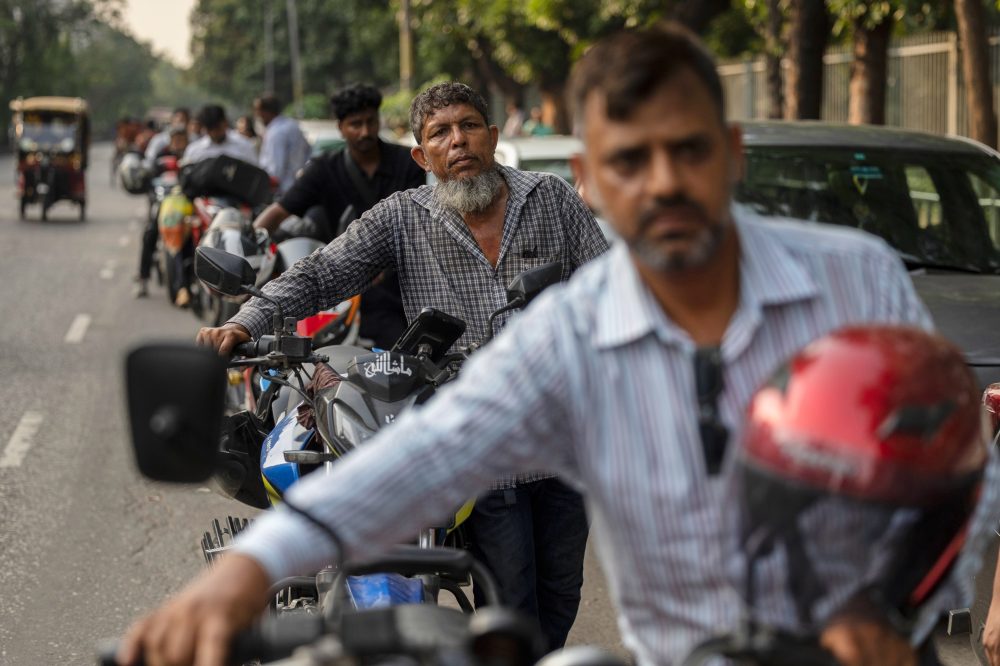

DHAKA, Bangladesh (AP) — After losing his life savings when his clothing venture failed 18 months ago, Tariqul Islam began driving a motorcycle taxi to support his family. Recently, he has spent countless hours waiting in fuel lines as energy shortages connected to the Iranian conflict have reached Bangladesh.
The 53-year-old father of four worries the economic pressure will intensify if the conflict continues, explaining that extensive waits for fuel have dramatically reduced his earnings and made it increasingly challenging to provide for his family in Dhaka, Bangladesh’s capital, including supporting a daughter and son in higher education.
“My family was managing fairly well through ride-sharing,” he said. “But after the fuel shortage began, I would buy fuel one day and run the bike for two days. As a result, I had to sit idle for one day, which reduced my income.”
Islam’s financial struggles mirror a wider economic crisis in Bangladesh, which depends heavily on fuel imports. Energy shortages have disrupted everyday activities, reduced manufacturing production, and raised alarm about economic expansion as international conflicts drive up prices and limit availability.
The situation has improved modestly recently, with shorter lines at gas stations following government efforts to boost supplies, though worries remain throughout various industries.
Throughout Asia, nations are experiencing comparable difficulties as conflict-related energy price increases affect economies that depend on imported petroleum and natural gas.
The region faces vulnerability because it depends on fuel imports, with much of the supply traveling through the Strait of Hormuz — a critical passage for approximately one-fifth of worldwide oil and natural gas commerce.
Increased fuel expenses are causing inflation and pressuring family budgets, while sectors ranging from manufacturing to transportation confront higher operational costs and supply chain interruptions.
The Asian Development Bank reduced growth projections for developing Asia and the Pacific in late April, cautioning that conflict-related energy disruptions would decelerate economies and increase inflation. The bank now anticipates 4.7% growth in 2026, with inflation climbing to 5.2% as petroleum prices rise and financial conditions become more restrictive.
Many hope for a swift resolution to the conflict and a return to stability.
“If this situation continues, we will have to move back to our village and find some other way to earn a living,” Islam, the struggling father said. “It is not possible to survive in Dhaka by doing ride-sharing under these conditions.”
Escalating energy prices are anticipated to burden Bangladesh’s budget, with officials likely spending an extra $1.07 billion on LNG subsidies during the April-June period alone if worldwide prices stay elevated.
Bangladesh has requested supplies from neighboring India, which has responded favorably as it has diversified fuel sources, including purchases from Russia.
Officials have already implemented cost-cutting measures to address the crisis as international lenders predict slower growth in the nation of over 170 million residents. Natural gas and diesel shortages have caused more frequent electricity outages in manufacturing areas.
The administration has also closed fertilizer plants to redirect gas to power facilities, limited evening operating hours for shopping centers, and established fuel rationing programs.
The World Bank stated in April that it anticipates Bangladesh’s growth to decrease to 3.9% in the fiscal year concluding in June 2026, cautioning that an extended Middle Eastern conflict could increase inflation, expand the current account deficit, and strain government finances through higher energy subsidies.
Jean Pesme, the World Bank’s division director for Bangladesh and Bhutan, noted the economy already confronted “pre-existing vulnerabilities and challenges, in particular on the economic and employment front.”
The increasing expenses are “obviously making the fiscal situation more difficult.”
He also cautioned that officials should be careful about raising fuel prices, noting that higher costs could damage farmers and agricultural production.
The energy shortage is also increasing expenses and endangering Bangladesh’s clothing exports, which form the foundation of its economy, according to business executives.
Anwar-Ul Alam Chowdhury, president of the Bangladesh Chamber of Industries, indicated exports to Europe and the United States could experience a major decline. Shipments have decreased between 5% and 13% in recent months, he reported. He expressed concern that buyers could lose trust in Bangladesh’s delivery capabilities and that competing countries such as India, Vietnam, and Cambodia could capture market share if the crisis continues.
Chowdhury reported that factory production has declined by 30% to 40% for multiple reasons and that conditions have deteriorated since the United States and Israel launched their war against Iran, while business expenses have increased by approximately 35% to 40%.
Bangladesh, the globe’s second-largest clothing exporter following China, generates roughly $39 billion yearly from the industry, which employs around 4 million workers, primarily women from rural regions.
Alvi Islam, director of Arrival Fashion Limited, explained that manufacturers face higher expenses for petroleum-derived materials such as sewing threads, poly bags — plastic packaging materials — and shipping boxes, while spending more on diesel generators to manage frequent power outages.
His company, which exports products valued at approximately $40 million annually, now operates generators for at least four hours daily during production.
“For that reason, the cost of doing business for exporting garments has increased quite significantly in past one month,” he said.
Garment worker Mosammet Runa, 35, expressed concern about her family’s prospects if the conflict persists.
“Millions of people like us depend on this industry. It is how we survive,” said Runa, who, together with her husband, makes about $400 monthly to support their six-member family.
She indicated that an extended conflict could eliminate employment opportunities and urged for an end to the violence.
“We are innocent people. The world should not make us victims,” she said.