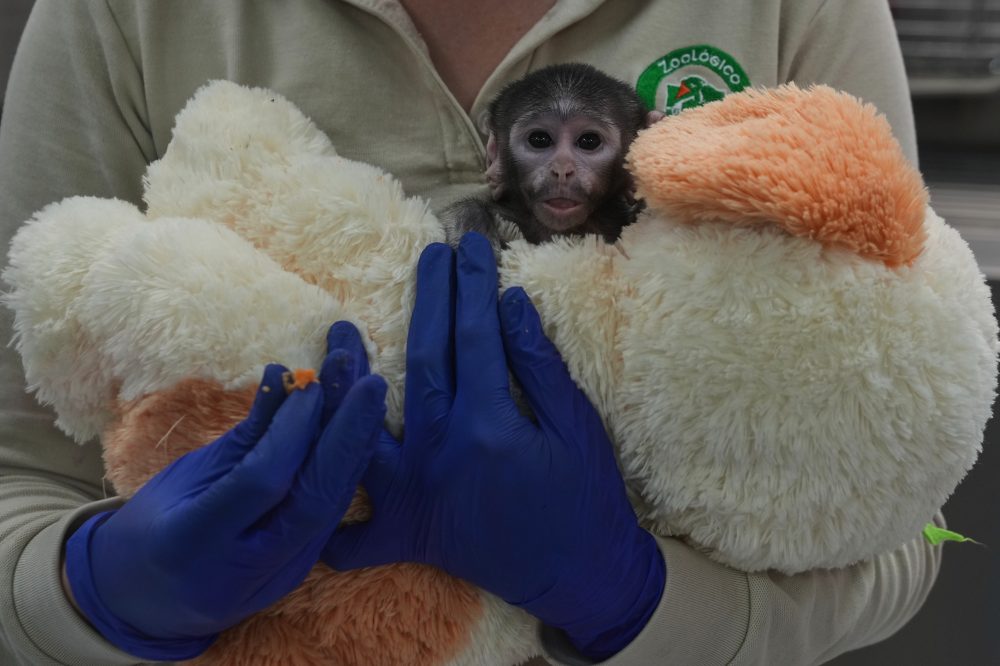

GUADALAJARA, Mexico — At a zoo in western Mexico, a tiny patas monkey named Yuji starts each morning wrapped around his most treasured possession: a stuffed dog that serves as his substitute mother.
The 6-week-old primate, weighing just 1.4 pounds, depends on his plush friend for emotional support after his biological mother Kamaria abandoned him shortly after birth. The first-time parent was unable to develop the necessary maternal connection with her offspring.
Yuji’s touching story has resonated throughout Mexico, reminding many of Punch, a Japanese macaque who became an internet sensation for his attachment to a stuffed orangutan after facing similar maternal rejection.
However, Yuji’s situation differs from Punch’s case. The young monkey remains isolated from other primates, spending his days in a specialized enclosure at the Guadalajara Zoo’s Comprehensive Center for Animal Medicine and Welfare, known as CIMBA. A team of 12 veterinarians and biologists oversees his daily care.
Zoo officials have not established a timeline for introducing Yuji to the facility’s colony of 12 adult patas monkeys and three other young primates. According to veterinarian Iván Reynoso Ruiz, who leads the zoo’s primate department, this transition will occur once Yuji graduates from his current milk-only nutrition to a mature diet including fruits and vegetables, likely around 6 months of age.
The crisis began just hours after Yuji’s birth on March 3, when Kamaria displayed troubling maternal behaviors. She appeared unable to properly support her newborn, preventing the infant from maintaining the crucial grip needed for survival.
Recognizing the emergency, zoo staff quickly intervened by removing the 443-gram newborn from his mother’s care. The fragile infant required immediate incubator treatment at CIMBA to regulate his body temperature and ensure his survival, Reynoso Ruiz explained.
This marked the beginning of Yuji’s human-assisted upbringing, a common zoo practice designed to protect vulnerable young animals. Staff members chose his name as a tribute to a beloved Japanese manga character.
Throughout his initial weeks, Yuji received continuous monitoring and regular bottle feedings with enriched formula.
Zoo staff provided Yuji with stuffed companions from day one. Reynoso Ruiz noted that these toys function as maternal substitutes, offering him essential emotional security. To ensure cleanliness, caregivers cycle between three different plush animals — the original dog, plus a bear and monkey — guaranteeing Yuji always has a sanitary comfort object.
Staff members have enhanced Yuji’s living space with developmental tools including a miniature hammock and climbing ropes. As the young monkey has gained weight and extended his sleep periods, his care team has modified his feeding routine. Yuji now begins his day with the first of four daily bottles at 7:00 a.m.
Although both Punch and Yuji have gained social media fame, certain animal welfare advocates question the ethics of human-raised wildlife programs.
Animal rights campaigner Diana Valencia contends that natural environments cannot be replicated artificially, stating that creatures “have the right to be born, grow, develop, and die where they belong.”
Addressing such concerns, the Guadalajara Zoo’s primate specialist stressed that contemporary zoological facilities offer crucial protection for species facing worldwide dangers. He characterized the intervention as essential for survival, noting that Yuji would likely have died in natural conditions without this “second chance” at life.