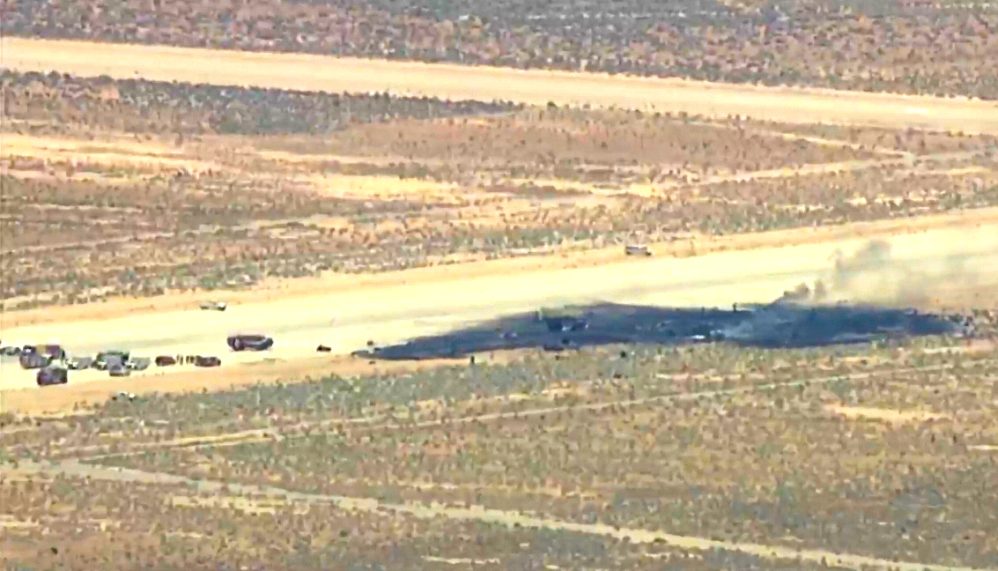

Edwards Air Force Base, located in Southern California’s Mojave Desert roughly 100 miles north of Los Angeles, has long been one of the most storied flight research facilities in the United States. But on Monday, tragedy struck when a B-52 bomber went down shortly after takeoff and burst into flames, claiming the lives of all eight people aboard.
The base has a rich history of aviation firsts dating back to the early 1940s. In 1942, test pilot Bob Stanley flew the first jet-powered aircraft in U.S. history, launching from the base’s dry lake bed — a naturally expansive stretch of flat terrain that proved critical for early turbojet engines that were prone to “flaming out.”
Five years later, in 1947, Air Force test pilot Chuck Yeager made global aviation history by pushing an orange, bullet-shaped Bell X-1 rocket plane to Mach 1.05, officially breaking the sound barrier. That milestone was kept under wraps for nearly a year — during which time the world believed the British had achieved the feat first.
Then in 1981, astronauts John Young and Robert Crippen landed on that same dry lake bed, completing the first flight of an orbiting space vehicle that launched on rocket power and returned to Earth gliding on wings like a conventional aircraft.
Today, the base is described as an “irreplaceable national asset” and continues to serve as a central hub for Air Force aircraft testing and development. All Air Force aircraft undergo testing there, along with select Navy and Army aircraft. The base itself has stated that “arguably, more major milestones in flight have occurred at this base than anywhere else in the world.”
Operations at the base are overseen by the 412th Test Wing, which handles developmental testing of Air Force weapons systems, software, and components — both before they are purchased by the military and throughout their operational lifespan.
In 2025, Boeing delivered a B-52 to Edwards equipped with a new, modernized radar system. According to an Air Force news release from that year, a test team was scheduled to conduct ground and flight tests on the aircraft through 2026 to inform a production decision. The updated Active Electronically Scanned Array, or AESA, radar replaced the plane’s older, outdated system. It remains unclear whether that aircraft is the same one involved in Monday’s crash.
Military officials confirmed the B-52 went down during what was described as a routine test mission. Col. James Hayes, the deputy commander of the 412th Test Wing at Edwards, told reporters at a news conference that the aircraft was supporting the “radar modernization program” at the time of the crash.
Among those killed were both government contractors and uniformed military personnel. Aircraft manufacturer Boeing confirmed that two of its employees were on board.
The cause of the crash has not yet been determined, and an official investigation is currently underway.