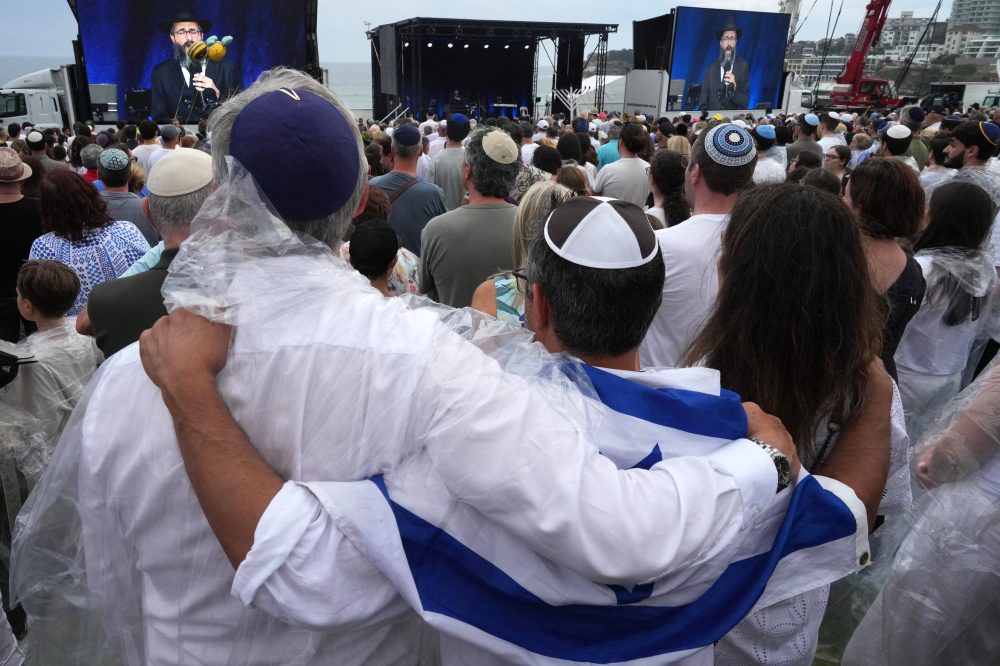

MELBOURNE, Australia — The leader of Australia’s primary domestic intelligence service testified Monday that he had redirected resources from counterterrorism operations to focus on espionage and foreign interference several years prior to a deadly shooting that claimed 15 lives at a Sydney Hanukkah event.
Mike Burgess, who heads the Australian Security Intelligence Organization known as ASIO, appeared before a comprehensive government investigation examining antisemitism’s growth in Australia leading up to the December 14 attack at Bondi Beach.
The intelligence agency lowered Australia’s National Terrorism Threat Level from “probable” to “possible” in November 2022 — placing it at the second-lowest rating on their five-level system — following the defeat of the Islamic State group in the Middle East and the end of their recruitment efforts.
Following this change, ASIO redirected attention toward foreign interference and espionage cases while maintaining adequate staffing for counterterrorism operations, according to Burgess.
“Because terrorism has the potential to cause people to lose their lives or get harmed, it always remained a priority for us. There was just less activity that we were investigating because the nature of the environment had changed and the number of tasks we were looking at had reduced,” Burgess testified.
“At the same time, every rock we lifted up we found espionage or foreign interference that needed to be inquired and investigated and so resources were moved over there,” he continued.
Following the Hamas-led assault on Israel on October 7, 2023, Burgess said he took the unusual step of issuing a public warning about how inflammatory rhetoric could spark violence — something no previous ASIO director had done.
“Before the Israeli government responded to that horrific attack, we saw the strong emotions appear in this country where we had people celebrating the Hamas terrorist attack,” Burgess stated.
The intelligence chief reported that threatening and intimidating conduct toward Jewish Australians continued through late 2023, especially in New South Wales, Victoria and Queensland. This behavior intensified to include targeting Jewish-owned businesses and religious sites by October 2024, he noted.
ASIO raised Australia’s terrorism threat level back to “probable” in August 2024.
The Royal Commission on Antisemitism and Social Cohesion, Australia’s most authoritative form of investigation, must deliver its findings to the government before the first anniversary of what became the country’s deadliest mass shooting since 1996.
Prosecutors claim the father-and-son shooters, Sajid and Naveed Akram, drew inspiration from IS and carried homemade IS banners to Bondi.
Both attackers sustained injuries during a police confrontation, with the father dying from his wounds, all within eight minutes of the shooting’s start. The son faces charges for terrorist activity, 15 murder counts and 40 attempted murder counts. He has not entered any pleas.
Richard Lancaster, who directs the legal team as Senior Counsel Assisting the Royal Commission, revealed that only four police officers were present when the attackers began firing on approximately 1,000 attendees.
In the first 29 seconds of gunfire, 10 people died and another was injured, Lancaster reported.
Eleven police officers arrived within five minutes, with three sustaining wounds, he added.
The Community Security Group, a Jewish safety organization, had asked the New South Wales Police Force to station officers at the waterfront park throughout the Hanukkah celebration, Lancaster explained. Instead, officers received orders to make periodic visits.
Law enforcement assigned the Hanukkah event the lowest security classification on their three-level system, with a local commander overseeing police deployment, Lancaster said.
In contrast, Jewish High Holy Days in September and October received top-level security status, with the specialized Police Force Major Events Group coordinating with the Police Force Counter Terrorism and Special Tactics Command.
“There is no evidence that any intelligence agency or law enforcement agency had any actual knowledge or specific information to suggest there might be an armed attack on the Hanukkah celebration,” Lancaster testified.
“In that sense, it was a surprise attack,” he concluded.