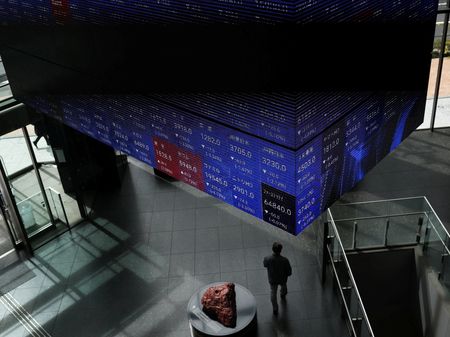

Asian financial markets showed positive momentum during Tuesday’s early trading session, marking a second consecutive day of upward movement as investors prepare for a busy week of central bank announcements while monitoring escalating Middle East tensions.
Financial markets remain nervous as they attempt to assess the economic consequences of President Donald Trump’s conflict with Iran and potential policy responses from global monetary authorities.
The MSCI Asia-Pacific stock index excluding Japan advanced 0.9%, with South Korea’s Kospi leading gains at 2.4% higher. Japan’s Nikkei 225 increased 0.3%, though S&P 500 futures declined 0.3%.
Monday’s Wall Street session saw the S&P 500 climb 1.0%, ending a four-day decline thanks to artificial intelligence stock gains, although the index remains 3% lower than pre-conflict levels.
“The rally still has the feel of a positioning squeeze rather than the start of a new directional trend,” commented Chris Weston, head of research at Pepperstone Group Ltd in Melbourne. “I remain reluctant to buy dips at this stage.”
Oil prices surged with Brent crude jumping 2.7% to $102.89 per barrel following several U.S. allies’ rejection of Trump’s Monday request to deploy naval vessels for tanker escorts through the Strait of Hormuz, a critical passage handling one-fifth of global energy shipments.
The Reserve Bank of Australia will reveal its latest interest rate decision at 0330 GMT Tuesday, with economist surveys anticipating the central bank will implement its second rate increase this year to 4.1%.
Australia’s central bank leads a parade of major monetary institutions meeting this week, including the Federal Reserve, European Central Bank, Bank of England and Bank of Japan, all evaluating the worldwide economic ramifications of the Iran war, though policy changes are not anticipated.
The Bank for International Settlements advised policymakers Monday against hasty responses to Iran crisis-related global energy price increases, describing it as a classic example of when to “look through” a supply disruption.
Federal funds futures indicate a 99.1% likelihood that the U.S. central bank will maintain current rates following its two-day meeting concluding Wednesday, based on CME Group’s FedWatch tool.
“The Federal Open Market Committee is likely to defer action until it becomes clear whether the output or price effects are dominant,” stated Steve Englander, global head of G10 FX research at Standard Chartered in New York.
“We would be surprised if the FOMC indicated a strong direction on the impact of the war, as it has no way of knowing how long the war will last or whether the biggest response will be on activity or inflation.”
The 10-year U.S. Treasury bond yield increased 1.8 basis points to 4.236%.
The dollar index, tracking the currency against six major counterparts, edged 0.1% higher to 99.963 after breaking a four-day winning streak Monday.
Japan’s yen declined 0.2% to 159.415 against the dollar, approaching the significant 160 threshold despite Tuesday warnings from Japanese officials.
Market analysts anticipate higher intervention thresholds due to rising oil costs. Bank of Japan Governor Kazuo Ueda noted Tuesday that core inflation was steadily moving toward the central bank’s 2% objective.
Gold remained relatively stable, gaining 0.1% to $5,011.53. Bitcoin jumped 2.0% to $75,705.24, while ethereum rose 0.7% to $2,362.25.