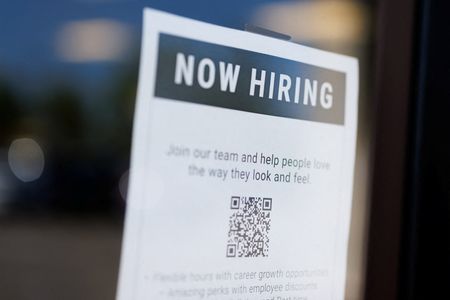

WASHINGTON – Employment specialists are forecasting that April’s job creation numbers will demonstrate a cooling in hiring activity across the United States, as temporary elements that previously elevated employment figures start to diminish, according to predictions ahead of Friday’s Labor Department report.
The anticipated employment data is expected to reveal that joblessness remained stable at 4.3% while showing an uptick in salary growth during the previous month. This combination would likely strengthen financial market predictions that the Federal Reserve will maintain current interest rates through 2027.
Employment conditions have remained in what experts and officials describe as a “slow hire, slow fire” pattern. This stagnation has been attributed to President Donald Trump’s trade and immigration strategies, along with recent conflict impacts that have driven up fuel costs and commodity prices for goods transported through the Strait of Hormuz.
“The status quo holds, we haven’t had sufficient time for the war to dislodge demand for labor, which is typically determined months in advance of actual hiring,” said Joe Brusuelas, chief economist at RSM. “The Fed will take a look at the earnings … and most importantly the unemployment rate, and it will confirm the new consensus, which is we are not going to get rate cuts based on weakness in the labor market this year.”
Economic forecasters predict nonfarm employment rolls expanded by approximately 62,000 positions in April, following a recovery of 178,000 jobs in March, based on a Reuters economist survey. Projections varied widely, from a 15,000 job decline to gains of 150,000 positions. Employment figures have shown irregular patterns since mid-2025, swinging between increases and decreases.
Analysts have linked some of this inconsistency to modifications in the birth-and-death model used by government agencies to calculate employment changes from business openings and closures. Some experts noted that significant business turnover has complicated the Bureau of Labor Statistics’ ability to accurately estimate job creation from new enterprises.
Climate conditions, labor disputes, public sector workforce reductions, and substantial labor force changes due to the Trump administration’s immigration enforcement have contributed to the fluctuating numbers. Economic analysts suggest examining three-month employment averages for a clearer labor market picture.
“Averaging through recent months would still imply modestly positive job growth,” said Veronica Clark, an economist at Citigroup. “This alone would not be concerning given substantial change in immigration flows that have led to a much lower average pace of job growth this year.”
Employment expansion averaged 68,000 monthly during the first quarter. Economists calculated that the economy requires between zero and 50,000 new positions monthly to match working-age population growth. With this breakeven threshold significantly lower than previous years, analysts don’t anticipate unemployment rate spikes even if job gains slow substantially.
RURAL HOSPITALS ARE CLOSING DOWN
Healthcare and social assistance industries likely maintained their leadership in employment growth last month, driven by demographic aging, though expansion rates have moderated.
“A lapse in subsidies for the Affordable Care Act, curbs on Medicaid in many states, tariffs and a jump in the cost of H-1B visas for immigrant doctors and nurses are headwinds,” said Diane Swonk, chief economist at KPMG. “Rural and poor urban hospitals rely most on H-1B doctors and nurses to fill open positions. They cannot afford the new $100,000 fee for visas. Many rural hospitals have already closed.”
Manufacturing employment likely continued growing amid increased business activity as companies accelerate orders anticipating higher costs and supply shortages from Middle Eastern conflicts. Government payrolls are expected to decline further, having dropped in nine of the past twelve months as the White House works to reduce federal employment levels, though some agencies are pushing to rebuild staffing.
Salary growth likely accelerated, with average hourly pay projected to increase 0.3% after March’s 0.2% gain. This would push annual wage increases back to 3.8% from March’s 3.5%. While stronger nominal wages suggest labor market stability, some economists noted this partly reflects reduced working hours.
The average work week decreased to 34.2 hours in March from February’s 34.3 hours, likely remaining unchanged at 34.2 hours in April.
“This is one piece of evidence suggesting strong job growth is more reflective of technical factors than a true pick-up in activity and demand for workers,” said Citigroup’s Clark.
Rising wages are being offset by elevated inflation, with gasoline prices exceeding $4.50 per gallon.
Consequently, some economists suggest labor market stability is concealing economic weaknesses, as lower-income families struggle financially. The economy receives primary support from higher-income households whose wealth has grown through stock market gains.
“People in the low end of the income spectrum have been suffering and cutting back,” said Sung Won Sohn, a finance and economics professor at Loyola Marymount University. “If people at the upper end of the income spectrum were to feel a similar way, the economy would be in trouble.”