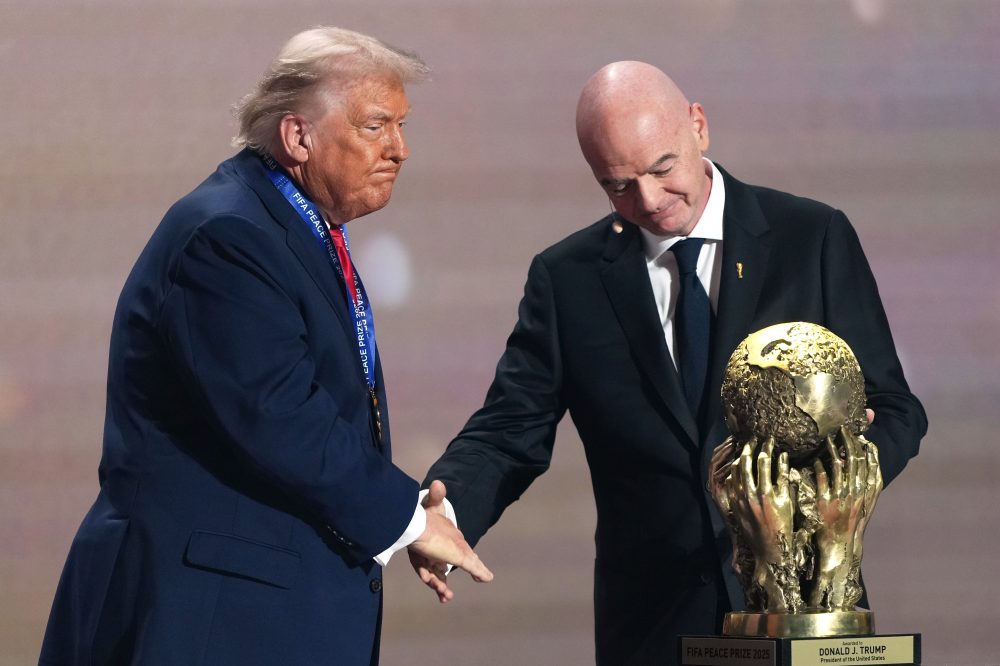

International anti-doping officials are exploring new regulations that could block President Donald Trump and other American government representatives from the 2028 Los Angeles Olympics over millions in unpaid membership fees.
The World Anti-Doping Agency will discuss the potential rule changes during next Tuesday’s executive committee session, marking the latest escalation in a multi-year financial standoff. America has refused to pay its annual contributions as part of a bipartisan government protest against how WADA handled cases involving Chinese swimmers and other controversies.
The Associated Press discovered the agenda item through internal communications between WADA and European agency officials. Two additional sources familiar with the meeting confirmed the rule proposal exists, though they weren’t permitted to discuss the unreleased agenda publicly.
WADA spokesperson James Fitzgerald downplayed the development, stating “there is nothing new here” and noting that conversations about non-paying governments have continued since 2020 and aren’t specifically targeting the United States.
Agency records show this proposal initially surfaced in 2024, when American officials successfully pushed for its rejection. Since then, the U.S. has lost its executive committee position.
“In spite of WADA’s increasing threats, we continue to stand firm in our demand for accountability and transparency from WADA to ensure fair competition in sport,” stated Sara Carter, who directs the U.S. Office of National Drug Control Policy.
Any such restriction would likely carry more symbolic weight than practical enforcement power, given the challenges an international sports organization would face trying to bar a sitting president from events within American territory.
“I have never heard of a $50-million-budget Swiss foundation being able to enforce a rule to, for example, prevent the United States president from going anywhere,” commented Rahul Gupta, Carter’s predecessor who previously served on WADA’s executive committee and opposed the proposal two years ago. “And the next question you have to ask is: How are you going to enforce it? Are they going to post a red notice from Interpol? It’s ludicrous. It’s clear they have not thought this through.”
The proposed sanctions would establish three levels of penalties for countries failing to meet their financial obligations. America currently owes approximately $3.7 million from last year plus another $3.6 million from 2024. The most severe punishments would involve “government representatives being excluded from participation in major events such as World Championships and Olympic & Paralympic Games.”
Such restrictions would potentially affect Trump, Vice President J.D. Vance, and congressional members who recently authorized hundreds of millions in funding for World Cup and LA Olympics security and logistics.
Fitzgerald indicated the WADA Foundation Board, which must formally approve any measures, won’t convene until November, suggesting the rules wouldn’t take effect before this summer’s World Cup. He didn’t immediately address questions about Trump’s World Cup attendance status.
However, in correspondence with European officials, WADA indicated flexibility on timing: “The proposal could be implemented without undue delay. If necessary, the Foundation Board could consider the proposal by circular or within the context of an extraordinary meeting.”
Draft language shows the regulations would target governments failing to pay dues by January 31st of the year following their billing. America hasn’t contributed to WADA since 2023.
Representatives from the International Olympic Committee, FIFA, and the U.S. Olympic and Paralympic Committee didn’t respond to Associated Press requests for comment regarding potential enforcement of bans on Trump and other American officials.
WADA operates on a $57.5 million budget for 2025, receiving equal funding from the International Olympic Committee and global governments. Government contributions roughly correspond to their athletic team sizes, making America traditionally one of the largest contributors.
This conflict traces back to the first Trump presidency, rooted in American skepticism toward the global anti-doping framework. International scrutiny initially focused on WADA’s management of Russian doping scandals preceding the 2014 Sochi Games.
The dispute intensified in 2024 when reports emerged about 23 Chinese swimmers—including Paris Olympics team members—who competed despite positive tests. WADA accepted Chinese regulators’ explanation that athletes were contaminated by traces of prohibited heart medication from hotel kitchen sources.
Both Trump and Biden administrations, along with Congress, have withheld WADA payments over these concerns.
In recent developments, the government conditioned payments on WADA submitting to independent auditing. WADA defended its current audit procedures and renewed calls for American payment during last month’s Milan Cortina Games.
The agency now seeks additional pressure tactics to secure the outstanding funds.
“This initiative is aimed at better protecting WADA’s funding so that it can deliver on its mission to protect clean sport,” Fitzgerald explained. “If WADA’s funding is cut, it is ultimately athletes who will suffer. Indeed, athletes (including those on WADA’s Executive Committee and Foundation Board) have continuously expressed their support for this initiative.”