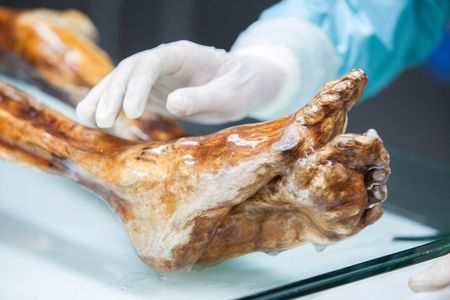

A comprehensive new study reveals that Ötzi the Iceman’s ancient remains continue to harbor living microorganisms more than five millennia after his violent death in the Alps.
The famous mummy, who perished approximately 5,300 years ago near what is now the Italy-Austria border after being struck by an arrow, has become home to a complex ecosystem of bacteria, fungi, and yeasts. Researchers found his body contains three separate microbial communities that developed over different time periods.
The most extensive microbial examination ever conducted on Ötzi’s preserved remains, spanning over 30 years of sample collection, identified ancient intestinal bacteria from his original lifetime, cold-resistant microorganisms from his glacial burial site, and contemporary microbes introduced during decades of museum preservation.
“Our study reveals that Ötzi is not a static, biologically inert relic – he is a dynamic ecosystem,” said microbiologist Mohamed Sarhan of Eurac Research’s Institute for Mummy Studies in Bolzano, Italy, lead author of the study published in the journal Microbiome.
Sarhan explained that the mummy continues to host living organisms that actively adapt to their surroundings. “His body hosts living, metabolically capable organisms that are actively responding to their environment,” Sarhan said. “The cold-adapted yeasts are growing. Certain bacteria have colonized and persisted across his tissues for decades. The mummy is, in a very real sense, a living biological interface – a meeting point between the ancient world and the present, where microbes from 5,000 years ago coexist with organisms that arrived last decade.”
The ancient intestinal bacteria offer researchers an unprecedented glimpse into the digestive system of a Copper Age human, predating the industrial revolution, antibiotics, and processed foods that have dramatically altered modern human microbiomes.
However, the presence of actively growing cold-loving yeasts on Ötzi – who is stored at 21 degrees Fahrenheit at the South Tyrol Museum of Archaeology in Bolzano to replicate his glacial preservation conditions – raises concerns about the long-term preservation of the mummy, according to Sarhan.
The intestinal microbes dating to Ötzi’s lifetime included bacteria typically associated with high-fiber, pre-industrial eating habits that are seldom present in individuals following contemporary Western diets.
“Their disappearance from Western guts is likely linked to dietary shifts, antibiotic use and reduced exposure to natural environments. Ötzi essentially shows us what we have lost, and potentially what we might one day want to restore for health reasons,” Sarhan said.
When asked whether any of the original intestinal microbes remained biologically functional, Sarhan described it as one of the study’s most intriguing questions.
“The ancient gut bacteria show clear DNA damage signatures consistent with thousands of years of chemical degradation. This tells us their DNA is genuinely ancient. However, whether the cells themselves retain any metabolic activity is something we cannot fully determine from DNA analysis alone. What we can say is that they have been remarkably preserved in the protected anaerobic environment of the intestinal tract for over five millennia,” Sarhan said.
Earlier studies of Ötzi’s stomach revealed his final meals consisted of deer and goat meat along with wheat. Previous research indicated he was approximately 45 years old at death – considered advanced age for his time period – and maintained excellent physical condition. His possessions included clothing made from various animal species, a copper ax, longbow, arrows, quiver, flint dagger, and backpack, plus geometric tattoos on his skin.
“He is a visitor who provides us precious insights into the past,” said microbiologist and study co-author Frank Maixner, director of Eurac’s Institute for Mummy Studies.
The research team distinguished between microorganisms present during Ötzi’s lifetime and those that arrived after his death. Following his demise, the glacial environment introduced its own microbial population to his remains – cold-resistant bacteria and yeasts from the surrounding ice and earth.
Microorganisms found only in deep internal tissues with significant DNA deterioration were almost certainly present during Ötzi’s life or immediately afterward, Sarhan noted.
Those lacking DNA damage and matching the preservation environment represented modern additions, while glacier-derived microbes fell between these categories, indicating post-death but pre-discovery colonization. The living and biologically active microorganisms were the cold-adapted yeasts found on Ötzi’s skin and internal body fluids.
His transfer to the museum after discovery triggered another round of microbial colonization.
“We found that the spray water used to keep the mummy humid has introduced a dominant signature of bacteria onto his external surfaces. These modern introductions are effectively reshaping the mummy’s external microbiome – a consequence of conservation practices that was previously unrecognized,” Sarhan said.