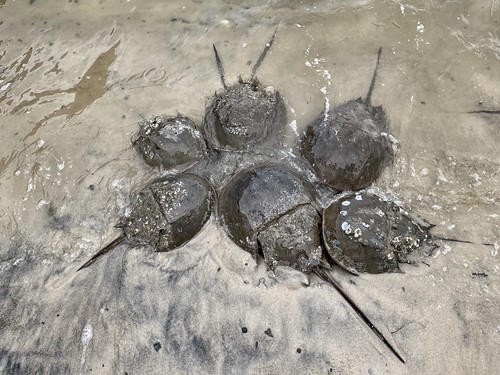

Maryland’s beaches are becoming home to thousands of horseshoe crabs this spring as one of Earth’s most ancient wildlife migrations gets underway. This remarkable journey, which scientists estimate has been happening for 350 million years, brings the prehistoric creatures to shore from May through July, with the busiest period occurring during high tides that coincide with June’s full and new moons.
During the spawning process, each female will lay approximately 20,000 eggs in the sand while a male attaches to her shell to fertilize them. This reproductive cycle not only continues the survival of this ancient species but also provides crucial nutrition for migrating shorebirds that rely on the eggs as fuel for their journey to summer breeding areas in northern Canada.
The larvae serve as vital sustenance for young Atlantic loggerhead turtles, striped bass, American eel, and flounder. The species also plays an important role in human medicine, as their copper-based blood is essential for testing bacterial contamination in medical products. Licensed operations carefully collect the animals, extract blood samples at specialized facilities, then return them to the ocean.
Contrary to their intimidating appearance, these armored creatures pose no threat to humans – they cannot bite or sting. Their distinctive tail serves multiple purposes: helping them navigate through sand and mud, steering while swimming, and flipping themselves upright when overturned. People can assist stranded crabs by carefully turning them over using both hands, though they should never lift them by the tail.
Researchers from the Maryland Department of Natural Resources and the Maryland Coastal Bays Program track the returning population for conservation and scientific studies. Officials are asking residents to report any spawning behavior or horseshoe crab sightings through the department’s Horseshoe Crab Volunteer Angler Survey.
Prime viewing times occur during evening hours around June’s full and new moons (June 15 and June 29 in 2026). Sunset Park near the Ocean City Inlet offers excellent observation opportunities, and additional viewing locations around the Chesapeake Bay are available on the Horseshoe Crab Volunteer Angler Survey website.