
WASHINGTON — American military forces successfully retrieved a service member who had been stranded in Iranian territory following the downing of their fighter aircraft, officials announced Sunday. The rescue comes as President Donald Trump has issued fresh ultimatums to Tehran demanding the reopening of the Strait of Hormuz.
Tehran continues to show defiance, launching attacks against economic and infrastructure facilities in nearby Gulf Arab nations.
The successful extraction concluded a U.S. search-and-rescue mission that began after an F-15E Strike Eagle went down on Friday in Iranian territory. Iranian officials had offered bounties for capturing any “enemy pilot.” According to Trump, the rescued aviator sustained injuries but remains in stable condition.
“This brave Warrior was behind enemy lines in the treacherous mountains of Iran, being hunted down by our enemies, who were getting closer and closer by the hour,” Trump wrote on social media.
Military officials had previously rescued a second crew member from the same aircraft.
The downed fighter represents the first American military aircraft to crash within Iranian borders since U.S. and Israeli forces initiated their military campaign against Iran on February 28.
Trump declared last week that American forces would conclude the conflict “very fast.” However, just two days afterward, Iranian forces successfully shot down two U.S. military aircraft, demonstrating both the continued dangers of the air campaign and Iran’s capacity to retaliate despite military setbacks.
With Iran maintaining its grip on the Strait of Hormuz, Trump issued weekend social media warnings threatening to unleash “all Hell” unless the waterway reopens by Monday. The president has made similar threats previously, extending deadlines when mediators claimed progress toward a negotiated settlement.
The second aircraft lost was a U.S. A-10 attack plane. Details about the crew’s condition and the exact crash location remain unclear.
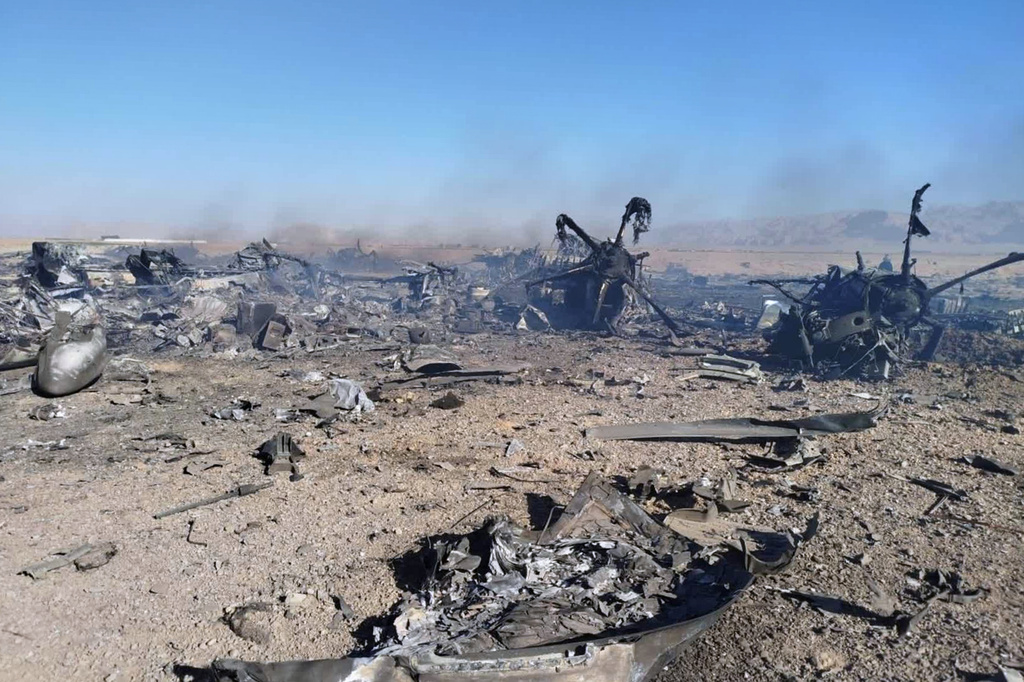
Iranian state television broadcast footage Sunday showing what officials claimed were fragments of American aircraft destroyed by Iranian forces, accompanied by images of dense black smoke billowing skyward. The network reported that Iranian forces had shot down an American transport aircraft and two helicopters participating in the rescue mission.
A regional intelligence source familiar with the operation told The Associated Press that U.S. military personnel destroyed two transport planes due to mechanical failures, requiring additional aircraft to complete the rescue operation.
The source requested anonymity when discussing the classified mission.
Iranian drone strikes targeted infrastructure and economic facilities across Gulf nations. In Kuwait, the attacks severely damaged power generation facilities and a petrochemical complex, while also disabling a water desalination facility, according to the Ministry of Electricity. Officials reported no casualties from these strikes.
Bahrain experienced drone attacks that ignited fires at a national oil company storage facility and a government-operated petrochemical plant, the kingdom’s official news service reported.
United Arab Emirates officials responded to multiple fires at the Borouge petrochemicals facility, which they attributed to intercepted debris from Iranian attacks. Operations at the Ruwais plant, located near the UAE’s western border with Saudi Arabia, have been suspended.
These retaliatory strikes followed Israel’s attack on an Iranian petrochemical facility that Prime Minister Benjamin Netanyahu claimed generated funds used to finance the ongoing conflict.
The petrochemical sector represents a crucial economic component for many Gulf nations. Facilities in Bahrain, the UAE, and Iran process oil and gas into products including plastics, polymers, and fertilizers, generating billions in export income.
Trump reiterated his demands for Iran to reopen the Strait of Hormuz by Monday or face severe retaliation, posting Saturday on social media: “Remember when I gave Iran ten days to MAKE A DEAL or OPEN UP THE HORMUZ STRAIT. Time is running out — 48 hours before all Hell will reign down on them.”
The strategic waterway serves as a vital passage for global energy shipments, particularly oil and gas exports from the Persian Gulf to European and Asian markets. Disruptions in this area have created market instability and forced oil and gas-importing nations to pursue alternative supply sources.
Pakistan’s Foreign Ministry spokesperson Tahir Andrabi informed the AP that his government’s ceasefire mediation efforts remain “right on track” following Islamabad’s announcement last week about hosting upcoming discussions between American and Iranian representatives.
Officials from Pakistan, Turkey, and Egypt are collaborating to facilitate negotiations between the United States and Iran, according to two regional sources.
The potential agreement includes halting hostilities to enable diplomatic resolution, according to a regional official participating in the mediation efforts and a Gulf diplomat briefed on the discussions. Both sources spoke anonymously to discuss confidential diplomatic activities.