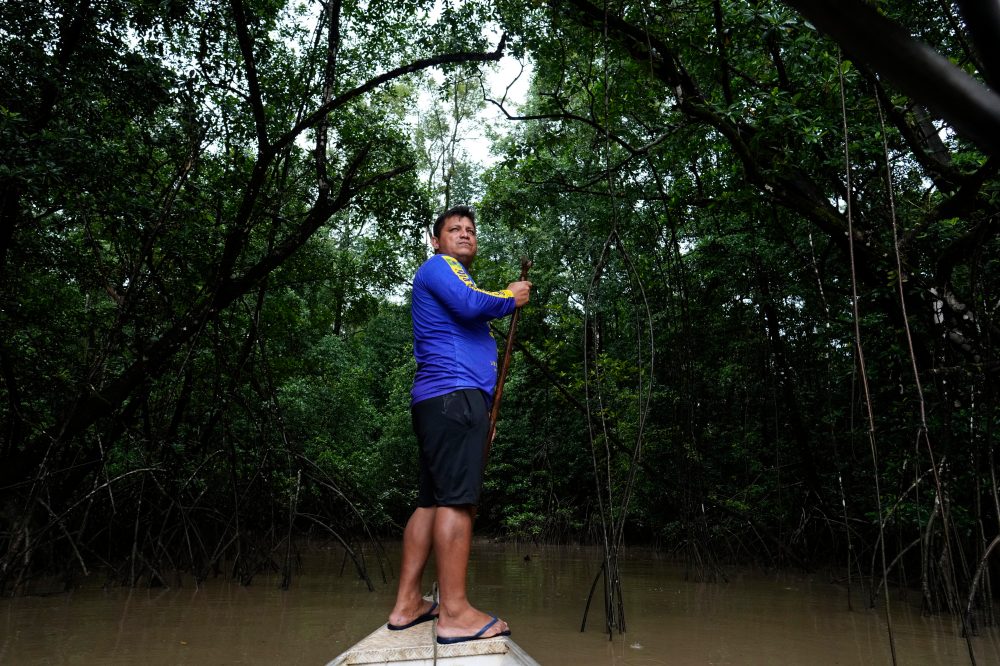

OIAPOQUE, Brazil — Reginaldo Nunes Fonseca sheltered from heavy rainfall on his friend’s wooden porch, cigarette in hand, gazing across what locals call Nova Conquista — New Conquest — where untouched Amazon rainforest existed just twelve months earlier.
The downpour prevented Fonseca from constructing his home or finding day labor in the settlement, but weather wasn’t his biggest obstacle. Along with thousands of newcomers flooding into Oiapoque, a remote city in Brazil’s northern Amapa state, Fonseca waits for an economic transformation that remains uncertain.
This migration wave began after Petrobras, Brazil’s government-owned petroleum company, obtained environmental approval in 2023 for ocean drilling along the Equatorial Margin near the Amazon River’s mouth, approximately 180 kilometers offshore from Amapa.
“I figured this was positive news — the community would expand and create numerous employment possibilities,” Fonseca explained, recalling how a January television news segment about the licensing prompted his relocation from northeastern Maranhao state. “I began contacting my friends and declared: ‘I’m heading there since I’m jobless here with nothing to do.’”
Amapa ranks among Brazil’s most impoverished and underdeveloped regions. Oiapoque’s local economy depends on commercial fishing, unauthorized gold extraction, and tourists from adjacent French Guiana who visit daily spending euros, which maintain stronger value than Brazil’s currency. Though potential business opportunities inspire optimism, uncontrolled population expansion strains a community already lacking basic services.
This petroleum-driven enthusiasm illustrates a complex challenge facing developing nations: balancing greenhouse gas reduction goals with dependence on fossil fuel revenues for economic advancement.
The situation also questions President Luiz Inácio Lula da Silva’s environmental protection promises. Forest preservation became central to his administration, and Brazil hosted the 2023 United Nations climate conference COP30.
“We refuse to contaminate even one millimeter of water, yet nobody can prevent us from elevating Amapa from poverty if petroleum exists here,” Lula declared during his Amapa visit last year.
On March 10, roughly 2 miles from Fonseca’s residence, Petrobras conducted a public meeting with local officials, business leaders and community representatives to outline operational plans.
Corporate officials reported that exploratory drilling commenced in October with an expected five-month duration. Should substantial oil deposits be discovered and extraction considered, additional government approvals would be necessary — a potentially lengthy process requiring months or years.
Environmental organizations and Indigenous groups have filed lawsuits against Brazil’s government and Petrobras seeking exploration suspension, claiming inadequate consultation with traditional communities, underestimated contamination risks, and insufficient climate impact evaluation. Federal prosecutors requested IBAMA cancel or pause the environmental permit, arguing Petrobras conducted incomplete studies while concealing environmental damage scope. Courts have not yet ruled.
Meeting attendees learned Oiapoque primarily functions as a helicopter staging area for offshore personnel due to its proximity to drilling sites. Administrative oversight operates from Belem, a major city in neighboring Para state.
Despite uncertainties surrounding future extraction and Oiapoque’s minimal operational involvement, speculation has dramatically altered the community.
Census records show 27,482 residents in 2022, though recent population counts remain unavailable, making current numbers unclear.
“Over the previous 18 months, Oiapoque experienced substantial demographic increases,” stated Tiago Vieira Araújo, a city councilman who expressed concerns during the gathering. “Seven new neighborhoods have emerged, accompanied by social challenges.”
Oiapoque’s urban infrastructure remains inadequate. Under 2% of homes connect to proper sewage systems, while only 0.2% sit on paved roads, according to Brazil’s Geography and Statistics Institute.
Conditions worsen in newer settlements — termed “invasions” locally. Residents clear public forestland, establishing unofficial lots and constructing temporary shelters. Fresh tree stumps, wooden markers and crude dwellings emerge from muddy terrain, containing only essentials: cooking areas, sleeping spaces and basic restrooms.
“We understand forest clearing is inappropriate. Everyone recognizes this wrongdoing,” Fonseca acknowledged. “However, available land is scarce.”
Yuri Alesi, a 34-year-old attorney advocating for settlement land rights and former councilman, seeks the vice mayor position in April’s special election. He envisions Oiapoque becoming an “Amazonian Dubai” powered by petroleum revenues.
“Dubai sits within desert terrain, an improbable growth location,” he observed. “Oil industry development fueled its expansion.”
Brazil’s offshore Equatorial Margin, stretching from Suriname’s border to the nation’s northeast, potentially contains significant petroleum and natural gas reserves. Initial estimates suggest up to 10 billion barrels worth approximately 3.8 trillion reais ($719.7 billion). Alesi calculated royalties could generate roughly 100 million reais ($19 million) monthly for Oiapoque, matching the city’s annual economic output according to Brazil’s statistics bureau.
The Amazon forest plays a crucial role regulating global climate by storing carbon dioxide, yet faces constant pressure from agricultural deforestation, cattle operations and mining activities. Amapa experiences less intensive pressure, maintaining approximately 82% forest coverage according to MapBiomas, a land-use monitoring nonprofit.
Geographic isolation — surrounded by waterways and lacking road connections to mainland Brazil — has protected the state from southern Amazon deforestation patterns.
While some cite Dubai as Oiapoque’s development model, nearby petroleum-dependent cities offer cautionary examples.
Petrobras has conducted oil and gas exploration in Coari, another Amazon state, since the 1980s. Despite decades of activity, the city remains among Brazil’s poorest, with roughly 72% of residents experiencing extreme poverty according to recent research by Agenda Publica, a public policy nonprofit.
Other Amapa communities experienced boom-and-bust cycles linked to mining operations. Pedra Branca, located 280 miles from Oiapoque, flourished between 2007 and 2014 during iron ore expansion.
Pedra Branca’s prosperity attracted Selma Soares, 46, who relocated from Maranhao to Amapa in 2008 and established a grocery business.
A 2013 port collapse operated by Anglo American mining company killed six workers and disrupted iron ore production. India’s Zamin Ferrous later assumed mine control before suspending operations.
“Customers who shopped with us for years could barely afford food,” Soares recalled.
Recently, she heard increasing reports about Oiapoque’s growth. After visiting last year, she moved with her husband and son. The family now operates a small supermarket on the town’s outskirts. Soares noted many others have followed similar paths.
“People anticipate drilling commencement,” she explained. “They expect everything will get better.”
At the river boundary separating Oiapoque from French Guiana, a busy port bustles with boats connecting Brazil, its neighbor and surrounding communities. Green-and-yellow stickers declare: “Oil yes! Development yes!” — messaging promoted by local politicians.
Just 20 minutes away by boat, Indigenous Galibi Kali’na community members remain skeptical. Some recognize economic potential, but leaders oppose exploration, warning about environmental dangers and cultural threats.
“Petrobras arrived with powerful political support, promising advancement as though we would sleep one way and awaken like Dubai,” said Renata Lod, a representative on Oiapoque’s Indigenous council. “Instead, we’ve witnessed completely chaotic population growth and invasions of Indigenous territories.”
Lod detailed common complaints among Oiapoque residents, both Indigenous and non-Indigenous, including overcrowded educational facilities and the city’s sole hospital operating beyond capacity.
Concerns about potential petroleum spills also persist.
“Most Indigenous lands consist of flooded wetlands. How would you clean wetlands? Once oil reaches rivers, removal becomes impossible,” Lod warned.
Petroleum contamination could rapidly spread pollutants to nearby coastlines and waterways, threatening ecosystems and communities dependent on fishing and mangrove resources. Petrobras stated it performed spill modeling to secure environmental permits and has deployed floating monitoring devices to track ocean currents since October exploration began.
In January, Petrobras reported a drilling-fluid leak that temporarily suspended operations. IBAMA, the environmental regulatory agency, imposed a 2.5 million reais ($470,500) fine.
During the community gathering, Petrobras representatives attempted to address concerns while defending operational safety. They highlighted everyday products, from textiles to air conditioning systems, emphasizing oil’s economic significance.
“Residents view Petrobras as an economic solution,” observed Araújo, the city councilman. “However, even remedies produce side effects. We’re already experiencing negative consequences before seeing any benefits.”