
The world-renowned Calgary Stampede opened its gates Friday, but the festive atmosphere is being overshadowed by a growing movement to separate Alberta from Canada — a debate that is stirring up conflict at rodeos and summer events throughout the oil-rich province.
In October, Alberta residents will cast ballots in a non-binding referendum asking whether the province should begin the constitutionally required legal steps toward eventually holding a binding independence vote. It marks the first time any Canadian province outside of Quebec has ever brought such a question to the public.
The tension has already disrupted some events. In the central Alberta town of Sundre, organizers called off an annual rodeo parade after they chose to ban a pro-independence float from participating — a decision that triggered what organizers described as a wave of hostile messages online. The organizers did not respond to a request for comment.
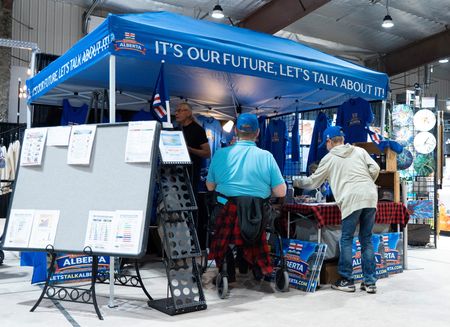
At the Ponoka Stampede, a booth set up by Alberta separatists under a “let’s talk” banner drew both curious visitors and frustrated attendees who simply wanted to enjoy a beloved summer tradition without the political noise.
“I’m getting tired of hearing about it because it’s just causing a lot of people to be stressed or angry with each other for no reason,” said Leanne Brown, a retired police officer who was at the Ponoka event, located roughly 150 kilometers — about 93 miles — northeast of Sundre. “It’s a little too much all of the time.”
Not everyone shared that frustration. Chris Parsons, 44, who works in the oil and gas industry and backs Alberta independence, said he was pleased to see separatists represented both in a parade and at a fairground booth alongside the rodeo.
“Maybe they — the federal government — will take us a little bit more seriously,” Parsons said.
An Ipsos poll conducted in early June found that support for Alberta independence has dropped 10 percentage points since January. Just 19% of voters now say they support the province starting the process to leave the Canadian federation.
The October 19 referendum question will not directly trigger a split from Canada. Rather, it will ask voters whether the Alberta government should initiate the legal steps required by the constitution before any future binding independence vote could take place.
Supporters of separation have long expressed frustration with the environmental policies advanced under former Prime Minister Justin Trudeau’s Liberal government, arguing those policies damaged Alberta’s oil and gas sector.
Trudeau’s successor, Liberal Prime Minister Mark Carney, has been working to address some of those concerns through a federal-provincial agreement designed to help Alberta expand its energy industry. Carney confirmed he will attend this year’s Calgary Stampede. Speaking to reporters last week, he declared that Canada “is the greatest country in the world.”
“We’re not perfect, we can get better, but Canada’s worth fighting for. And standing up for Canada and supporting Canada is important,” Carney said. Carney, who largely grew up in Edmonton — Alberta’s provincial capital — previously led the Bank of England in 2016 when Britain held its referendum to leave the European Union. He has referred to the vote being pursued by Alberta’s right-wing provincial government as a “dangerous bluff.”
Officials in Ottawa are also concerned that the referendum could undermine Carney’s efforts to present a unified Canadian position during the upcoming renegotiation of the U.S.-Mexico-Canada trade agreement. Carney is scheduled to be in Alberta on Wednesday for Canada Day celebrations.
The Calgary Stampede is far more than a rodeo — it’s a 10-day celebration of Western Canadian culture drawing people from across the country and around the world. The event, Alberta’s largest tourist attraction, features chuckwagon racing, pancake breakfasts, live concerts, and what is billed as the world’s largest outdoor rodeo. It’s a tradition that brings together people from all walks of life, from young children to top business executives.
Politicians from across the political spectrum routinely attend the Stampede and other Alberta summer events, which serve as major networking opportunities.
Neither those pushing for independence nor those advocating for a united Canada will have a float in the official Calgary Stampede parade this year — applications closed back in February, according to a Stampede spokeswoman. However, many unofficial Stampede-related events are organized by community groups and politicians. The spokeswoman noted that the Stampede remains focused on “bringing people together through Western hospitality and community spirit.”