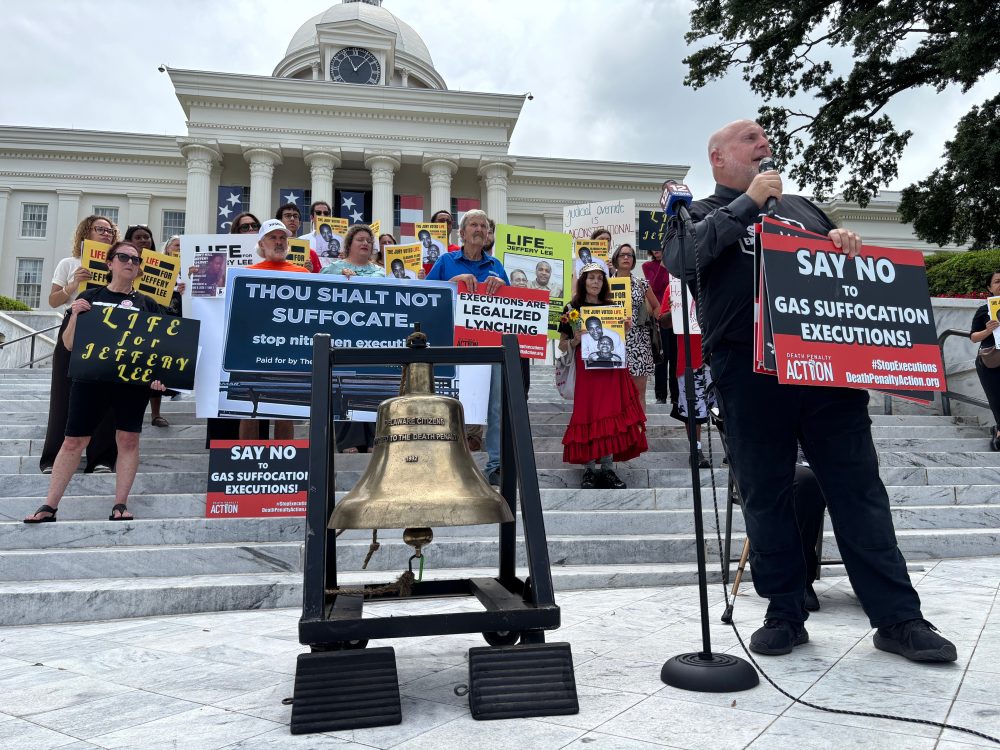

Alabama officials are mounting an urgent legal challenge to proceed with a nitrogen gas execution scheduled for Thursday evening, petitioning the U.S. Supreme Court to overturn a federal judge’s determination that the procedure violates constitutional protections against cruel and unusual punishment.
On Tuesday, a federal judge declared Alabama’s nitrogen execution protocol unconstitutional and prevented the state from using the method to execute Jeffery Lee, 49. State attorneys are now challenging that ruling.
This urgent legal dispute will decide whether Lee’s Thursday night execution proceeds using nitrogen gas. The case could also shape the future of the disputed execution technique that Alabama started implementing in 2024.
“As Alabama continues to defend its execution protocol in the courts, the governor remains prepared to move forward with the planned execution,” Mike Lewis, a spokesman for Alabama Gov. Kay Ivey, wrote in an email.
The procedure involves securing a breathing mask to the condemned person’s face and substituting regular air with pure nitrogen gas, leading to death through oxygen deprivation. Eight executions in the United States have employed nitrogen – seven in Alabama and one in Louisiana. Lee would have been the ninth person executed using nitrogen.
U.S. District Judge Emily Marks determined Tuesday, following an appeals court’s reversal of her earlier constitutional approval, that Lee had demonstrated by a “preponderance of the evidence that the protocol constitutes cruel and unusual punishment in violation of the Eighth Amendment.” The 11th U.S. Circuit Court of Appeals, in a 2-1 Wednesday night ruling, denied Alabama’s request to halt the decision. The court previously stated that the three minutes potentially required for an inmate to lose consciousness represents an “intolerable” timeframe, “given the suffering that would likely take place under Alabama’s nitrogen hypoxia protocol.”
A representative for the Alabama attorney general’s office confirmed Wednesday night that the state is taking the matter to the Supreme Court. The nation’s highest court has never determined that a particular execution method breaches the Constitution.
The situation has renewed focus on the nitrogen execution procedure and the intense debates surrounding its implementation.
In previous Alabama nitrogen executions, condemned individuals trembled, struggled against restraints and displayed difficult breathing when the procedure began. During the state’s most recent nitrogen gas execution, 30 minutes passed between Anthony Boyd showing effects from the gas and officials drawing the viewing room curtain to indicate the execution’s completion.
State officials have argued the procedure is constitutional and produces no greater suffering than alternative execution methods.
“If nitrogen hypoxia violates the Eighth Amendment because of a risk of anxiety and emotional discomfort, then so too must every other method of execution, many of which carry inherent risks of real physical pain,” state lawyers wrote in a Wednesday court filing to the 11th Circuit.
Lee’s legal team stated Alabama is trying to proceed with an execution method that courts have deemed unconstitutional. His advocates have pressed Ivey to reduce his sentence to life imprisonment, which matches the recommendation made by jurors during his trial.
“Alabama Attorney General Steve Marshall wants to execute Jeffery Lee under a death sentence the jury rejected using a nitrogen gas method that two federal courts have ruled unconstitutional. This execution is simply too flawed to move forward,” Lee’s lawyers said in a statement.
“We remain hopeful that Governor Ivey will intervene,” they added.
A jury found Lee guilty of two capital murder charges for the deaths of Jimmy Ellis and Elaine Thompson during a pawnshop robbery on Dec. 12, 1998. Prosecutors stated Lee entered Jimmy’s Pawnshop carrying a sawed-off shotgun and killed Ellis, the shop’s owner, and Thompson, a worker there.
Jurors voted 7-5 for Lee to receive life imprisonment. A judge, however, overruled that recommendation and imposed a death sentence. Alabama eliminated the judicial override practice in 2017 and no longer permits judges to disregard jury sentencing decisions in capital cases. The law ending judicial override did not apply retroactively.