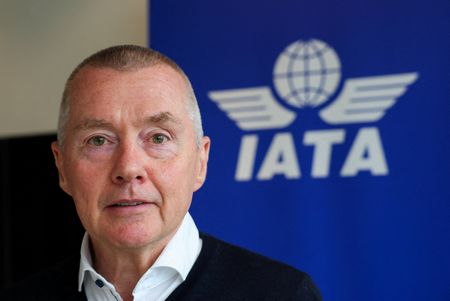

Aviation industry leaders are convening in Rio de Janeiro this weekend to tackle what experts are calling the sector’s most significant challenge since the coronavirus pandemic, as ongoing conflict involving Iran pushes jet fuel prices higher and forces airlines to reroute flights.
The International Air Transport Association’s annual conference, scheduled for June 6-8, serves as the aviation sector’s premier gathering, drawing hundreds of senior executives from airlines, aircraft manufacturers, suppliers and financial institutions.
The trade organization represents over 370 airlines that handle approximately 85% of worldwide air traffic, positioning it as a key player in an industry that had projected record profits of $41 billion this year before the Iran conflict escalated.
Aviation executives and industry analysts anticipate that profit projection will be revised downward during the summit, where conversations are likely to focus on climbing fuel expenses and supply concerns, Middle Eastern airspace restrictions, worsening aircraft manufacturing delays, and questions about whether carriers can achieve their environmental targets.
Carriers worldwide have already begun implementing fare increases, eliminating less profitable flight paths, and preserving cash reserves while waiting for conditions to improve, creating additional uncertainty about reaching IATA’s 2050 net-zero emissions target amid expensive and scarce sustainable aviation fuel supplies.
Credit rating agency Moody’s Ratings recently revised its global airline industry outlook from stable to negative, stating that fuel expenses related to the Iran conflict and disruptions near the Strait of Hormuz would “materially reduce” operating profits this year. The agency projected profits could decline by more than 35% in 2026 before rebounding the following year.
Statistics from IATA revealed that worldwide passenger traffic decreased in April for the first time since the post-pandemic recovery began, with Middle Eastern airlines experiencing particularly steep declines.
Campbell Wilson, the departing chief executive of Air India, explained that elevated fuel prices and restricted airspace access were making certain flight routes financially unsustainable.
“When you take on all those competitive dynamics, the added cost of this extra flying, the added cost to fuel, it just makes some routes uneconomic,” he said.
Airlines operating with stronger passenger demand and more premium travelers have greater flexibility to increase ticket prices, though the capacity to offset fuel expenses varies significantly across different markets and business approaches.
Bob Jordan, chief executive of Southwest Airlines, which became an IATA member last year, noted that American carriers had implemented fare increases seven times since February without experiencing reduced demand. However, he indicated that current prices were still “not close” to offsetting existing fuel costs.
Middle Eastern carriers face particularly challenging circumstances. Emirates and Qatar Airways depend heavily on their operational centers in Dubai and Doha, while Etihad Airways is pursuing expansion from Abu Dhabi after previously reducing its international operations.
While the Iran conflict hasn’t dismantled the Gulf hub business model, required flight detours have highlighted its dependence on open airspace and reliable routes, extending flight durations and increasing fuel consumption.
These disruptions are also creating opportunities on certain long-distance routes for airlines providing direct service between Asia and Europe, including Lufthansa Group, Air France-KLM, Singapore Airlines and Cathay Pacific.
European carriers face varying impacts. Some may gain advantages from Gulf airline difficulties on international routes while avoiding the most affected airspace, but higher fuel costs are intensifying pressure from closed Russian airspace, air traffic control problems, and sustainable aviation fuel requirements.
Across Asia, Air India confronts increased fuel expenses and extended flight paths, while IndiGo continues dealing with aircraft shortages and Pratt & Whitney engine problems. Currency devaluation is magnifying fuel costs for Japanese airlines, while Air New Zealand has cautioned about significant earnings impacts.
In Latin America, the fuel price surge is combining with currency fluctuations and consumers who have limited capacity to absorb fare increases, even as reduced competition provides some carriers more opportunity to transfer costs to customers. LATAM has lowered its earnings projection due to fuel expenses, while Brazil’s Azul remains vulnerable to fuel price and currency instability.
Delayed aircraft deliveries from Boeing and Airbus are compelling airlines to maintain older, less fuel-efficient planes in operation, increasing pressure on profit margins.
Scott Kirby, chief executive of United Airlines, identified engines and components as the primary bottleneck, estimating that 800 to 900 aircraft globally were out of service due to engine problems.
“There are not enough engines and they’re not going to be for many, many years,” Kirby said at a Bernstein conference last week.
The fuel crisis is also spurring discussions about industry consolidation, as airlines with smaller profit margins and limited pricing flexibility struggle to manage higher costs, highlighted by last month’s bankruptcy of U.S. budget airline pioneer Spirit Airlines.
American investment firm Castlelake, which leases aircraft and has invested in Scandinavia’s SAS, has indicated it’s exploring a potential bid for British low-cost carrier easyJet, while United’s recent unofficial merger overture to American Airlines has renewed attention on U.S. deal-making, despite American’s rejection and Washington’s apparent opposition.