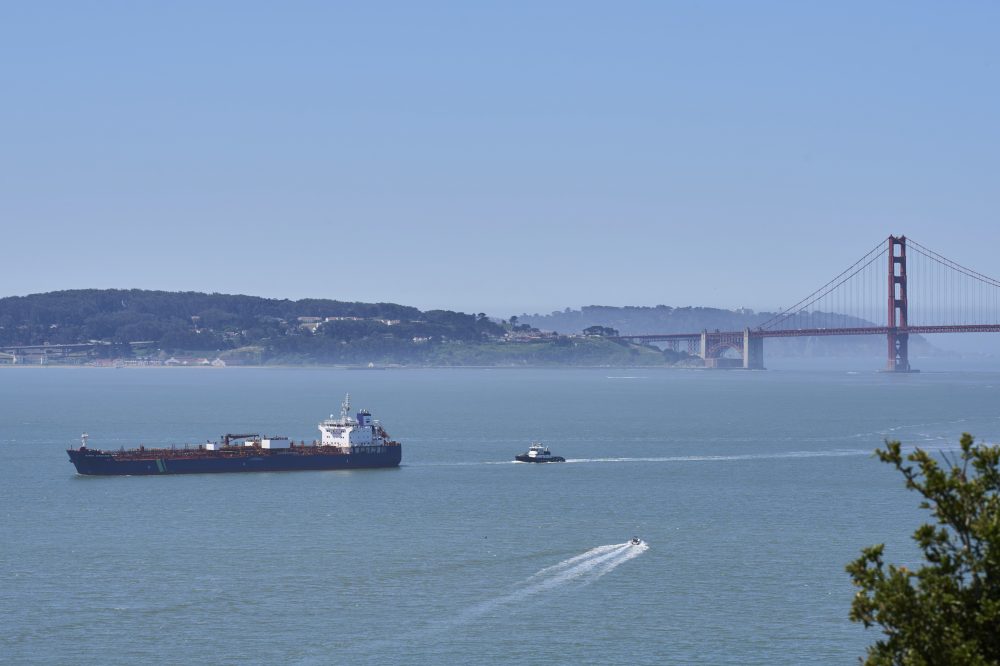

SAN FRANCISCO, Calif. — Commercial vessels navigated the choppy waters of San Francisco Bay this Tuesday while a whale emerged nearby, its breath spray barely distinguishable against the breaking waves. Previously, these marine mammals could pass undetected by boat operators, but a newly launched artificial intelligence monitoring system aims to track their movements continuously.
The technology, known as WhaleSpotter, monitors the bay continuously for whale breathing patterns and thermal signatures within a 2-nautical-mile radius, sending notifications to vessel operators to reduce speed or change course when whales are detected in the area.
“They’ll be able to make adjustments way before they get anywhere close,” said Thomas Hall, director of operations for San Francisco Bay Ferry. “It will also allow us to track data over time and see where the whales are camping out so we can adjust our routes during whale season to avoid those areas completely.”
This initiative responds to a troubling increase in gray whale fatalities throughout the bay region. During the previous year, 21 deceased gray whales were discovered across the broader Bay Area — representing the highest count in a quarter-century, as reported by The Marine Mammal Center — with ship strikes responsible for killing at least 40% of them. An additional 10 or more have perished in the Bay Area during the current year.
Researchers indicate these statistics probably underrepresent the actual death toll since numerous whale bodies either sink beneath the surface or drift back to open ocean before discovery or documentation.
Gray whales have historically traveled along California’s coastline during their approximately 12,000-mile (19,300-kilometer) migration between Mexican breeding areas and Arctic feeding territories.
However, rather than simply traveling past the coast, growing numbers are now entering San Francisco Bay and remaining for extended periods within the busy waterway — a behavioral change researchers increasingly attribute to climate change. Rising temperatures and changing sea ice patterns in the Arctic are disrupting the food systems gray whales depend on during summer feeding periods, according to a 2023 study in Science, resulting in malnutrition during their migration journey.
Numerous whales now gather in a busy shipping corridor between Angel Island, Alcatraz and Treasure Island, creating direct overlap with ferry paths and commercial shipping routes.
“It’s the worst place possible in terms of all the ship traffic,” said Rachel Rhodes, a project scientist at the Benioff Ocean Science Laboratory who led the initiative. There have been so many collisions that “the teams responding to strandings said they ran out of places to even land dead whales.”
The eastern North Pacific gray whale population was previously celebrated as a conservation achievement after recovering from commercial hunting and being delisted from the Endangered Species Act in 1994. However, population numbers have since dropped dramatically, falling by 50% during the past decade, according to the National Oceanic and Atmospheric Administration. Only 13,000 individuals survive today.
“They may not be getting the quality or quantity of food they’re used to in the Arctic,” Rhodes said. “That means they’re starting this incredibly long migration at a disadvantage.”
Artificial intelligence technology automatically identifies possible whale observations, which trained marine mammal specialists then confirm before notifications are transmitted via radio to ferry operators, vessel traffic controllers and published on the Whale Safe website.
WhaleSpotter technologies are currently deployed on boats and permanent installations including lighthouses and coastal structures throughout the United States, Canada and Australia. However, researchers indicate the San Francisco Bay network represents the first system to directly combine land-based and ship-mounted detection capabilities with official maritime alerts, enabling whale observations to be communicated almost instantly to vessels operating in the bay.
Initial testing hours generated an immediate surge of whale detections.
“Suddenly to have a full sense of how much whale activity is in this space honestly put me a little bit on edge,” said Douglas McCauley, director of the Benioff lab. “But we’re going to use that data and we’re going to be smart about how we use that space and share it with the whales.”
Scientists emphasize the system’s primary benefit is continuous surveillance. Unlike human watchers, thermal imaging equipment can function during nighttime hours and in frequent foggy weather typical of the bay area.
One camera has been positioned on Angel Island while a second will be mounted on a ferry operating between downtown San Francisco and Vallejo to establish what Rhodes called a “moving data collection platform.” Researchers anticipate additional cameras on the Golden Gate Bridge and Alcatraz could eventually provide comprehensive bay coverage.
A persistent marine heat wave along California’s coast is reducing the zone of cold, nutrient-dense water where krill, anchovies and sardines flourish. As coastal waters warm, humpback whales are increasingly pursuing their prey nearer to shore, where California’s Dungeness crab fishing industry operates.
The fishing industry employs thousands of vertical lines connecting seafloor traps to surface markers, creating entanglement dangers for whales traveling and feeding along the coastline.
During this spring season, officials once again restricted portions of the central California fishery from using conventional equipment, a protective action that has become more frequent in recent years as warming waters increase whale encounters with crab fishing activities.
Although gray whales face risks, humpbacks remain most susceptible to entanglement.
“Humpbacks are curious and they’ll scratch their backs on the gear,” said Kathi George, director of cetacean conservation biology at The Marine Mammal Center. “If they get a line caught on their body, they’ll breach and they’ll roll and end up entangling themselves.”
Whales may carry heavy fishing equipment for months, preventing proper diving or feeding behavior, resulting in starvation, infection and drowning.
Thirty-six whales were documented as entangled along the West Coast during 2024 — the highest total since 2018, according to NOAA – although scientists warn most incidents remain unreported.
California authorized commercial deployment of ropeless pop-up crab fishing equipment for the first time this spring, enabling fishermen to continue operations through the season’s conclusion.
Rather than using floating surface markers connected to traps, this system keeps ropes and markers on the ocean floor until fishermen return and activate an acoustic mechanism that brings the equipment to the surface.
Advocates argue this technology permits fishermen to maintain crab harvesting while significantly reducing whale endangerment.
As climate change continues altering ocean environments and whale migration behaviors, scientists anticipate ongoing conflicts between whales, shipping vessels and fishing operations.
“We will have to continue to be adaptive and science driven in terms of our management to reduce wildlife risk and keep fishermen on the water,” said Caitlynn Birch, Oceana’s Pacific campaign manager and a marine scientist. “California has been a national leader in developing whale-safe fishing technologies and we hope that model can help guide other fisheries on the West Coast and nationally.”