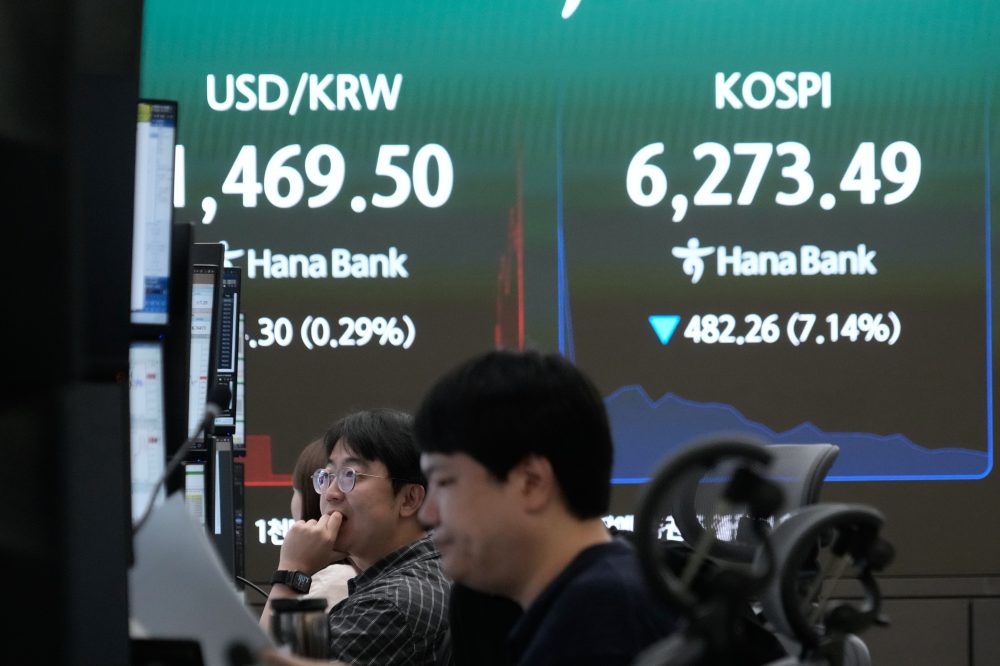

Asian financial markets took a sharp dive on Tuesday, driven by growing unease over the staggering amounts of money being poured into artificial intelligence infrastructure, with semiconductor companies bearing the brunt of the losses.
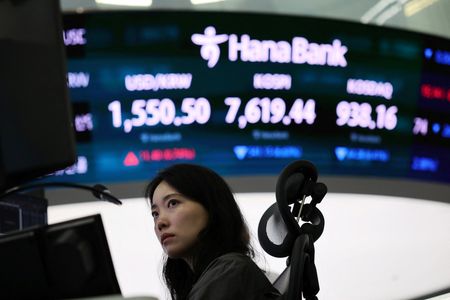
South Korea’s KOSPI index plummeted more than 8%, hitting its lowest point in three months and triggering an automatic circuit breaker to pause trading. Japan’s Nikkei index dropped 4%, following a 2.2% decline in the Philadelphia Semiconductor index.
Nvidia’s stock fell 5% during overnight trading after the Wall Street Journal reported the company is in discussions to provide approximately $250 billion in financing guarantees for OpenAI as part of a large-scale data center project.
Meanwhile, shares of CXMT Corp surged an extraordinary 466% on their first day of trading in Shanghai, underscoring growing investor excitement around China’s semiconductor industry and the competitive challenge posed by Chinese chip manufacturers.
“There is clearly a growing sense of optimism within mainland markets about China’s ability to build a globally competitive AI ecosystem,” said Chris Weston, head of research at Pepperstone.
Adding to the sector’s pressure, The Information reported Monday that China has started producing domestically built immersion deep ultraviolet lithography machines — a specialized chipmaking tool that Dutch company ASML has long dominated. That news sent ASML shares down 8.5%.
South Korea’s SK Hynix dropped nearly 11% and Samsung Electronics lost more than 9%. In Tokyo, Kioxia was among the hardest hit, falling 18%, while Tokyo Electron declined 9.8%. Chinese stocks also retreated, with CXMT pulling back 7% in early trading and chipmaking indexes moving lower.
Oil prices continued to slide as well, with Brent crude futures extending Monday’s nearly 9% drop to reach $87.55 per barrel. The decline came after a pause in hostilities between the U.S. and Iran, following Washington’s sudden halt of air strikes on Saturday.
President Donald Trump said Monday that the United States was engaged in “good talks” with Iran and that there was a possibility of reaching a deal.
The easing of military tensions pushed the benchmark 10-year U.S. Treasury yield down about four basis points to 4.64%, though shorter-term rates barely moved. Traders have factored in roughly a 38% probability that the Federal Reserve will raise interest rates by 25 basis points on Wednesday.
“The U.S.-Iran War, by propelling the price of crude oil, remains the most important determinant of what will happen to the global economy in the next few months, and, by extension, what informs central bank policy outlooks, at the margin,” said Thierry Wizman, currency and rates strategist at Macquarie Group. “We expect that the (Fed) this week will wish to adopt a tightening bias.”
Expectations for rate increases kept the U.S. dollar firm, holding the euro below $1.14 at $1.1370 and pushing the Australian dollar to just under 70 cents.
The Japanese yen traded at 163.78 to the dollar, barely above a four-decade low. Markets remained on edge about the possibility of Japan stepping in to support its currency — especially if the Bank of Japan holds rates steady this week and triggers another yen decline.
“If BoJ communication is not hawkish enough and USD/JPY heads higher, traders should anticipate an official response, including verbal intervention, rate checks, or even direct FX market intervention, perhaps on Friday,” Wizman added.