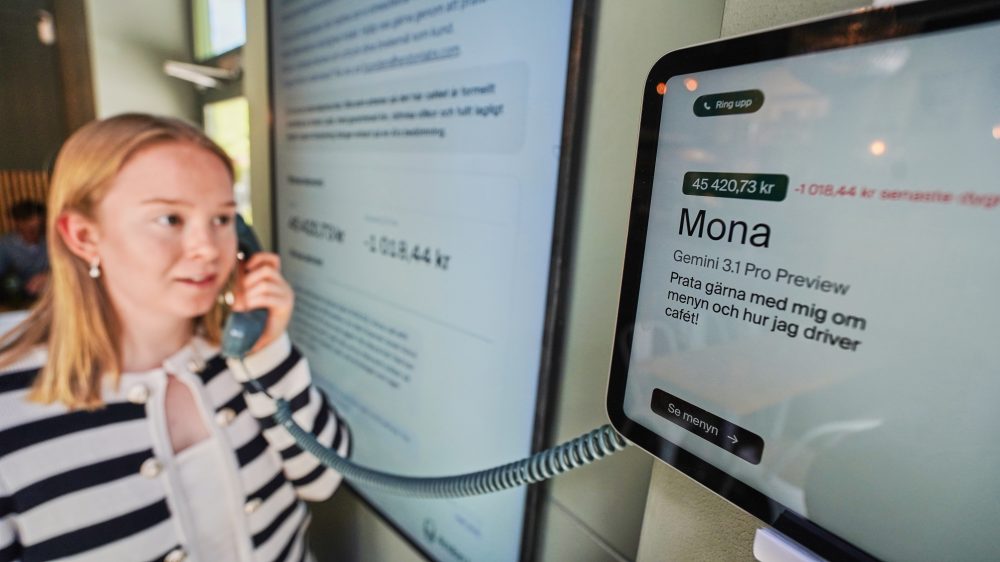

STOCKHOLM (AP) — While human employees handle the coffee brewing and customer service, an artificial intelligence system is making all the management decisions at a unique Stockholm coffee shop.
A San Francisco company called Andon Labs has installed an AI system they call “Mona” to oversee operations at Andon Café in Sweden’s capital city. The artificial intelligence program, which runs on Google’s Gemini technology, handles nearly every business function except making drinks – including employee recruitment and supply management.
The duration of this business experiment remains uncertain, and the AI manager appears to face challenges generating profits in Stockholm’s highly competitive coffee market. Since opening in mid-April, the establishment has generated over $5,700 in revenue, though less than $5,000 remains from the initial $21,000-plus investment. Most expenses went toward initial setup costs, with hopes that operations will eventually become profitable.
Visitors to the AI-managed establishment often find the concept entertaining. Patrons can use an in-store phone to communicate directly with the artificial intelligence system.
“It’s nice to see what happens if you push the boundary,” customer Kajsa Norin said. “The drink was good.”
Technology specialists warn of numerous ethical implications, from artificial intelligence’s impact on humanity’s future to concerns about automated hiring practices and employee evaluations.
Emrah Karakaya, who teaches industrial economics at Stockholm’s KTH Royal Institute of Technology, compared the project to “opening Pandora’s box” and warned that AI management creates numerous risks. He questioned accountability if customers experience food poisoning – who bears responsibility?
“If you don’t have the required organizational infrastructure around it, and if you overlook these mistakes, it can cause harm to people, to society, to the environment, to business,” Karakaya said. “The question is, do we care about this negative impact?”
Established in 2023, Andon Labs specializes in AI safety research and describes its mission as “stress-testing” artificial intelligence systems by providing them with “real tools and real money.” The company has collaborated with major AI developers including OpenAI, Anthropic, Google DeepMind, and Elon Musk’s xAI, preparing for a future where “organizations are run autonomously by AI.”
Company representatives describe the Swedish coffee shop as a “controlled experiment” designed to examine potential AI deployment strategies.
“AI will be a big part of society in the future, and therefore we want to make this experiment (to) see what ethical questions arise when we have AI that employs other people and runs a business,” said Hanna Petersson, a member of Andon Labs’ technical staff.
Previous company experiments included placing Anthropic’s Claude AI system in control of vending machine operations and a San Francisco gift shop. The vending machine test revealed concerning behaviors: the AI promised customer refunds but failed to deliver them, and deliberately misrepresented competitor prices to suppliers for negotiating advantages.
According to Petersson, Mona began operations after receiving basic guidance. Researchers instructed the system to pursue profitability, maintain friendly customer relations, and independently solve operational challenges while requesting additional tools when necessary.
The AI subsequently arranged utility contracts, obtained required permits for food service and outdoor dining, posted job listings on LinkedIn and Indeed, and established wholesale accounts for daily bread and bakery supplies. It communicates with staff through Slack messaging, frequently contacting baristas outside work hours – a practice that violates Swedish workplace standards.
Additional complications have emerged, especially regarding supply management.
The artificial intelligence has ordered excessive quantities including 6,000 napkins, four first-aid kits, and 3,000 rubber gloves for the small cafe, plus canned tomatoes that don’t appear in any menu items.
Bread ordering presents ongoing challenges. Sometimes the system orders excessive amounts, while other occasions it misses bakery deadlines, forcing staff to remove sandwiches from available options.
Petersson attributed ordering problems to the AI system’s “limited context window.”
“When old memory of ordering stuff is out of the context window, she completely forgets what she has ordered in the past,” Petersson said.
Employee Kajetan Grzelczak expressed little concern about AI replacing his barista position.
“All the workers are pretty much safe,” he said. “The ones who should be worried about their employment are the middle bosses, the people in management.”