
The African kingdom of Eswatini rapidly agreed to accept deported migrants from the United States after learning through diplomatic channels that the Trump administration was seeking African partners for such arrangements, according to three senior government officials familiar with the discussions.
Prime Minister Russell Dlamini held private discussions with then-Acting U.S. Charge d’Affaires Caitlin Piper in mid-February of last year regarding the deportation arrangement, the sources revealed.
After Dlamini brought the proposal to King Mswati III, who celebrated four decades of rule in April, the monarch quickly approved hosting the deportees, two sources said, describing previously undisclosed private negotiations.
The rapid approval, which has resulted in 19 migrants being held at a detention facility south of the capital Mbabane, demonstrates Eswatini’s eagerness to maintain strong ties with its American partner.
“The king embraced the deal as Eswatini’s contribution to world order,” King Mswati’s spokesperson, Percy Simelane, told Reuters of the decision.
America served as Eswatini’s primary external donor in 2024, with substantial funding directed toward HIV/AIDS initiatives, according to U.S. Official Development Assistance data. The small landlocked nation of 1.2 million has among the world’s highest HIV infection rates.
Under the arrangement to house up to 160 deportees, Eswatini – where one-third of residents survive on less than $2.15 daily according to World Bank poverty measurements – would receive $5.1 million, based on a leaked agreement document reviewed by Reuters.
ATTORNEYS QUESTION DEAL’S CONSTITUTIONALITY
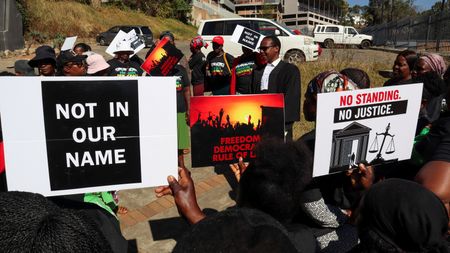
The agreement to accept deportees from countries including Cuba, Jamaica, Cambodia and Laos has generated controversy and unusual public demonstrations, despite the monarch’s broad authority.
Small but uncommon demonstrations occurred in July outside the detention facility. Two attorneys are pursuing legal challenges, arguing the arrangement violates multiple constitutional provisions.
The legal violations include circumventing parliamentary approval, detaining individuals beyond the constitutionally mandated 48-hour limit without charges, denying legal representation, and holding people who committed no offenses within Eswatini’s borders.
“The government of Swaziland (Eswatini) have put themselves in a mess that they don’t know how to take themselves out of,” the lawyer for the deportees, Sibusiso Nhlabatsi, told Reuters.
“Swaziland (Eswatini) is regarded as a golden boy in Africa,” by the U.S., Nhlabatsi said. “I think we found ourselves in the good books … (and) wanted to stay there.”
Following months of legal efforts, Nhlabatsi secured a court victory on April 10 granting detainees access to legal counsel, though prison officials have not yet provided such access, he reported.
Eswatini’s correctional services director did not respond to requests for comment.
ARRANGEMENT MAINTAINED IN SECRECY
A U.S. State Department representative declined to address specific inquiries but stated “we remain unwavering in our commitment to end illegal and mass immigration and bolster America’s border security.”
The initial group of five deportees arrived in July of last year. Additional arrivals have brought the total to 19, with two individuals having been released and returned to their home countries.
Based on information from three government officials and three diplomatic sources, only the king, Queen Mother Ntfombi and Prime Minister Dlamini were aware of the arrangement until the migrants arrived.
“Bringing USA deportees to Eswatini (concerned) security. It had to start where it started and the rest of the system structures were to learn of the decision later,” said Simelane.
Two diplomatic sources and one government official reported that when the $5.1 million payment arrived in government accounts, officials including the finance minister were unaware of its purpose.
Simelane declined to provide additional comment.
BENEFICIAL U.S. TRADE TERMS AND HEALTHCARE AGREEMENT
In contrast to neighboring South Africa, Eswatini has preserved positive U.S. relations and secured favorable terms in a health agreement signed in December, supporting its struggling healthcare infrastructure.
Among 14 African nations signing bilateral U.S. health agreements in December to replace discontinued USAID programs, Eswatini received the highest per-person allocation of $205 million. The country also received 10% tariffs, one-third of those imposed on South Africa.
“The MOU had a significant impact,” health portfolio committee head Nxumalo Somntongo told Reuters, referring to the December health deals. He said they had made financing more sustainable and supply chains more reliable.
However, three sources and Nxumalo stated they were unaware of any evidence that restored aid or favorable trade terms were discussed as components of the deportee arrangement.
“To the best of our knowledge, no carrot, in the form of tariffs was dangled. Health aid was going on long before the deal and could not have been bait,” Simelane said.
HARSH DETENTION CONDITIONS
For some detainees and their families, the experience has been distressing.
Pheap Rom from Cambodia, one of the two released detainees, became alarmed upon realizing he was being transported to an African country rather than another U.S. ICE (Immigration and Customs Enforcement) facility.
“I was (so) scared, my knees were shaking,” he told Reuters last month in Phnom Penh.
The detention conditions in Eswatini were overcrowded, he reported, with four individuals sharing small cells.
The long-term partner of another deportee still held in Eswatini, Felix Perez, 64, said most of their phone conversations center on his fears of dying in detention due to poor health.
“It’s a thought I can’t shake,” the woman, who gave her name as Phyllis, told Reuters in a text message from her Louisiana home town. “To know he has to fight mosquitoes all night and can’t get proper care. I cry daily.”