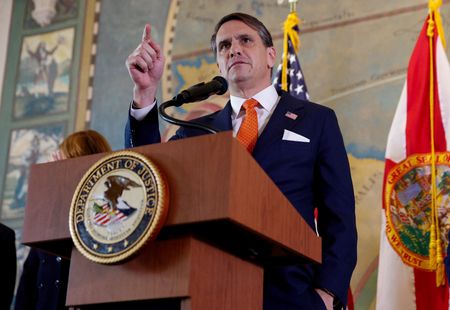

Todd Blanche’s efforts to secure permanent confirmation as attorney general hit a major obstacle as lawmakers return to Washington next week, with a controversial $1.776 billion compensation fund drawing fierce criticism from his own party.
Since becoming acting attorney general in early April following President Donald Trump’s dismissal of his predecessor, Pam Bondi, Blanche has pursued an aggressive agenda aligned with Trump’s priorities. Under his leadership, the Justice Department filed criminal charges against former FBI Director James Comey, intensified investigations into former CIA Director John Brennan, and pulled press releases regarding prosecutions of individuals who participated in the January 6, 2021 Capitol attack.
However, the so-called “Anti-Weaponization Fund” – established through a settlement of Trump’s lawsuit against the Internal Revenue Service over leaked tax records – has become a lightning rod for criticism. Opponents have labeled the compensation program a “slush fund” designed to benefit Trump’s political supporters.
The fund’s unveiling last week prompted such strong opposition that senators scrapped a scheduled vote on immigration enforcement funding in protest. Several Republican legislators are now considering either imposing restrictions on the fund or scrapping it completely.
During a heated closed-door session with Senate Republicans, Blanche faced intense criticism over the fund’s political implications and the possibility that individuals convicted of violent offenses could receive taxpayer money.
“The Republican senators were pissed,” Senator Ted Cruz, a Republican from Texas, said on his podcast. “The entire meeting, they were screaming at the acting attorney general.”
Trump has endorsed the compensation program, stating in a social media message that he supports helping those “abused” by Democratic President Joe Biden’s administration.
In defending the initiative, Blanche maintains that no political affiliation requirements exist for filing claims. A five-member oversight commission, with four members to be selected directly by Blanche, would manage payments to individuals claiming victimization through “lawfare” or “weaponization” – terminology frequently employed by Trump and his supporters when criticizing legal actions against them.
The resistance from Senate Republicans, whose approval Blanche needs for confirmation, highlights the dangers of his Trump-focused strategy. Federal courts have also expressed skepticism toward the Justice Department in multiple proceedings.
“There’s just a fundamental incompatibility between his (Trump’s) demand that the Justice Department carry out loyally all of his retributive goals, and his desire to see those things succeed in courts and before grand juries,” said Peter Keisler, a former DOJ official who served as acting attorney general under Republican President George W. Bush.
A department spokesperson said Blanche has “strong, productive relationships with both Congress and the courts as the laws of our nation are enforced.”
“Any notion that Acting AG Blanche lacks support from these institutions is simply false,” the spokesperson said.
One day after the confrontational meeting with Republican lawmakers, a federal judge delivered another setback to Blanche’s leadership.
Tennessee-based U.S. District Judge Waverly Crenshaw threw out human smuggling charges against Kilmar Abrego Garcia, determining that prosecutors improperly filed the case as retaliation for his legal challenge to his wrongful deportation to El Salvador last year.
In his decision, the judge referenced Blanche’s comments during a June 2025 Fox News interview when Blanche, then serving as deputy attorney general, stated that the government launched its investigation into Abrego after another federal judge questioned his deportation.
Crenshaw, an appointee of former Democratic President Barack Obama, said Blanche’s statements connected DOJ leadership “to the tainted investigation and confirm what motivated it.”
The Justice Department has promised to challenge the decision, describing it as “wrong and dangerous.” In legal documents, prosecutors have rejected any claims of political motivation.
Blanche rose through the ranks from paralegal to supervisor at the U.S. Attorney’s Office in Manhattan, known for attracting elite federal prosecutors. He departed his role at a prestigious New York law firm in 2023 to represent Trump, who was having difficulty securing legal representation amid numerous state and federal investigations.
“He’s lived this lawfare for years. He understands the viciousness of it. He understands the dangers of it,” said Mike Davis, a Trump ally and the head of the Article III Project, a conservative legal advocacy group, who called Blanche the “man for the moment.”
Blanche developed a strong relationship with Trump, embracing his combative approach while defending against three of the four criminal cases Trump confronted during his time out of office. He was appointed to the Justice Department’s second-highest position after Trump’s 2024 election victory.
Rebecca Roiphe, a professor at New York Law School and a legal ethics expert, said Blanche’s previous role as Trump’s lawyer may place him “in a different mindset” than others who have led the DOJ.
“You have really one person that you’re looking out for and you grow to think of them and their goals as the be all and end all of your professional life,” Roiphe said. “Then when you assume a position where you’re supposed to be representing the public, you might have an altered view.”