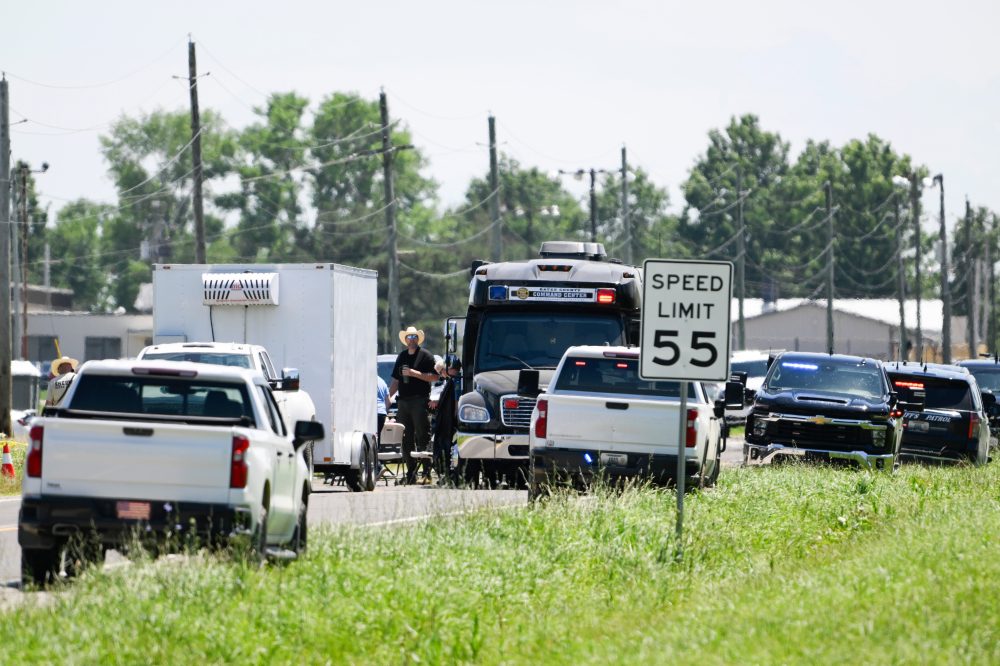

BUTLER, Mo. — All 12 people aboard a small plane — a pilot and 11 passengers headed out for an afternoon of skydiving — were killed Sunday when the aircraft crashed and burst into flames near a Missouri airport, authorities confirmed.
The Missouri State Highway Patrol said troopers responded to the crash site to assist the Butler Police Department and Bates County Sheriff’s Office. The wreck happened near Butler Memorial Airport, located in the small town of Butler — a community of roughly 4,300 residents situated about 65 miles south of Kansas City.
Missouri Highway Patrol Sgt. Justin Ewing said the plane had been taking passengers up to skydive when it went down. Emergency crews received a call around 11:30 a.m. Sunday reporting that a plane had crashed and was fully engulfed in flames.
“It landed in a field adjacent to the airport, but I think they’re shutting down the roadway just as a precaution,” Ewing said.
At the scene, a crumpled mass of blue and silver wreckage could be seen lying in the grass near the airport, with a large line of emergency vehicles parked along the adjacent roadway.
Investigators from the National Transportation Safety Board and the Federal Aviation Administration were making their way to the crash site Sunday afternoon, according to the Missouri State Patrol.
Dennis Jacobs, who serves as both the acting airport manager and director of the Bates County Emergency Management Agency, identified the aircraft as belonging to Skydive Kansas City.
“It had just taken off and made a left turn” before going down, Jacobs said. “In my opinion I think it was losing power, and he was trying to make it over to the highway and land, and he stalled and went down nose first and caught fire.”
Firefighters managed to extinguish the blaze shortly after the crash, Jacobs said, describing what he witnessed as “brutal.”
First responders swept the area beneath the plane’s flight path and found no indication that anyone had attempted to jump from the aircraft before it went down, Jacobs said.
The aircraft involved was a Pacific Aerospace 750XL, a single-engine turboprop commonly used by skydiving operations but also suited for cargo transport, aerial surveying, and medical evacuation flights. The model can accommodate up to 17 skydivers and is designed to operate from shorter runways. FAA records indicate the plane that crashed was manufactured in 2010.
Ewing noted that the small airport serves around 30 privately owned planes, including those used by crop dusting companies and skydiving operators.
Skydiving businesses in the area typically operate eight or nine months out of the year, generally running from late March or early April through October or November. A person who answered the phone at Skydive Kansas City declined to comment to the Associated Press.
The cause of the crash has not yet been determined, Ewing said, and investigators with the NTSB will be working to find answers.
Aviation safety expert Jeff Guzzetti noted that poor aircraft maintenance has played a role in several past skydiving plane crashes, partly because skydiving companies are not held to the same rigorous standards as charter airlines under FAA regulations. He explained that skydiving operators must follow only the same rules that apply to private plane owners — not the stricter requirements governing charter flights and commercial airlines.
“There’s been a whole history of skydiving accidents for inadequate maintenance and deficient safety culture,” said Guzzetti, a former crash investigator for both the NTSB and FAA.