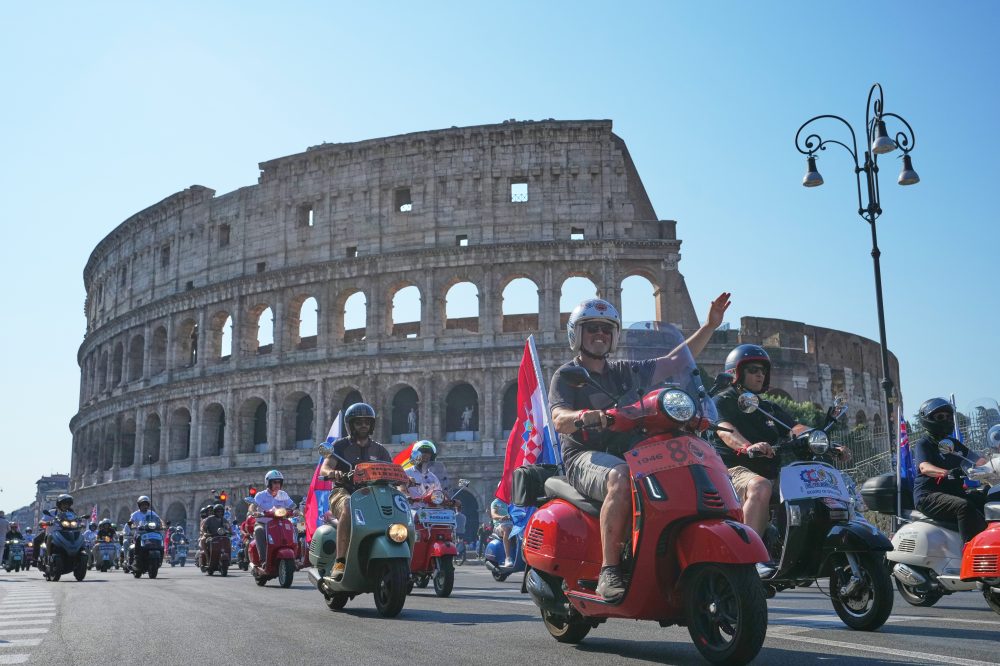

ROME — The streets around the Colosseum and Roman Forum were filled with the familiar putt-putt of more than 10,000 Vespas on Saturday as riders from around the world gathered to mark eight decades of the legendary Italian scooter.
Riders made their way to Rome from all corners of the globe. The Associated Press spoke with attendees from countries across continental Europe, northern England, San Francisco, Australia’s Gold Coast, the Philippines, and beyond. For one day, the mighty Ferrari and Ducati took a back seat as the humble little Vespa stole the spotlight on Rome’s ancient cobblestone streets.
“The passion for Vespa is for the Italian style, freedom, the ’60s,” said Natalie Dunand, a retired woman from France who was also celebrating her own 61st birthday that day. “I love it.”
The scooter first captured the world’s imagination through the 1953 film “Roman Holiday,” in which Gregory Peck gave Audrey Hepburn a romantic ride through the city. Since then, Vespas have appeared in other well-known films, including “The Talented Mr. Ripley” and the more recent animated feature “Luca.”
With its graceful curves that evoke a simpler time and its uncanny ability to make passersby smile, the Vespa — whose name means “wasp” in Italian — holds a place in two-wheeled transportation similar to what the Volkswagen Beetle holds in the car world.
The scooter’s birth was something of a happy accident. After World War II, as Italy worked to rebuild itself from the destruction, aircraft manufacturer Piaggio found its Pontedera factory in ruins from wartime bombings. Forced to reinvent itself, the company shifted its focus dramatically and began producing scooters instead.
According to Davide Zanolini, Piaggio’s executive vice president of marketing, women were among the first target customers, since the scooter’s design allowed them to ride while wearing long skirts without exposing their legs.
“The shape, the elegance. This very charming attitude of Vespa is much more of a lady than a man,” Zanolini told the Associated Press.
The little scooter helped breathe life back into Italy’s recovering economy, and before long Vespas were everywhere. A 1950 AP article described the sound of Rome’s downtown streets as resembling the Indy 500 due to the scooters’ constant “staccato exhaust racket.”
“There probably isn’t a noisier scooter in all the world,” the article noted. “Scooters darting loudly around Rome are said to impress motor-minded Americans as strongly as St. Peter’s or the Colosseum. The scooter quickly teaches visitors to look four ways at once at street crossings.”
Those kinds of scenes returned to Rome starting Thursday, as Vespa fans began flooding the city’s streets, many traveling in groups and wearing matching T-shirts to show their club colors.
Outside Rome’s Stadium of the Marbles, row after row of Vespas spanning eight decades were on display — like a motorcycle rally, but with considerably more charm. Some of the scooters were decorated with flowers and stuffed animals.
Dunand’s West Highland terrier rode along behind her, its fur trimmed short to handle the heat. A man who had traveled from Tokyo brought his 8-year-old daughter along for the ride and exchanged his hometown club’s banner with an Italian one. Riders swapped stickers with one another. And one German man had the Vespa logo tattooed on his left calf, alongside three words in flowing cursive: “La Dolce Vita” — The Sweet Life.
Many riders talked about the nostalgia the brand stirs up, even among those who weren’t around during the Vespa’s heyday. A number of them also mentioned trading in larger, heavier motorcycles for the lighter, automatic Vespa, which features an accelerator on the hand grip.
“You get on, twist, go. Doddle. Easy,” said Andrew Walton, a 59-year-old truck driver who purchased his first Vespa nearly 20 years ago and never looked back. He had just completed an eight-day journey from Newcastle, taking a ferry to Rotterdam and then following the Rhine River through Germany to Austria’s “Romantic Road” before heading down along Italy’s coastline to reach Rome.
Once Rome’s mayor cut the ribbon at the Stadium of the Marbles, the crowd poured in — singing, chanting, and waving flags. Many rushed straight to the gift shop, which offered everything from Vespa jackets and hats to blankets, water bottles, and umbrellas. The hottest item, though, was a limited-edition helmet with “80 Years of an Icon” printed on the side.
A photo exhibit showcased the Vespa through the decades — couples enjoying picnics in flower-filled fields, seaside getaways, and sun-drenched road trips — as well as some surprising moments, like explorer Soren Nielsen’s 1963 journey to the Arctic Circle on a Vespa.
Piaggio also displayed an immaculate collection of vintage Vespas, which drew nearly as much admiration as the classical sculptures housed nearby.
Since the Vespa first rolled off the production line in 1946, Piaggio has sold roughly 20 million of them worldwide. Today the scooter is available in 110 countries, Zanolini said. In the United States, it’s most popular in Florida and California and is gaining ground in cities like Austin — though it remains a niche product overall.
Burke Sandman, whose family runs a 108-year-old car dealership in Indiana, told the AP he fell for Vespas about two decades ago after spotting one with a sidecar. Realizing there were no local dealers nearby, he reached out to Vespa directly and got into the business. He has since sold around 1,000 Vespas across the country — and kept 15 for himself.
“No one ever says anything bad about a Vespa. You know, it’s crazy,” Sandman said from inside the Vespa Village. “Everyone that trades other brands for a Vespa, they never go back. It’s just something about it. And everyone likes Italian stuff. I get a lot of people that come back from Europe, and they’ve got the bug.”