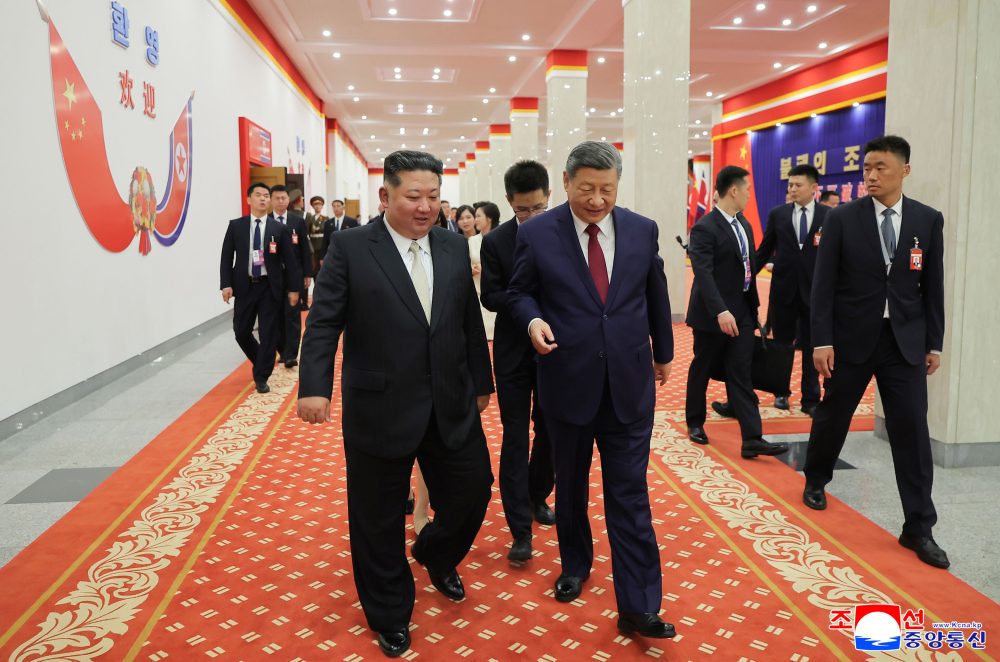

State media from China and North Korea published extensive coverage this week about the meeting between Xi Jinping and Kim Jong Un, yet completely omitted discussion of a critical concern for Washington: North Korea’s continued development of nuclear weapons capable of threatening the United States and regional allies.
This notable omission reveals more than volumes of carefully crafted state propaganda could convey.
Before diplomatic negotiations collapsed in 2019, Washington and Beijing had maintained a years-long partnership aimed at convincing North Korea to give up its nuclear program in exchange for essential aid and international legitimacy.
China consistently advocated for “denuclearization” — diplomatic language for nuclear disarmament — and officials in Washington, Seoul, and Tokyo held hopes that Beijing would leverage its position as North Korea’s key diplomatic and economic ally to pressure Pyongyang regarding the nuclear crisis.
Xi’s trip to Pyongyang on Monday and Tuesday — marking his first journey there in seven years — may represent the conclusion of such expectations and indicate a major change in his approach to North Korea’s nuclear capabilities.
From China’s viewpoint, Xi’s refusal to address the nuclear issue might reflect recognition of how advanced North Korea’s nuclear development has become since Kim Jong Un assumed leadership in 2011 — and acknowledgment of how improbable it is that negotiations could convince the North to surrender weapons it considers its primary defense against external threats.
The Chinese leader’s previous North Korean visit in 2019 presented a dramatically different message — Xi was reported in Chinese outlets as stating his country would contribute constructively to Korean Peninsula denuclearization efforts.
China’s primary objective remains maintaining stability in North Korea and the broader region. A governmental collapse in Pyongyang could result in millions of refugees crossing their extensive shared border.
With this goal in mind, China has frequently refrained from directly demanding an end to North Korea’s nuclear activities, according to research by Jiyong Zheng, dean of the Institute of Regional Studies at Tianjin Foreign Studies University in China.
Rather than targeting North Korea specifically, Beijing advocated for denuclearization across the entire Korean Peninsula — strategic language that enabled China to simultaneously call for ending U.S. nuclear protection commitments to South Korea and halting deployments of American nuclear-capable aircraft near the Korean Peninsula.
Recent months have seen Beijing indicate its preference for prioritizing regional stability over denuclearization goals, Zheng noted in his analysis.
“China is increasingly concluding that a rigid denuclearization-first approach is impractical and may worsen the regional security environment,” he said.
For Kim Jong Un, the absence of any public discussion or condemnation of his nuclear arsenal represents a victory. He has consistently sought international acknowledgment of his nation’s nuclear weapons status, which could result in lifting U.N. sanctions.
When questioned Tuesday about whether Seoul should reduce its expectations of Beijing following Xi’s apparent avoidance of nuclear topics in Pyongyang, South Korean Foreign Ministry spokesperson Park Il maintained that China continues supporting nuclear disarmament objectives.
Likewise, following last month’s meeting between U.S. President Donald Trump and Xi, the White House stated both leaders reaffirmed their mutual commitment to North Korean denuclearization.
China, however, merely reported that the American and Chinese leaders discussed Korean Peninsula nuclear matters.
On Sunday, Kim’s sister and senior official, Kim Yo Jong, rejected the U.S. account of the Xi-Trump discussion as “false information.”
Last week, Kim Jong Un revealed a new facility for producing nuclear materials and promised to strengthen nuclear capabilities “at an exponential rate.” His sister also characterized any American efforts toward North Korean denuclearization as an “anachronistic dream.”
China may prefer preventing North Korea and the United States from developing closer ties, suggested Park Won Gon, a professor at Seoul’s Ewha Womans University, noting that Beijing might want to maintain North Korea within its influence sphere and utilize that connection as bargaining power with the U.S.
South Korean President Lee Jae Myung informed reporters Monday that North Korea produces sufficient nuclear material yearly for approximately 10 to 20 weapons and approaches completion of intercontinental ballistic missile capabilities that could deliver nuclear warheads to the American mainland.
Kim, meanwhile, has emphasized that nuclear weapons form a fundamental component of North Korea’s national character. He has incorporated North Korea’s nuclear status into the constitution and allocated increasing resources, industry, and government infrastructure toward maintaining it.
Several analysts interpret China’s avoidance of “denuclearization” terminology during Xi’s current visit as a clear shift in Beijing’s position and implicit recognition of North Korea’s nuclear status.
This transformation could mean that deterrence efforts by the United States, Japan, and South Korea will become ongoing rather than temporary measures, according to Seong-Hyon Lee, a senior fellow at the George H.W. Bush Foundation for U.S.-China Relations.
“Beijing’s silence should not be viewed as a bureaucratic oversight but as a deliberate strategic signal,” Lee said. “By tacitly accepting North Korea’s nuclear status, Beijing strengthens its position as an indispensable stakeholder in any future negotiations.”
Nevertheless, China’s tolerance for North Korea’s military objectives may have boundaries.
While Xi’s visit demonstrates a “strategic embrace of Kim,” it does “not a blank check for North Korea,” said Leif-Eric Easley, also a professor at Ewha Womans University.
Beijing seeks stability and recognition of its regional goals, Easley explained. “North Korea’s persistent expansion of military capabilities is pushing the limits of what its larger neighbor will tolerate.”