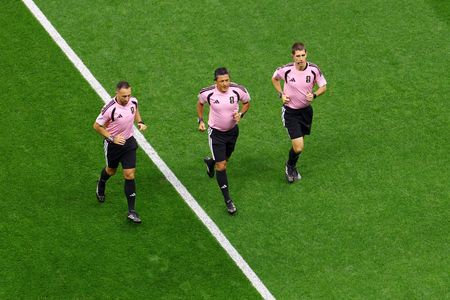

KANSAS CITY, Missouri — When a World Cup match comes down to a split-second call in the final moments, the referee has to be in exactly the right spot — no easy feat when conditions range from sweltering Miami humidity to the thin air of Mexico City, sitting more than 2,200 meters above sea level.
While the crowd watches strikers and defenders chase the ball, referees are running just as hard. According to FIFA, officials typically cover between 12 and 13 kilometers during a single match — a distance comparable to many outfield players.
That reality has completely changed how soccer’s governing body gets its officials ready for the sport’s biggest stage.
“Referee preparation for the 2026 World Cup began almost four years ago,” FIFA told Reuters.
The preparation has mirrored what elite athletes go through. Officials have completed multiple rounds of physical testing, with training intensity ramping up significantly in the six months leading into the tournament.
The physical demands go well beyond just logging miles. A referee might battle oppressive heat and humidity in one match, then find themselves gasping for breath at high altitude in the next — all while managing long flights, shifting time zones, and extreme temperatures. FIFA noted that experience gained during the 2025 Club World Cup held in the United States was especially valuable in preparing officials for “heat, humidity and also different time zones.”
Officials work on endurance, strength, speed, agility, and acceleration — often through drills designed to mimic real game situations. Performance specialists watch every sprint, monitor heart rates, and analyze recovery patterns.
The goal is straightforward: make sure the referee arrives at every key moment before controversy does.
Studies have shown that fatigue leads to worse positioning, narrower sightlines, and slower reaction times — exactly the conditions that can produce the kind of officiating error that gets replayed for decades.
That is why FIFA now treats its referees much the way clubs treat their players.
The officiating team for this World Cup includes 52 referees, 88 assistant referees, and 30 video match officials drawn from 50 member associations. They are based in Miami, living in a structured environment centered on training, nutrition, recovery, and technical development. Supporting them are 12 medical specialists, 10 physiotherapists, and a chef with a background in sports nutrition.
GPS devices track workload, heart-rate monitors measure physical exertion, and blood-lactate testing helps staff understand how each official’s body is holding up. Training programs are then fine-tuned using that data.
“We use data trackers at the same level as players,” FIFA said.
In the three days before a match, officials take part in simulated game sessions along with short bursts of explosive speed work. Once a match is over, the focus shifts entirely to recovery.
“(The two days following games) are dedicated to active recovery training, along with massages and cryotherapy, which help achieve a faster and more effective recovery,” FIFA said.
FIFA has also introduced hydration supplements and reworked training schedules to reduce officials’ exposure to direct sunlight.
It is easy to overlook all of this because referees almost never appear on highlight reels. Yet research shows that high-intensity running can make up more than a third of their total movement during top-level matches, with heart rates frequently reaching between 80% and 100% of maximum levels.
All the while, officials are tracking player positions, identifying potential fouls, reading tactical patterns, and constantly searching for the best angle to make the right call — often while running at full speed.
Even with all that preparation, injuries can still happen. During the United States’ 2-0 group stage win over Australia, German referee Felix Zwayer went down with cramps in stoppage time. Players from both teams, along with an assistant referee, had to help stretch his leg so he could finish the match.
As the tournament moves into the quarterfinal round, the spotlight will stay on the players — but behind every defining moment is a referee pushing hard to keep pace, knowing a single whistle can change everything.