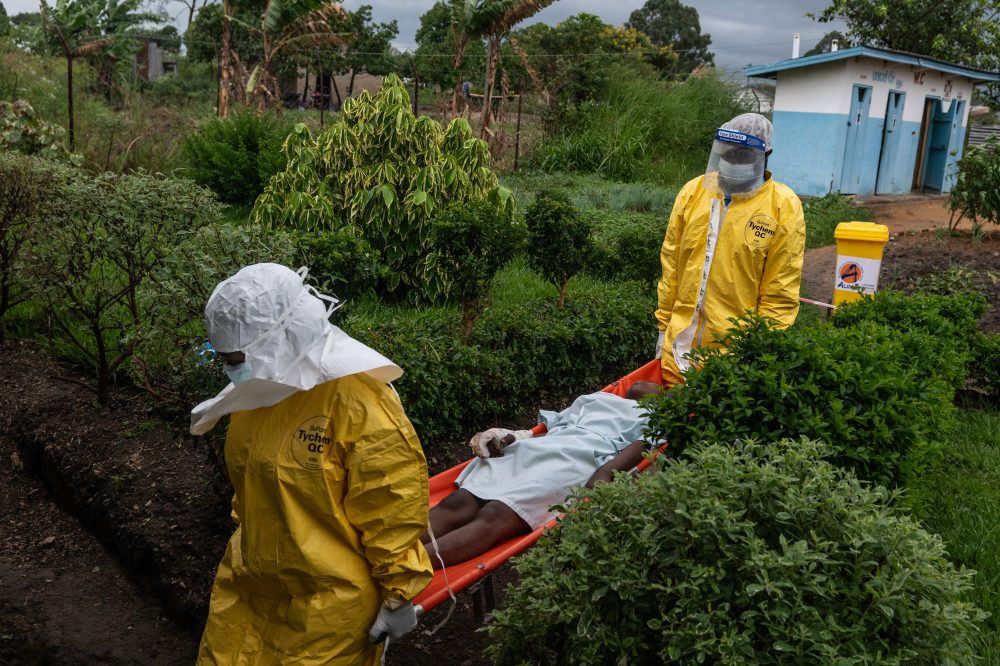

Health workers at the heart of Congo’s deadly Ebola outbreak have begun leaving their posts in protest, demanding wages they say have gone unpaid — a development that threatens to derail an already struggling response effort.
In Ituri province, the hardest-hit of three eastern Congo provinces dealing with the outbreak, front-line workers told The Associated Press they have received neither their regular wages nor their bonuses since authorities declared the outbreak on May 15. Workers also reported shortages of protective equipment and said they felt they were being treated unfairly by both officials and response teams.
“Since the Ebola virus disease outbreak was declared, we’ve been demanding payment for our work,” said Dr. Biensi Kano, a member of the epidemiological surveillance committee in Bunia, the capital of Ituri province.
The most recent government figures show 1,708 confirmed cases and 580 deaths. Health authorities noted that the first month of this outbreak was already the worst ever recorded. The labor unrest is occurring just as clinical trials begin for treatments targeting the Bundibugyo virus, which is responsible for this particular outbreak.
The World Health Organization’s representative in Congo, Dr. Anne Ancia, said Tuesday that the virus continues to move through the population, driven by the movement of people and ongoing insecurity in the region, while some treatment facilities are running close to capacity.
Dr. Kano said the lack of pay “exposes us and our families to significant socio-economic difficulties and seriously undermines our living conditions.”
Over the weekend, front-line workers in Ituri issued an official notice to national and provincial authorities, warning they would strike within 24 hours if their wages were not paid. By Tuesday, some workers had already stopped reporting for duty, even though no formal strike had been officially declared.
Those participating in the work stoppage include not only medical professionals but also safety and security personnel, community outreach workers, and teams responsible for burying Ebola victims.
Congo’s national government did not respond to a request for comment. Officials in Ituri said they have met with the workers and are working to address their concerns.
Akilimali Pierre, the incident manager at Congo’s National Institute of Public Health, pointed to logistical obstacles as a contributing factor. “The fact that Bunia airport is closed is hampering the very implementation of the response, particularly certain aspects of the flow of funds. This is one of the reasons that may account for the delay in payment,” he told The Associated Press.
On Monday, a group of workers organized a demonstration outside the Rwampara Ebola treatment center. Protesters set tires on fire, briefly causing panic in the surrounding area before police stepped in to restore calm.
Beyond the pay dispute, health workers also face physical danger on the job. Dr. Ben Bakule, a community investigator, said he barely escaped serious harm in late May when a group of angry young men attacked him and his colleagues while they were tracking contacts of a confirmed Ebola case in the village of Tutu, in Djugu territory.
“We spend money on transport to get to work. We thought we’d be rewarded. At the moment, nothing is going right because we’re not being paid. We don’t deserve this sort of treatment,” Bakule told The Associated Press.
He added with clear frustration: “We might have to give up our jobs. These are risks we’re taking. We risk dying for nothing. This government wants this epidemic to continue.”
During a visit last month to Mongbwalu — a mining town considered the disease’s hot spot — Congo’s Minister of Health Roger Kamba assured response teams that the government was making their working conditions a priority. “All doctors, all nurses and all staff working on the response will be fully supported. We have the money for that,” Kamba said at the time.
Front-line workers say that promise has not translated into reality.
“We are doing everything we can to make the public understand how dangerous this disease is. I came here to save people’s lives, but this is how I am being thanked. We are working day and night without being paid,” said Dr. Ghislain Maneba, an epidemiologist and community investigator in the Rwampara health zone.
Residents of Ituri are watching the situation with growing anxiety. Bunia resident Anifa Kito, speaking from her tomato stand, expressed concern that the strike could cause the response effort to collapse. “I would ask the authorities to resolve this situation before things get any worse,” she said.