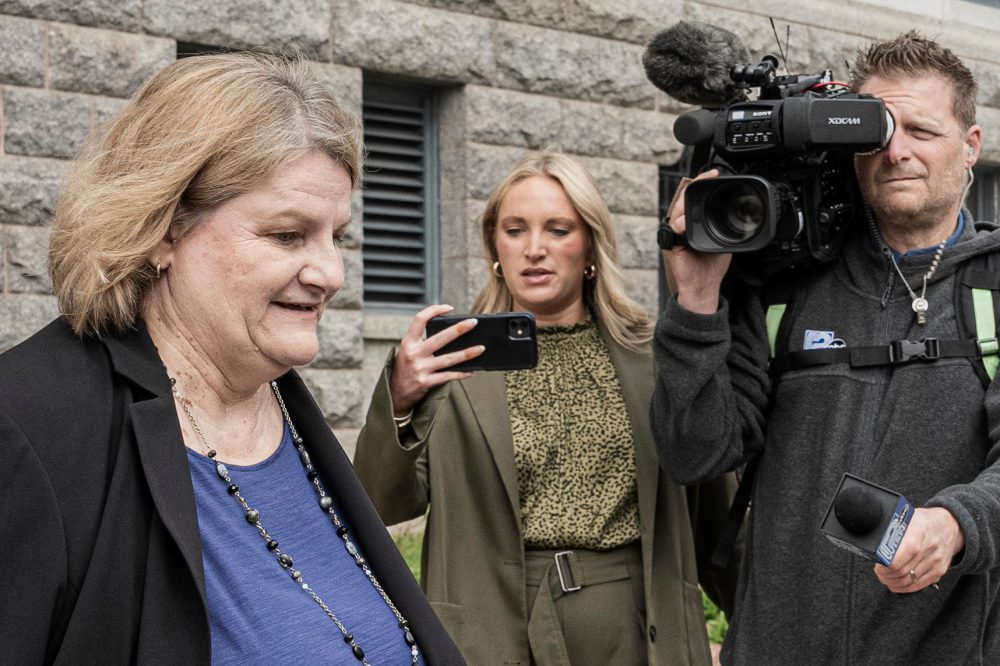

MILWAUKEE (AP) — A federal judge delayed sentencing Wednesday to consider overturning the conviction of former Wisconsin Judge Hannah Dugan, who was found guilty of felony obstruction for assisting an immigrant in avoiding federal authorities.
The proceedings represented an early judicial test of how courts would handle President Donald Trump’s extensive immigration enforcement efforts.
While Dugan was originally set to receive her sentence Wednesday, U.S. District Judge Lynn Adelman delayed the hearing without setting a new date to instead review arguments about potentially reversing her conviction.
Adelman made no immediate ruling and gave no timeline for a decision. Dugan and lawyers from both sides exited the courtroom without speaking to the media.
Defense attorney Steven Biskupic contended that Dugan’s conviction should be reversed and declared invalid. He cited a federal appeals court decision from April that overturned a crucial Virginia immigration case that both the judge and prosecutors had referenced in Dugan’s proceedings.
Based on the 4th U.S. Circuit Court of Appeals reversing that decision, Biskupic maintained that Dugan was wrongfully convicted under procedural aspects of federal law.
“Our primary argument is this was an invalid theory of conviction,” Biskupic stated.
The Virginia case involved an immigrant who was in the country without authorization and was detained by U.S. Immigration and Customs Enforcement agents before escaping. After being captured again, he faced charges for obstructing a pending immigration proceeding.
The federal appeals court determined that the ICE action did not qualify as a “pending proceeding,” which federal obstruction law requires.
Dugan’s legal team maintains she should never have faced charges because no “pending proceeding” existed against the immigrant in her courtroom that ICE agents were pursuing, only an arrest warrant. Filing a warrant doesn’t constitute a “proceeding” under the law, Biskupic contended.
Government prosecutors argued that the Virginia case facts differ and don’t relate to Dugan’s situation. They also pointed to other cases that support upholding Dugan’s conviction.
“The court should stick with its ruling,” stated Richard Frohling, acting U.S. attorney for the eastern district of Wisconsin.
When questioned by the judge, he maintained that the appeals court erred in overturning the Virginia case. The judge also questioned Frohling about what legally constitutes a proceeding and its duration.
“It could be a couple minutes, it could be a couple years,” Frohling responded. “It all depends on the context.”
Dugan, 67, could face up to five years in prison following her December 19 jury conviction. However, prison time appears unlikely for Dugan. Federal sentencing guidelines typically recommend probation for defendants without criminal records convicted of nonviolent offenses.
She stepped down from her Milwaukee County circuit judge position two weeks after her conviction as Republican state lawmakers threatened impeachment. She had served as a judge for nine years.
Dugan attended Wednesday’s hearing but remained silent throughout.
The Trump administration pursued charges against Dugan as the president advanced his comprehensive immigration enforcement agenda. Trump’s administration and supporters characterized Dugan as an activist judge, while her attorneys claimed she was being unfairly prosecuted and unsuccessfully argued she had judicial immunity from charges.
Dugan’s case became the first instance of a Wisconsin state judge facing trial for obstructing immigration agents. She was cleared of a misdemeanor charge for concealing an individual to prevent arrest.
On April 18, 2025, immigration officers arrived at the Milwaukee County courthouse after discovering Eduardo Flores-Ruiz had illegally reentered the country and was scheduled to appear before Dugan for a state battery case hearing.
Dugan approached agents outside her courtroom and sent them to the chief judge’s office, telling them their administrative warrant was insufficient for arresting Flores-Ruiz.
Following the agents’ departure, she escorted Flores-Ruiz and his attorney through a private jury exit. Agents noticed Flores-Ruiz in the hallway, pursued him outside and arrested him after a foot pursuit. FBI agents arrested Dugan at the courthouse a week later, escorting her out in handcuffs.
Flores-Ruiz was deported in November.