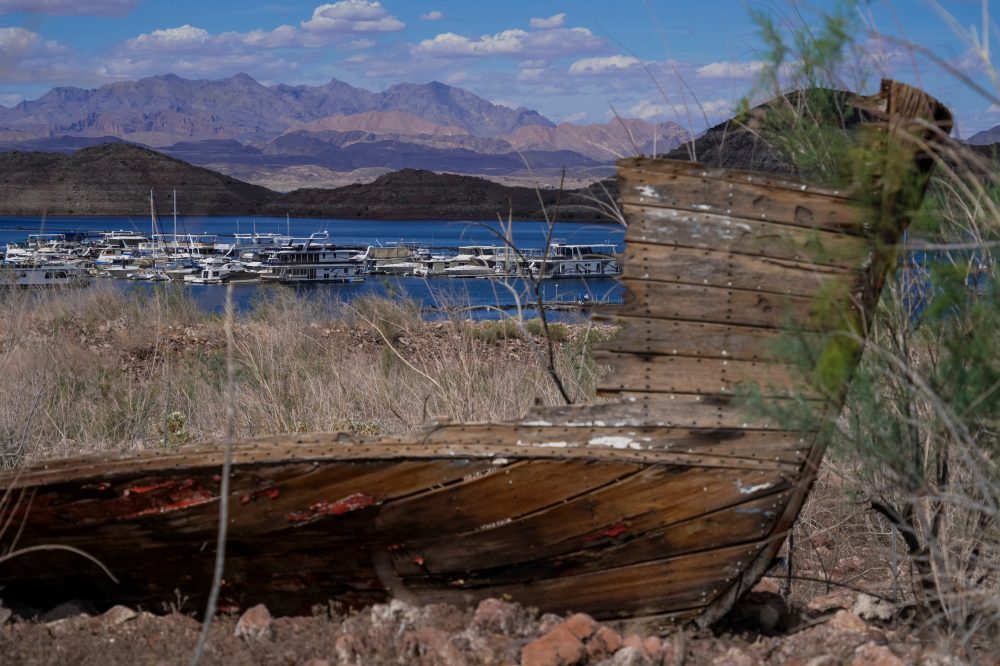

Three western states have unveiled an emergency water conservation strategy to address the Colorado River’s declining levels after experiencing the most severe winter drought in recorded history.
This month, Arizona, California and Nevada revealed their commitment to conserve as much as 1 million acre-feet (equivalent to 44 billion cubic feet) of Colorado River water by 2028. When combined with previously announced reductions by these states and Mexico, the total water savings would reach 3.2 million acre-feet (139 billion cubic feet) – sufficient to supply over 25 million people annually.
“We have kind of a crisis situation that this past winter has created,” Tom Buschatzke, Arizona’s lead negotiator, said earlier this week. “We need to do everything we can, and that’s what our plan does, to find a short-term fix.”
The U.S. Bureau of Reclamation has already announced it will discharge additional water into severely depleted Lake Powell earlier than normal to maintain hydroelectric power generation at one of the nation’s largest reservoirs.
Federal authorities and state legislatures must approve the three-state proposal, though officials describe it as comprehensive and beneficial to the entire river system.
The Colorado River provides water to 40 million residents across seven U.S. states, two Mexican states and Native American communities. Agricultural operations depend on it for irrigating vast farmlands, while approximately 155 utility companies rely on it for hydroelectric power generation.
Current water-sharing agreements are set to expire this year, but interstate negotiations have largely collapsed. The states haven’t engaged in meaningful discussions for roughly four months. Upper Basin states – Utah, Colorado, Wyoming and New Mexico – have called for mediation, while the Bureau of Reclamation is developing contingency plans in case states fail to reach agreement.
Kevin Moran from the Environmental Defense Fund expressed optimism that the water reduction commitment could spark collaborative solutions among all states.
“The Colorado River is tanking,” he said. “We are at the 11th hour in needing to have strong and collaborative solutions to protect the health of the river.”
Under the Lower Basin proposal, Nevada and Arizona would reduce their annual Lake Mead allocations by approximately one-third. California, holding the most extensive and established water rights, would decrease consumption by roughly 13 percent.
States have until August to determine how these reductions will be implemented across different sectors.
Arizona’s water allocation flows through the Central Arizona Project’s 336-mile canal network, serving 6 million residents in central and southern Arizona. The distribution system operates on a priority basis affecting farmers, municipalities, tribal communities and industrial users.
Agricultural operations consume the majority of the river’s water, particularly in areas like the Imperial Irrigation District – the largest single user of Colorado River water and a major producer of the nation’s winter vegetables.
The Metropolitan Water District of Southern California serves 19 million people and depends on the Colorado River for approximately 20 percent of its water supply. Board member Mark Gold noted that reducing Colorado River dependence will help prevent more severe shortages, though risks remain.
The Lower Basin strategy requires both state and federal financial support. Conservation measures may include farmers leaving fields unplanted or switching from water-intensive crops like alfalfa to drought-resistant alternatives.
Urban areas could experience higher water costs for residents and businesses due to reduced supply availability, Gold explained.
Persistent overuse, extended drought conditions and climate change-related temperature increases have reduced the river’s flow below allocations established over a century ago.
Lake Powell and Lake Mead, critical indicators of the river system’s condition, continue declining over time. If water levels drop below certain thresholds, hydroelectric generation would cease and downstream water delivery would become impossible.
The Bureau of Reclamation recently announced plans to release up to one-third of Flaming Gorge reservoir’s water upstream of Lake Powell to prevent this scenario. The Glen Canyon Dam’s hydroelectric facility powers more than 350,000 homes.
Bureau officials are evaluating the Lower Basin proposal while maintaining their focus on achieving a comprehensive interstate agreement.
Colorado’s lead negotiator Becky Mitchell called the Lower Basin plan a positive initial step but insufficient for protecting Lake Powell.
Upper Basin states want Lower Basin states to commit to avoiding legal challenges, which appears unlikely.
“While the Lower Division States have made progress, more is needed to protect the Colorado River System now and into the future,” she said in a statement. “These differences highlight the urgent need to come back together with the help of a mediator.”
All seven states continue disputing water reduction responsibilities and amounts during a drought spanning more than twenty years.
Upper Basin states recently agreed to federal plans sending nearly one-third of their annual water allocation to Flaming Gorge for Lake Powell protection. Water rights holders are also implementing earlier seasonal cuts, with some receiving only 14 percent or less of their normal allocations.