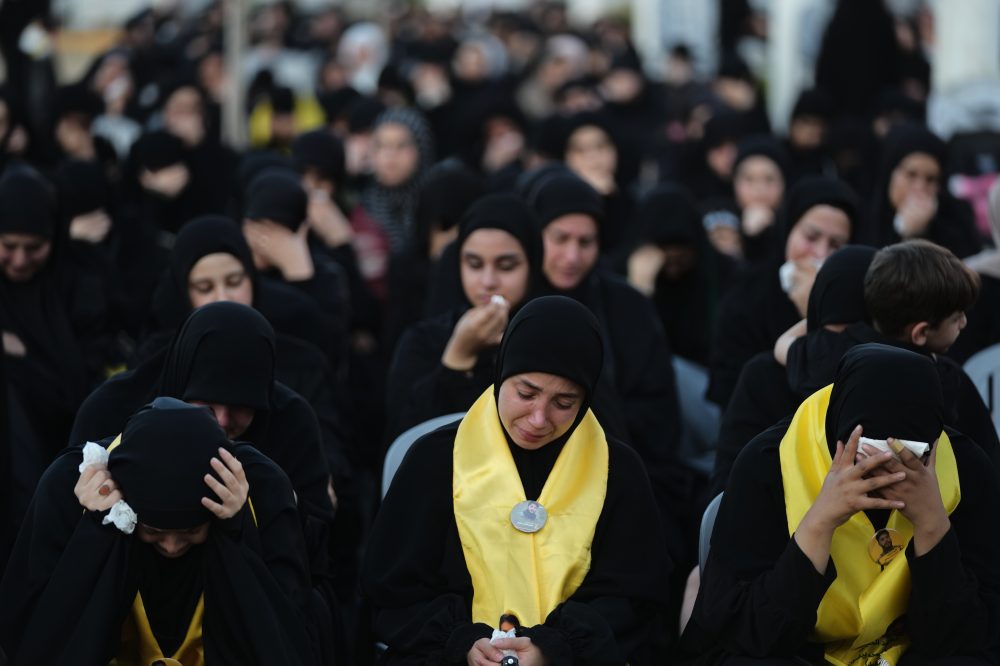

In the battered southern Lebanese city of Tyre, a grieving mother clutched a yellow scarf bearing the image of her son — a fighter killed serving Hezbollah — as she wept through a religious sermon on Friday. Iman Dilbani was among hundreds who gathered to observe Muharram, one of the holiest months in the Islamic calendar.
Tyre, Lebanon’s fourth largest city, has been left in ruins by the war between Israel and Hezbollah. Damaged buildings and piles of rubble line nearly every street following intense Israeli airstrikes.
Muharram holds deep significance for Shiite Muslims, commemorating the martyrdom of Imam Hussein — the Prophet Muhammad’s grandson — and his 72 companions who fell in the seventh-century Battle of Karbala, in what is now Iraq.
The ceremony took place in an open lot in the coastal city, with attendees dressed in black as if attending a funeral. Many wore scarves or held photographs of relatives who had died. Portraits of Hezbollah leader Sheikh Naim Kassem and Iranian Supreme Leader Ayatollah Mojtaba Khamenei were displayed above the podium. Red and black banners bearing Hussein’s name surrounded the gathering. A young girl held up a portrait of Khamenei as she stood beside her weeping father.
For Shiite Muslims in Lebanon, the ongoing destruction has made the meaning of Muharram even more profound. Some residents have placed banners with Hussein’s name on the wreckage of their homes. The mourning period reaches its highest point on Ashoura, the tenth day of Muharram, which is observed by millions of people around the world.
The conflict began escalating after Hezbollah launched rockets toward northern Israel on March 2 in a show of solidarity with Iran. Israel responded with sweeping aerial bombardments that repeatedly struck Beirut and leveled large portions of southern and eastern Lebanon. According to Lebanon’s Health Ministry, nearly 4,000 people have been killed in Israeli strikes. More than one million Lebanese citizens remain displaced, and Israeli ground troops have pushed into the country, holding significant portions of southern Lebanon. Hezbollah, in turn, fired rockets and sent drone attacks into northern Israel.
One of the event’s organizers, Sheikh Abdulkareem al-Rahi, reflected on the weight of the moment. “Given what has been happening in our world today, and seeing the martyrs and the destruction, no human mind can bear all of that unless they are a believer in the teachings of Imam Hussein,” he said.
Shiite Muslims draw from Hussein’s example a message of endurance and resistance against oppression, regardless of the odds.
Dilbani echoed that sentiment, speaking about the sacrifice she has already made and what she is prepared to give. “We learned from Imam Hussein’s teachings the struggle and martyrdom, and to stay on his path and to offer our youth,” she said. “I have three more sons, and I am willing to offer more of them if there is a need.”
Lebanon has been urgently seeking a ceasefire, and a U.S.-brokered agreement with Iran includes provisions to end the fighting in the country. However, hostilities had not fully stopped at the time of the ceremony. Hezbollah has said it will keep fighting for as long as Israel continues to strike and occupy parts of southern Lebanon.
Israel and Hezbollah did agree to halt fighting on Friday, though the memory of previous failed ceasefires has made many Lebanese deeply cautious about whether this one will hold.
A cleric speaking at the ceremony pushed back against critics who claim Hezbollah lost the war, despite the enormous toll it has taken. He drew a parallel between their current struggle and Imam Hussein’s stand at Karbala.
Sheikh Ibrahim Qassir, the imam of the town of Deir Qanoun En Nahr near Tyre — a community that suffered widespread damage during the conflict — offered a defiant message rooted in faith. Imam Hussein’s teachings “are an institution, in every way, in their values and their pride,” he said. “And that is why we are still here, and we will be victorious, and victorious, and victorious.”