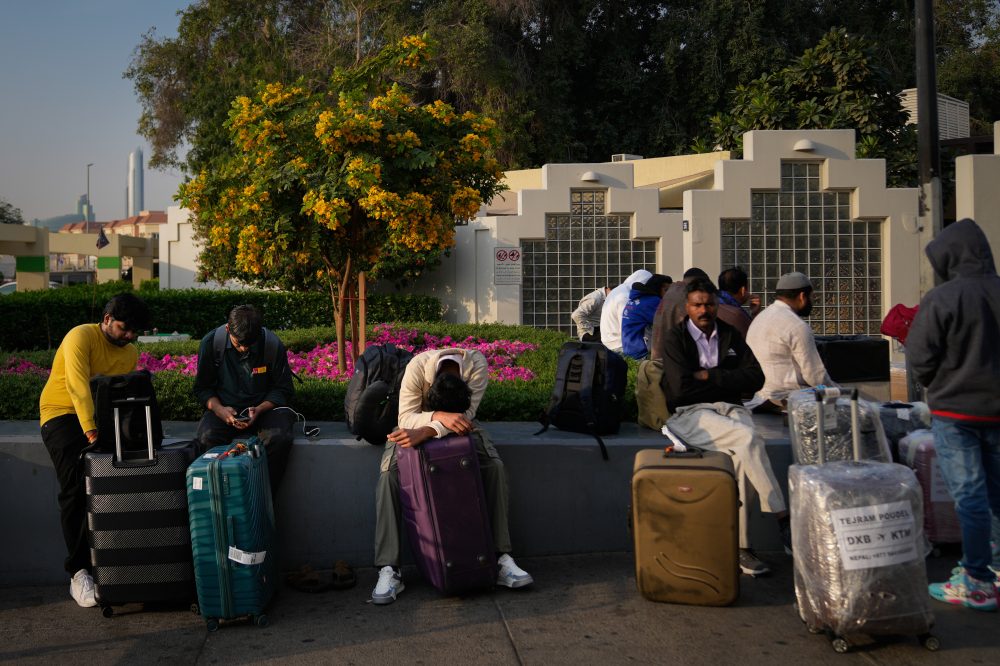

Massive numbers of travelers find themselves trapped throughout the Middle East as regional warfare between the United States, Israel and Iran continues to intensify. Flight cancellations and closed airspace have created chaos for passengers desperately trying to find ways home.
The rapidly escalating situation has particularly impacted Gulf region airports, which serve as vital connection points for travelers heading to Europe, Africa and Asia. Despite ongoing rescue operations, air travel remains severely disrupted, affecting tourists, business people, migrant workers and many others caught in the crossfire.
Several affected passengers spoke with The Associated Press about their experiences during this crisis.
A Serbian woman named Viktoriia Lokhmatova and Belgian man Michael Crepin had brought their children to Dubai for a meaningful family occasion. Though the couple had been dating for over a year, this marked the first in-person meeting between her 8-year-old daughter Anny and his 13-year-old son Gabriel. The February trip was also meant to celebrate all four family members’ birthdays.
Their plans were derailed when their departure flight was cancelled due to regional airspace restrictions caused by the conflict. A replacement booking was also scrapped, forcing the family to scramble for alternatives while dealing with unexpected accommodation costs.
“We stayed on calls with the airline for almost two days trying to figure out another flight,” Lokhmatova explained.
During their search for solutions, Lokhmatova found a program where local vacation rental operators were providing temporary housing for stranded passengers. The family received a complimentary one-night stay in a unit managed by AraBnB Homes, a Dubai luxury rental company that opened empty properties to travelers unable to depart the city.
This temporary housing allowed them to regroup and plan their extended stay. During their first few days, they occasionally heard explosions from air defense systems stopping incoming missiles or drones. “We tried to stay calm because the kids were there,” Crepin explained.
Despite the circumstances, he said they felt secure and appreciated being together during the ordeal. They’re hoping to depart Dubai on Saturday if their newest flight proceeds as scheduled. From there, they plan to travel together to Istanbul before going separate ways – Lokhmatova and Anny back to Serbia, while Crepin and Gabriel return to Belgium.
Technology executive Varun Krishnan, who operates the Indian tech company Fone Arena, discovered two hours into his weekend flight from Doha, Qatar to Barcelona that his aircraft was no longer heading toward Spain. He was completing the final segment of his journey from India to attend the Mobile World Congress telecommunications conference in Barcelona.
“It seemed something was off,” Krishnan explained, mentioning he had been monitoring the flight path and noticed they weren’t following the expected route.
The captain announced during breakfast service that Baghdad’s airspace had closed due to security concerns. Rather than continuing through Iraq toward Europe, the plane began circling over the United Arab Emirates.
While the captain kept passengers informed about developments, Krishnan said “people were panicking.”
Emergency alerts activated throughout the cabin as the aircraft prepared to return to Doha. Upon landing, passengers faced lengthy lines while departure screens displayed widespread cancellations.
Krishnan has remained at a hotel since then, and as of Wednesday was still awaiting airline confirmation about when flights might restart.
Pittsburgh retiree Louise Herrle and her husband became trapped in Dubai during their vacation when the war erupted. She reported to the AP that multiple flights have been cancelled, and while they’re currently booked on an early Thursday morning departure, uncertainty remains about whether this flight will also be scrapped.
They’ve occasionally heard fighter aircraft overhead and some explosions, she noted. Despite the “extremely stressful” circumstances, she’s found comfort in connecting with other affected travelers.
“It’s not a great experience, but it’s, you know, a shared experience and it brings people together,” she observed.
Agnes Chen Pun, a Hong Kong resident who relocated to Dubai with her husband and their 1½-year-old child last year, has attempted to keep her family secure as tensions escalate in the United Arab Emirates. They’ve relocated twice – initially to a resort approximately 90 minutes away in Fujairah, then to another near the port city of Sharjah – due to concerns about possible attacks.
“We were so nervous, so anxious,” explained Chen, who works as a partner at Asia Bankers Club, an investment firm with offices in Hong Kong and Dubai.
She eventually obtained commercial flight tickets to Singapore for $2,200 each, though her departure remains uncertain. Despite the disruption, Chen indicated she intends to return to the UAE once conditions stabilize, considering the country an appealing place to live and work.
“I think the scare, the fears, will be short-term. Definitely now, safety is the most important,” she stated. “I will go to Hong Kong … wait (until) the war is over, and then I probably, definitely would come back again.”