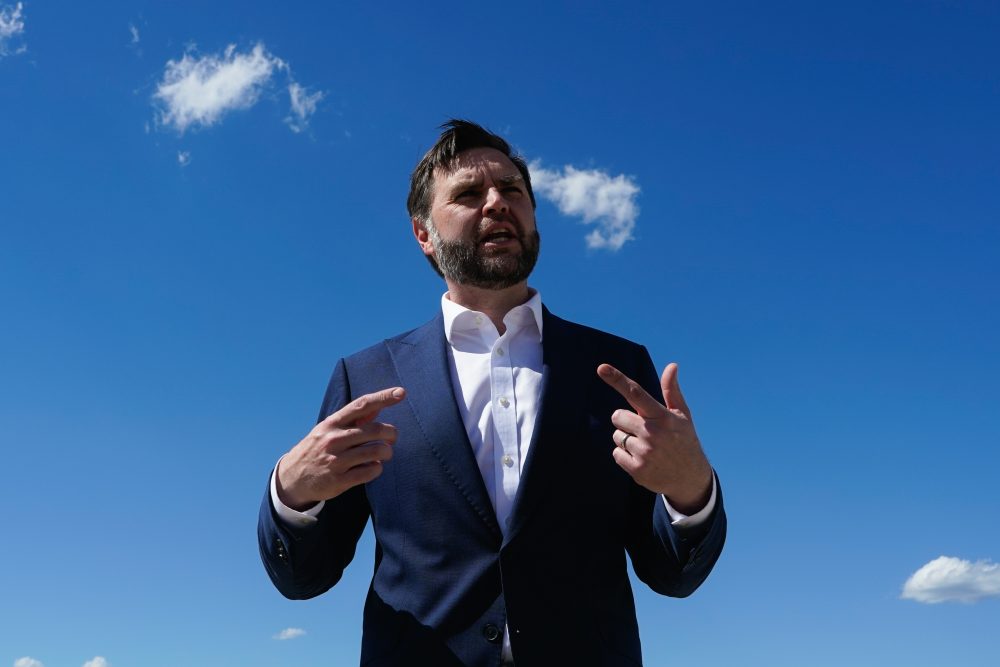

Vice President JD Vance touched down in Switzerland on Sunday to help formally open diplomatic talks with Iranian leaders focused on reining in Tehran’s nuclear ambitions and strengthening a shaky interim agreement to bring the conflict in Iran to a close.
A framework agreement was signed last week, and senior negotiators from both the United States and Iran are now working against a 60-day deadline to finalize the complex technical details — details that carry enormous weight for the global economy and international security.
The opening stretch of that two-month window has already been turbulent. Heavy fighting erupted in Lebanon between Israel and the Iranian-backed militant group Hezbollah, and Iran’s military announced it had shut down the Strait of Hormuz — the critical waterway through which roughly one-fifth of the world’s oil and natural gas supply passes.
Vance had originally been scheduled to arrive at the scenic Bürgenstock resort near Lucerne on Friday, but his departure from the United States was pushed back after the violence in Lebanon intensified and Iranian officials pulled out of their planned attendance at the talks.
U.S. Central Command pushed back on Iran’s assertion that the strait had been closed again, stating that American forces were actively monitoring the waterway to keep traffic moving. Vance noted that millions of barrels of oil have continued to flow through the strait in recent days.
The vice president left the U.S. shortly after Iranian state television reported that Tehran’s negotiating team had landed in Switzerland. Iran’s delegation includes parliamentary speaker Mohammad Bagher Qalibaf and Foreign Minister Abbas Araghchi, along with officials from the country’s central bank and oil sector.
Vance joins special envoy Steve Witkoff and Jared Kushner, President Donald Trump’s son-in-law, who were already on the ground working through the technical specifics of the nuclear agreement.
The broader negotiations will also involve Pakistani Prime Minister Shehbaz Sharif, army chief Field Marshal Asim Munir, and mediators from Qatar.
Although Vance indicated he planned to stay in Switzerland for only “a day or two” — leaving the bulk of the detailed work to Witkoff and Kushner — his participation has drawn increased attention, particularly as he is reportedly weighing a run for president in 2028.
Both Trump and Vance have faced sharp criticism from within their own Republican Party over the agreement, with hardline members drawing unflattering comparisons to a nuclear deal reached under the Obama administration — one that Trump and fellow Republicans have long argued failed to actually dismantle Iran’s nuclear capabilities.
The deal signed by Trump and Iranian President Masoud Pezeshkian immediately allows Iran to sell its oil on the open market and opens the door for Tehran to access billions of dollars in currently frozen assets. It also requires Iran to dilute its stockpile of highly enriched uranium, which is believed to be stored beneath nuclear facilities that were struck by U.S. airstrikes last summer.
Under the agreement, commercial ships may pass through the Strait of Hormuz for 60 days without being charged a fee — though the deal does not rule out Iran imposing tolls in the future. Trump himself threatened on Saturday to impose U.S. tolls on the strait if no deal is reached within 60 days, writing on social media that the funds would compensate for “services rendered as the Guardian Angel to the countries of the Middle East.”
Adding another layer of complexity, neither Israel nor Hezbollah are parties to the U.S.-Iran agreement. Israeli Prime Minister Benjamin Netanyahu has pledged to keep Israeli forces in southern Lebanon until all threats to Israel are eliminated, while Hezbollah has refused to stand down unless Israel commits to a full withdrawal from Lebanese territory.
In the days immediately following the U.S.-Iran agreement, clashes between Israeli forces and Hezbollah resulted in the deaths of 47 people in Lebanon and four Israeli soldiers.