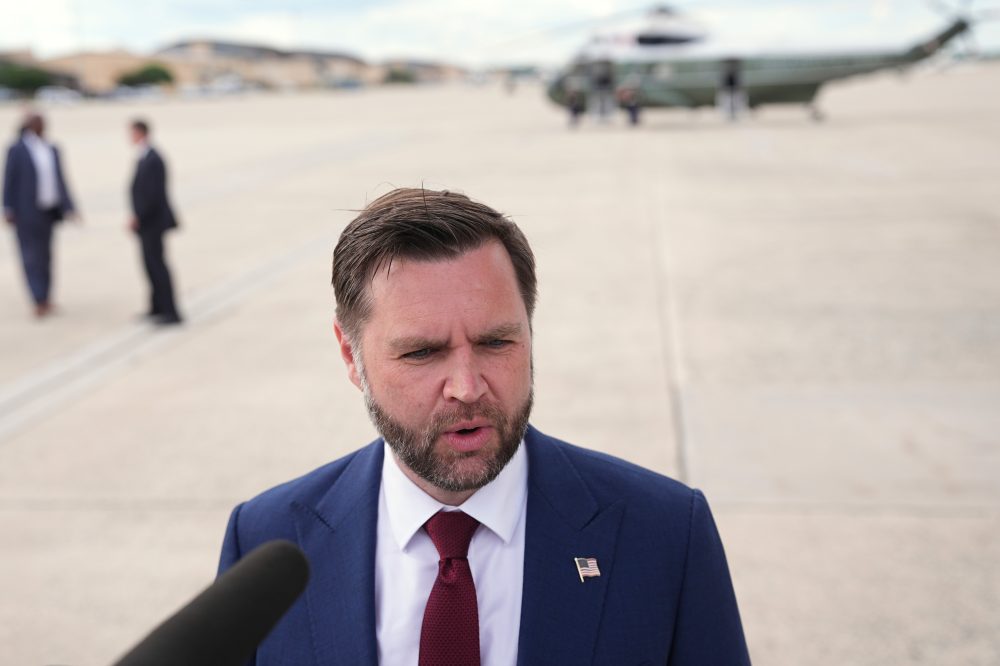

Vice President JD Vance, who converted to Catholicism and has made his faith a cornerstone of his adult life, has released a new book detailing his spiritual journey — one that many observers believe could lay the groundwork for a future run at the presidency.
Titled “Communion: Finding My Way Back to Faith,” the book went on sale Tuesday through Harper, and The Associated Press obtained a copy before its official release. The HarperCollins imprint previously published “Hillbilly Elegy,” Vance’s best-selling 2016 memoir that first brought him to national prominence.
Vance has been working on the new book intermittently ever since, across a decade that saw a Hollywood film adaptation of his life story, a brief term as a U.S. senator from Ohio, and ultimately his election as vice president alongside Donald Trump.
The book contains relatively little about Trump or behind-the-scenes political anecdotes. However, Vance does acknowledge regret over his past criticism of the Democratic Party’s “childless cat ladies” — a remark that resurfaced and created headaches for him during the campaign when he was Trump’s running mate.
At its core, “Communion” functions as a kind of argument for the importance of religion in public life. Vance traces his path from Protestant Christianity to atheism and eventually to Catholicism, saying his faith gave him a sense of purpose that neither his education at Yale University nor his career in finance had provided.
The book arrives less than five months before the midterm elections, which will shape the final two years of Trump’s second term and are widely expected to signal the unofficial start of the next presidential race — one in which Vance is considered a likely contender.
Vance described observing what he called “the fusion between Republican politics and the Christianity of my youth.” During that period, he wrote, “I heard a fair amount about the evils of abortion and homosexuality,” along with then-President Bill Clinton’s “rumored moral failings.”
He also said he felt he was “starting to witness the beginning of a fissure in the Republican Party: between its business elites and its religious rank and file” — a divide that, he wrote, would “eventually lead to my election as vice president.”
His grandmother — whom he refers to as his mamaw — was a defining presence in his life, and her death marked the beginning of his drift away from Christianity. “With her gone, no one really cared about my faith, and soon I stopped caring, too,” he wrote. Religion became “completely irrelevant” to him, even during his time serving in Iraq with the Marine Corps.
By the time his military service ended in 2006, Vance wrote that he “was no longer, in any real sense, a Christian.”
On his way back to base following his grandmother’s funeral, Vance recounted losing control of his vehicle on a wet road, only to stop inexplicably before crashing into a guardrail and potentially plunging off a mountainside. He described it as “the closest I’ve ever come to a supernatural experience,” a feeling that stayed with him even through what he called his “later years as a strident atheist.”
As his military career wound down, a fellow servicemember introduced him to the writings of author Ayn Rand, whose philosophy of selfishness as a virtue stood “in as stark opposition to Christian morality as anything I’d ever read.” Vance said Rand’s ideas “filled a void left by the faith I’d discarded” and that he became a “self-professed atheist and meritocrat.” “I didn’t care about God’s will,” he wrote. “I cared about my own.”
Vance wrote that he was immediately captivated by the woman who would become his wife, Usha Vance, telling a friend while the two were in law school that he thought he was “obsessed” with her. He praised her sharpness, intellect, and curiosity. “I will marry this girl,” he wrote. “Or I will be a lifelong bachelor.”
The couple’s differing views on the afterlife emerged through a conversation sparked by Joan Didion’s “The Year of Magical Thinking.” Vance wrote that his wife, like Didion, didn’t fear the loss of heaven or the pains of hell simply because she didn’t believe they existed. “I came to believe in both, but I still didn’t find either particularly motivating,” he wrote.
Around the same time, Vance attended a lecture by Peter Thiel, a Silicon Valley investor who would later become one of his early political supporters. He was struck by Thiel’s views on intense professional competition paired with what Thiel described as “technological stagnation.” Vance called Thiel “possibly the smartest person I’d ever met” and noted that Thiel openly identified as a Christian, which challenged Vance’s assumption “that dumb people were religious and smart people were atheists.”
Vance said he was initially doubtful his first book would find an audience, but an interview he gave in the summer of 2016 about how working-class Americans felt abandoned by their country’s leaders caught on quickly, aligning with Trump’s campaign message that year. “I became a controversial figure in my own right, and I tasted my first bit of heated public criticism,” he wrote.
In 2018, Vance visited a French cathedral with his wife and their young son, Ewan. Reflecting on the Catholic Church’s centuries of endurance, he felt his resistance to religion beginning to soften. He described feeling “a distinct sense of belonging and presence.” He was baptized the following year, writing that he appreciated the “work” involved in becoming Catholic — including readings and in-depth discussions.
When it came to being selected as Trump’s running mate, Vance wrote that he considered it a “long shot.” “When his staff told me I was on the short list, I almost thought it was a prank call,” he wrote. He described the in-person vetting interview as the most memorable part of the process, including being asked whether he had ever been unfaithful to his wife. “I haven’t, but I assume people who have don’t just admit it to a stranger?” he replied.
The campaign transition was hard on his family, he wrote, especially his oldest child. He shared that struggle with Charlie Kirk, the young conservative activist who founded Turning Point USA and was assassinated last year. Kirk’s advice: “Don’t try to convince your son it’s not a sacrifice.”
The “childless cat ladies” remark, originally made in 2021, came back to haunt Vance during the campaign. He now calls the comment “boneheaded” and “one of the dumbest things I ever said.” “Aside from enraging a great number of people,” Vance added, “it had the added benefit of distracting from the actual point I wanted to make, which was that our society is becoming pathologically hostile to having kids.”
The release of “Communion” is widely seen as fueling speculation about a 2028 presidential bid. Vance has said he is not focused on that possibility at the moment and has suggested he would wait until after the 2026 midterm elections before making any decision. Presidential hopefuls frequently publish books ahead of campaigns as a way to build visibility and sharpen their message. Several potential 2028 Democratic candidates have recently published or are preparing to release books of their own, including Kentucky Gov. Andy Beshear, Pennsylvania Gov. Josh Shapiro, California Gov. Gavin Newsom, and former Vice President Kamala Harris.