
RICHMOND—Agricultural producers from across Virginia made their voices heard at the state capitol as they gathered to discuss critical farming issues with elected officials.
The Virginia Farm Bureau Federation hosted its yearly Legislative Day, bringing together more than 100 farmers to share how pending legislation could affect their operations and local communities.
The discussions encompassed numerous agricultural concerns, such as state cost-share program funding, preserving minimum wage and overtime exemptions for agricultural workers, regulations for utility-scale solar installations, proper food labeling requirements, pesticide regulations, and addressing the shortage of large animal veterinarians.
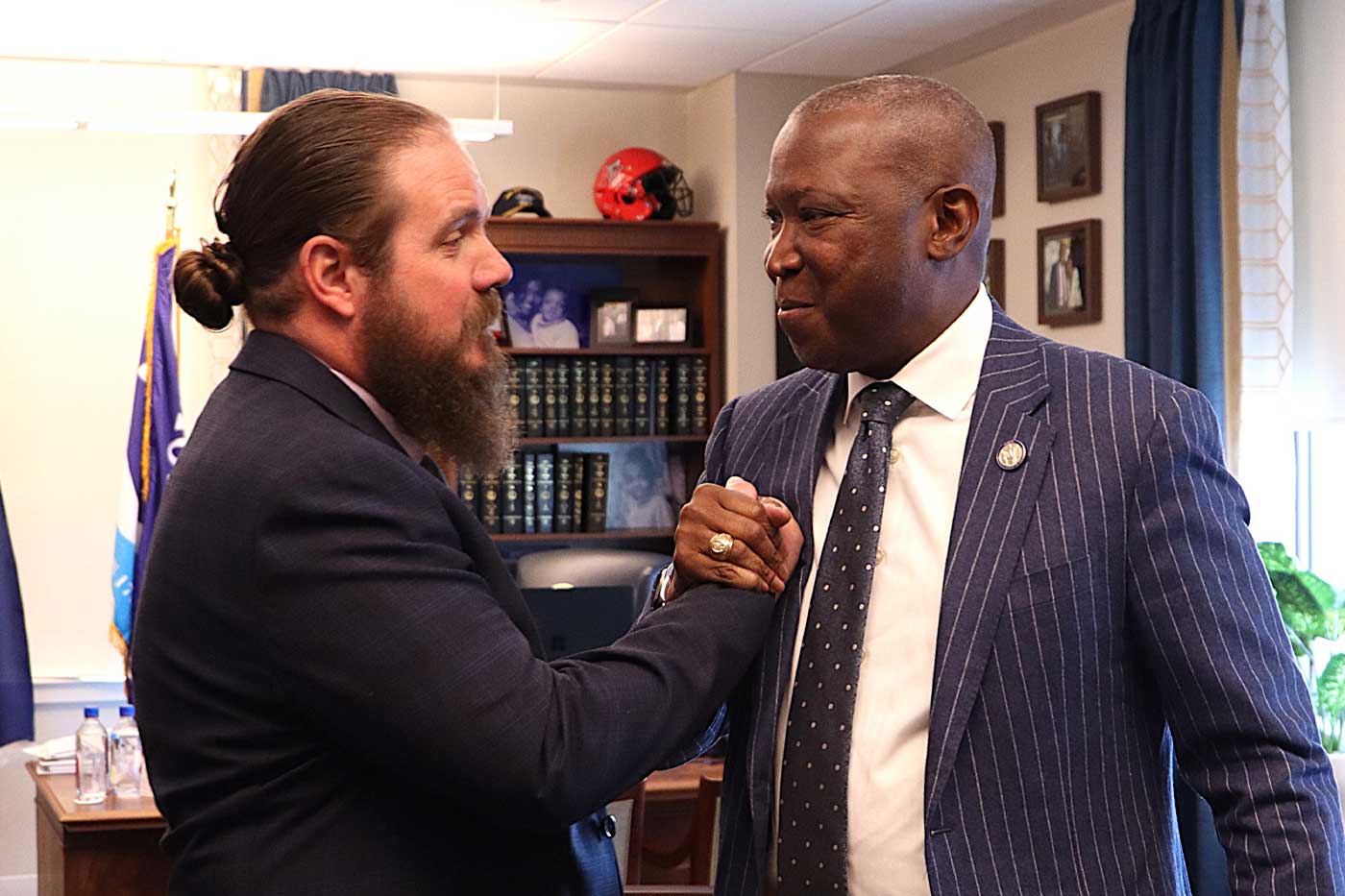
In their meeting with Lt. Gov. Hashmi, agricultural producers expressed backing for HB 508 and SB 340, bills that would establish a definition of agrivoltaics emphasizing farming as the primary use, with solar panels serving as an additional element of the agricultural business.
This definition ensures that agrivoltaics systems “work in conjunction with an operating farm that benefits both the farm and other users on the power grid,” explained Coty Goodwin, who raises beef cattle in Orange County.
Agricultural producers also emphasized the need to maintain local control over solar installation decisions and warned against implementing uniform statewide regulations.
“The best decisions are made at the local county board of supervisors where we can sit down and look at each unique situation,” Goodwin stated. “We don’t want our localities to lose the power of making their own siting decisions.”
The Farm Bureau backs HB 322 and SB 186, legislation requiring accurate labeling of alternative protein products to clearly indicate their source and ingredient composition.
Improper labeling “causes so much confusion at the grocery store,” noted Cecilia Moyer, who operates a dairy farm in Amelia County. “It’s very important to have clear labels so consumers know what they’re buying.”
The Senate version of the labeling bill received unanimous approval.
Agricultural producers from southern Virginia discussed labor issues and crop protection chemicals with Aaron Yohai, who serves as legislative aide to Del. Vivian Watts, D-Fairfax. They expressed opposition to HB 1375, legislation that would prohibit the production and distribution of paraquat, an essential herbicide for corn, cotton, soybean and peanut cultivation.
Pittsylvania County farmer Donny Moore pointed out that pesticide users must already undergo training for proper application. A complete prohibition would create additional challenges for crop producers because “right now there’s nothing else in our tool bag to take its place.”
VFBF board member Robert J. Mills Jr. and farmers from Loudoun County spoke with Sen. Kannan Srinivasan, D-Loudoun, and Syreeta Martin-Glenn, legislative assistant for Sen. Jennifer Carroll Foy, D-Fairfax and Prince William. Their conversation focused on HB 20 and SB 121, which would remove minimum wage exemptions for agricultural workers, and highlighted the financial burden this would place on farming operations.
The Farm Bureau seeks to exclude H-2A and H-2B worker programs from the proposed legislation. Mills observed that farmers provide housing and transportation under these programs, effectively raising compensation above minimum wage levels.
“Virginia is the only state in our region that’s taking out the minimum wage exemption,” Mills said. “Our margins are already so thin and this would put us at a competitive disadvantage to surrounding states that do have these exemptions.”
Throughout the morning, lawmakers received complimentary snack packages featuring Virginia-produced, value-added farm products.
Those interested in following agriculture-related legislation can visit the VFBF Plows and Politics blog.
For media inquiries, contact Martha Moore, VFBF senior vice president of governmental relations, at 804-347-5752.