
A veteran correspondent for The Associated Press who documented the fall of an authoritarian government and the rise of democratic rule during a turbulent era in the Philippines has passed away, according to his family. He was 82 years old.
The journalist died Sunday at a care facility in Kapolei, Hawaii, according to his wife, Leonor Briscoe. He had been battling amyloidosis since an April diagnosis, a condition where protein accumulation can cause damage to organs.
Throughout a distinguished career that took him across multiple decades and countries, the reporter applied his investigative instincts from his home state of Utah to the nation’s capital and eventually Hawaii. However, it was his position in Manila that placed him at the heart of his most significant assignment.
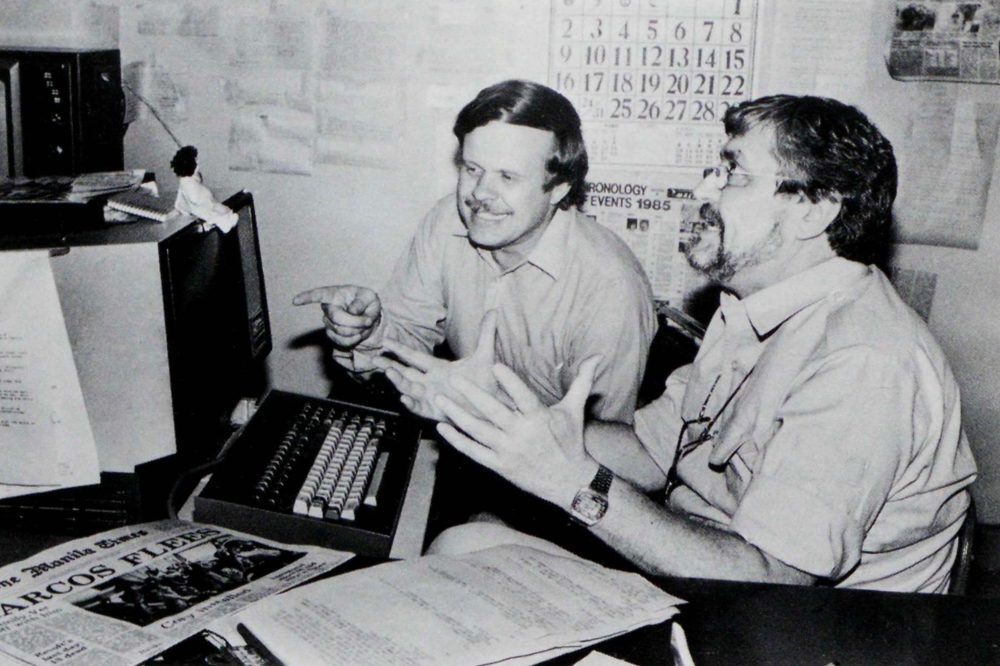
When he assumed leadership of the bureau in 1980, the correspondent documented the final years of Ferdinand Marcos’ dictatorial rule and the chaos that followed the murder of opposition figure Benigno Aquino Jr. Along with his team, he traveled throughout the nation using chartered aircraft, rental vehicles and on one occasion, a cart pulled by horses. Their work encompassed an intensive period of probes, official proceedings and an election campaign so unlikely it appeared fictional, featuring a hesitant widow propelled by circumstances to lead a democracy movement.
The dramatic finale, which saw Corazon Aquino rise to power while Marcos fled the country, left a lasting impression on the reporter. He remembered vivid scenes “of nuns kneeling in front of military tanks” and “soldiers and civilians crying in each other’s arms.”
“I expect to witness or cover no greater event in my life,” he wrote in AP World, an in-house magazine, in 1986, recounting his coverage of the upheaval.
Born July 30, 1943, in Salt Lake City, Utah, he was the son of a labor organizer and a stay-at-home mother who brought up her two boys in the Church of Jesus Christ of Latter-day Saints. His passion for reporting developed at the University of Utah, where he contributed to the campus publication before landing a position at the Deseret News, handling death notices and profiles of exceptional local students.
Following a two-year stint at the paper, he enlisted in the Peace Corps and was stationed in Paracale, then Naga City, in the Philippines, teaching English. For someone who had barely ventured beyond Utah during his early years, each new experience felt like a discovery, from water buffalo emerging from mud pools to youngsters racing along unpaved streets.
He fell in love with his adopted country. When his Peace Corps service concluded, the idea of departing troubled him deeply. He secured employment with a regional publication, and while covering an event where Marcos was scheduled to appear, he encountered the former Leonor Aureus, who edited a competing newspaper. The couple soon married in a ceremony where they decorated the aisle with editions of The Naga Times and the Bicol Mail.
The AP brought him aboard in Manila in 1970, where he reported on a devastating earthquake that struck the capital, an attack on Pope Paul VI and an aircraft hijacking. However, by the following year, AP required him to work stateside. He relocated to Salt Lake, hoping circumstances might eventually return him to the Philippines.
Back in his birthplace, his relationship with his religious community began to deteriorate. His spouse recalls he faced church discipline after addressing the organization’s prohibition against Black men serving in its priesthood during a class he led. He opposed this policy. The church subsequently removed the restriction.
He also clashed with the church regarding a three-part investigation he co-authored with colleague Bill Beecham, exploring the organization’s complex business operations and member donations that the reporters calculated exceeded $1 billion annually. No Utah publication would publish their findings, according to the writing team.
After nine years in Salt Lake, his supervisors offered him the opportunity to return to Manila as bureau chief. He immediately called his wife with the announcement.
“Noree, are you sitting down?” she recalled him asking.
Following his six-year tenure leading the AP’s Philippines operation, he transferred to Washington in 1986, concentrating on global affairs. He served as bureau chief in Honolulu from 2001 until his 2009 retirement.
In Hawaii, wearing tropical shirts under the island sun, he could once again call a Pacific island his home. He described feeling “halfway back.”
Until his final moments, he treasured his Philippine years. As death approached, his loved ones surrounded him in prayer. He clasped his wife’s hand, expressed his love, and asked her to release him.
The family intends to charter a vessel and spread his ashes in Pacific waters, hoping ocean currents will carry his remains to his chosen homeland.
“The land that David learned to love,” his wife said, “and where he met the love of his life.”