
WASHINGTON/LUCERNE, Switzerland — Vice President JD Vance is stepping into the most prominent international role of his career, serving as President Donald Trump’s lead negotiator in efforts to bring a lasting end to the three-month war with Iran — a position that could significantly influence his chances of one day occupying the Oval Office.
The United States and Iran reached a provisional peace agreement on Wednesday, halting active fighting but leaving several critical issues unresolved. Key questions surrounding Iran’s nuclear program, its backing of regional militant groups, and the strategically important Strait of Hormuz have been pushed to a 60-day negotiating window.
The stakes are enormous — for both sides in the conflict, for the wider Middle East, and for Vance’s own political future. Adding to the uncertainty, Vance cancelled a scheduled Thursday evening flight to Switzerland, where talks were set to begin. The White House said the U.S. delegation remains “prepared to depart at the first available opportunity.”
These rapidly unfolding events are happening at the same time Vance is promoting his new book, “Communion,” about his conversion to Catholicism. During his media appearances to discuss the book, he has also been positioning himself as the strongest advocate for the Iran agreement.
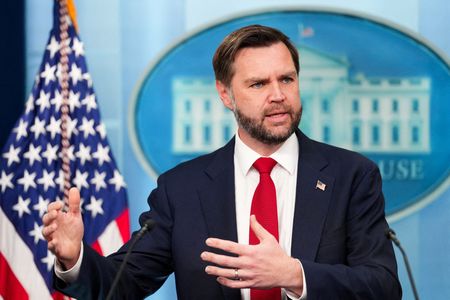
That push reached a high point Thursday at a White House news conference, where Vance outlined American hopes for a permanent peace deal and delivered what some observers described as one of the most pointed criticisms of Israel ever made by a senior U.S. official. He also brushed aside a question about whether he intends to run for president.
“If the Iranians don’t change their behavior, their military and their nuclear program is still destroyed,” Vance said. “If they do change their behavior, then they are going to have a transformative relationship with the Middle East, and the Middle East will have a transformative relationship with the people of Iran.”
Other Republicans have taken note of Vance’s elevated profile in the negotiations. Senator Lindsey Graham of South Carolina, a prominent voice on foreign policy within the party, referred to Vance as the “architect” of the peace agreement and said the vice president should bring any final deal before the Senate for a vote.
President Trump made light of the situation Wednesday, suggesting the arrangement put Vance in a tough spot politically.
“If it works out, I’m going to take the credit. If it doesn’t work out, I’m blaming JD!” Trump said with a laugh during a news conference at the G7 summit in Evian-les-Bains, France.
Representatives from Vance’s office declined to comment for this report.
Trump came into office promising to bring down costs for Americans and avoid prolonged military engagements in the Middle East. However, inflation has picked up pace, and he ordered strikes against Iran on February 28. Some of his Republican allies have accused Trump of making too many concessions to Iran in order to ease the economic strain caused by the conflict.
While Trump has characterized the provisional ceasefire as a complete military and diplomatic win, the current situation appears to fall short of his stated goals at the start of the war. Iran’s government remains in power, the country still holds ballistic missiles and a supply of highly enriched uranium, and it continues to support anti-Israel armed groups including Hezbollah in Lebanon.
Vance has found himself in the delicate position of defending the president’s choices while also trying to avoid being dragged down by Trump’s declining approval numbers. He has pointed to modest economic progress while acknowledging that “there’s a lot more work to do.”
“Have a little bit of faith in the president of the United States. The idea that he is going to strike a deal that’s bad for the American people, it’s preposterous,” Vance said Thursday.
Earlier in the week, speaking with conservative media host Megyn Kelly, Vance said stepping away from the Iran effort would be “a very immature way to approach the political process.” He also took aim at hawkish conservatives, accusing them of wanting to continue U.S. military strikes “until every bomb has been dropped, or until every Iranian is dead.”
Vance has consistently urged restraint and pushed for a diplomatic resolution, and he has emerged as a leading figure in a growing wing of the Republican Party that wants to pull back from large-scale U.S. military operations abroad.
Not everyone is supportive of his approach. Right-wing media figure Ben Shapiro said Thursday on Fox News: “In my opinion, the vice president — the chief negotiator on this project — has not well served the president.”
Trump’s decision to make Vance the public face of the agreement — rather than Secretary of State Marco Rubio, who traditionally serves as the nation’s top diplomat — has raised questions among administration allies about Rubio’s role in the process. A White House official, speaking anonymously to discuss internal conversations, said no one on Trump’s team objected to the provisional peace deal.
Rubio is also considered a potential candidate for the 2028 Republican presidential nomination, though neither he nor Vance has publicly stated plans to seek the presidency.
One person close to the White House, speaking on condition of anonymity, said Trump’s approach of rotating the spotlight among cabinet members is consistent with how he has managed his team throughout his second term.
“This back and forth is throwing people off, but Trump knows what he’s doing,” the person said. “He is literally conducting a tryout in real time.”
Throughout all of this, Vance has found ways to weave promotion of his book into nearly every media appearance, often with a sense of humor about it. When pressed on topics ranging from Iran to immigration to civil rights during an appearance on ABC’s “The View” on Tuesday, he quipped: “Let’s talk about the book — I’m here to sell books.”