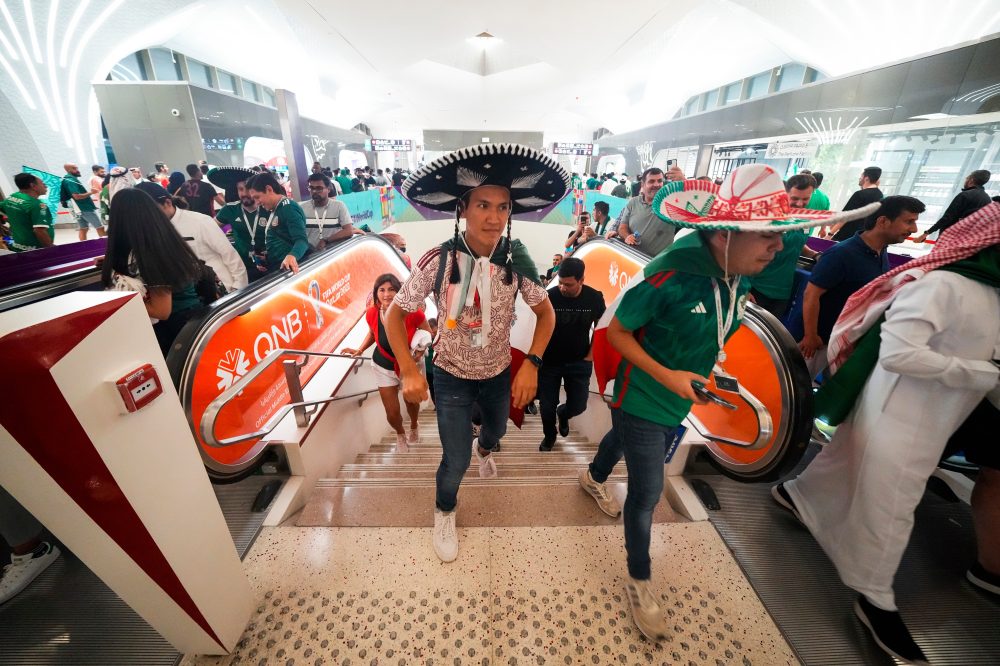

Known as the “Sommermärchen” or “Summer Fairy Tale,” Germany’s 2006 World Cup earned widespread acclaim as a celebration of a modern, unified country that welcomed international visitors. A key element of that achievement was the “KombiTicket,” which provided fans with complimentary local public transit access during game days.
Following that example, subsequent World Cup hosting nations have made substantial investments in fan transportation, particularly Russia in 2018, where even intercity rail travel between venues was provided at no charge, and Qatar in 2022, where complimentary subway access transformed venue-hopping into an integral tournament feature.
Now comes America’s turn.
Soccer supporters, already struggling with sky-high ticket costs, pricey airfare and steep hotel rates, have expressed anger upon learning that rail transportation to certain venues will carry another substantial expense: $98 for round-trip train travel in New Jersey and $80 in Massachusetts — journeys that typically cost NFL attendees $12.90 and $20, respectively.
Authorities maintain they’re not attempting to exploit supporters, but rather seeking to offset security expenses and enhanced rail operations without burdening taxpayers. However, fans view this as yet another financial burden placed on supporters who are already spending enormous amounts to visit America, a vast, automobile-dependent nation where mass transit has historically been neglected in numerous areas. Unlike previous host nations, certain state and local leaders have shown less willingness to absorb these expenses, contending that FIFA, the global soccer organization expected to generate billions from the tournament, should cover them.
“Planning for this World Cup has been a nightmare from start to finish,” said Scotland-born Rory Phillips-Hunter, a 37-year-old hospitality worker who lives in northern England. “I think it’s the most inaccessible one there’s ever been.”
Confused by the absence of reasonably priced travel options for the 25-mile (40-kilometer) journey from Providence, Rhode Island, to Foxborough, Massachusetts, where Scotland’s opening two games will occur, Phillips-Hunter and fellow Tartan Army supporters chose to arrange their own solution.
For approximately $50 per person, the Scottish fans have reserved roughly 20 school buses to transport nearly 1,000 members of their plaid-wearing supporter group to each game. They’re even receiving police escort services, all for slightly more than half the price of the $95 bus service that local authorities are providing — creating combined savings exceeding $85,000.
Phillips-Hunter acknowledges the $95 bus cost wouldn’t financially ruin him, but he and countless other Scottish supporters are already spending massive amounts to watch their men’s national team participate in the World Cup for the first time in 28 years. Phillips-Hunter calculates it will require two years to pay off the credit card debt he’s accumulating for his six-day American visit, including the $1,350 he paid for his Scotland-Morocco game ticket.
Above all else, Phillips-Hunter feels frustrated that a group of Scots from across the Atlantic managed to arrange transportation for significantly less than what local authorities proposed.
“When I look at that difference in cost, that’s just profits you’re taking from us,” he said.
Host cities aren’t all handling transportation identically. Atlanta, Houston and Seattle feature stadiums connected directly to rail networks, where standard ticket prices will be charged. Miami-Dade County leaders recently revealed they will provide complimentary shuttle services between Hard Rock Stadium in Miami Gardens and locations about 15 miles (24 kilometers) from downtown Miami. Philadelphia, meanwhile, offers free return trips from the venue, funded by FIFA sponsor Airbnb. Kansas City, Missouri, operates $15 shuttle services.
The comparatively expensive transit fees for games at MetLife Stadium in New Jersey and Gillette Stadium in Massachusetts stem partly from their suburban locations, where most fans typically drive to NFL contests they usually host. However, parking will be severely restricted during the World Cup due to expanded security zones, broadcasting requirements and lots designated for VIP use, compelling many more supporters to rely on public transportation.
David Gogishvili serves as a senior researcher at Switzerland’s University of Lausanne and examines how sports organizers coordinate major events like the World Cup.
He explained it’s typical procedure for organizers like FIFA to transfer much of the expense to host nations. The distinction this time involves the U.S. having “stronger and more independent” state and local leaders who have shown less willingness to accept the cost and “bow to the wills of FIFA.”
“These costs should be borne by the organization that is earning money out of these events, which is FIFA. It should not always be the host cities that take on all the expenses,” Gogishvili said, referencing the soccer organization’s anticipated $13 billion revenue from 2023-26.
New Jersey Gov. Mikie Sherrill, a Democrat, has called on FIFA to cover the transportation costs to matches.
However, FIFA responded by arguing that no other international event has been required to absorb such expenses and that its original agreements with host cities required free fan transportation to all games. The contracts were subsequently modified to permit cities to offer transit “at cost.”
Transportation has been so accessible at recent World Cups because host countries like Russia and Qatar treated the tournament as a “public relations exercise,” subsidizing transit costs accordingly, Gogishvili explained.
Leaders’ concerns about transit expenses also emerge amid increasing worry that the anticipated World Cup economic benefits won’t occur, with hotel reservations falling short of projections in most of the 11 American cities hosting tournament games. A 2022 study co-authored by Gogishvili discovered that nearly every World Cup from 1966 through 2018 operated at a financial loss.
Yonah Freemark, a researcher at the Washington-based Urban Institute think tank who specializes in transit issues, said World Cup fans from Europe and Asia will encounter less-developed but more expensive transit networks than they experience at home.
Referencing the transit costs associated with games in New Jersey and Massachusetts, Freemark said officials “are trying to get away with murder.” Delays and transit availability, he noted, will probably disappoint many international visitors.
Ynara Correa da Costa, a Brazilian systems analyst who lives outside Sao Paulo, will be attending her seventh World Cup.
Like many others, she was shocked when authorities initially suggested charging up to $150 for train travel from New York City to MetLife Stadium, where Brazil opens against Morocco. The widespread outrage prompted New Jersey officials to reduce the fare to $98 after obtaining additional funding.
But even the reduced cost for a brief train journey “is just not acceptable,” Costa said.
Costa felt encouraged when the local host committee announced it had obtained more buses for stadium transportation and cut the price from $80 to $20. However, only enough bus capacity exists for 18,000 supporters to reach the stadium, which accommodates approximately 82,500.
That appears much more reasonable to Costa. Previously, she questioned whether she and other budget-minded fans might need to walk to MetLife Stadium, but that option isn’t feasible.
“We’ll go to the match, that I know,” Costa said. “But how? Let’s see.”