
GENEVA (AP) — American and Iranian representatives are scheduled to conduct their second diplomatic meeting Tuesday in Geneva regarding Tehran’s nuclear activities, occurring while Washington increases its military footprint across the Middle East and Iran conducts extensive naval drills.
President Donald Trump has made repeated threats about using military action to force Iran into accepting restrictions on its nuclear development. Tehran has indicated it would retaliate with its own strikes. Trump has also issued warnings to Iran concerning its violent suppression of recent nationwide demonstrations.
The initial diplomatic session took place February 6 in Oman, located on the Arabian Peninsula’s eastern coast, and involved indirect communication. Vehicles bearing American flags arrived at the palace location only after Iranian representatives appeared to have departed. Details about Tuesday’s negotiation format remain unclear.
Trump’s representatives Steve Witkoff and Jared Kushner are making the trip for these latest discussions. During a visit to Budapest, Hungary on Monday, Secretary of State Marco Rubio expressed optimism about reaching an agreement with Iran despite existing challenges. “I’m not going to prejudge these talks,” Rubio stated. “The president always prefers peaceful outcomes and negotiated outcomes to things.”
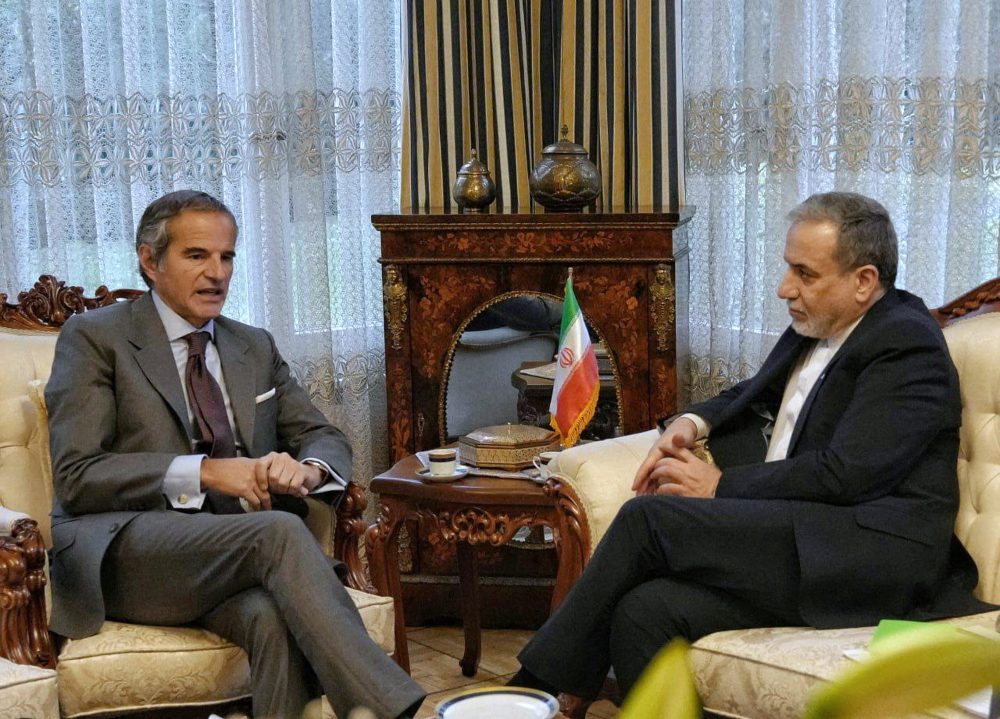
Iran’s Foreign Minister Abbas Araghchi, serving as Tehran’s lead negotiator, conducted a meeting Monday in Geneva with the director of the U.N. nuclear monitoring organization.
“I am in Geneva with real ideas to achieve a fair and equitable deal,” Araghchi posted on X. “What is not on the table: submission before threats.”
During the previous week, a senior Iranian security representative visited Oman for discussions with Foreign Minister Badr al-Busaidi, the primary mediator facilitating these negotiations. Their meeting likely centered on updates from the initial session and planning future steps.
“Regional peace and security is our priority, and we urge restraint and wise compromise,” al-Busaidi posted on X following his discussion with Ali Larijani, Iran’s former parliamentary leader who currently heads the Supreme National Security Council.
Iran has historically delivered its positions through written communication when engaging with American officials. Notably, in 2019, Japan’s then-Prime Minister Shinzo Abe attempted to deliver a letter from Trump to Iranian Supreme Leader Ayatollah Ali Khamenei, who declined to accept it.
Iran declared that its paramilitary Revolutionary Guard began military exercises early Monday in the Strait of Hormuz, Persian Gulf, and Gulf of Oman. These strategic waterways serve as vital international shipping lanes, handling approximately 20% of global oil transportation.
Additionally, EOS Risk Group reported that maritime personnel in the area received radio notifications warning of potential live-fire exercises Tuesday in the northern section of the Strait of Hormuz within Iranian waters. Iranian state television did not confirm the live-fire component.
This marked Iran’s second recent announcement regarding live-fire military drills.
Trump announced last week that the USS Gerald R. Ford, the globe’s largest aircraft carrier, would redeploy from the Caribbean to the Middle East, joining existing American naval forces in the region.
The Ford, whose deployment was initially reported by The New York Times, will operate alongside the USS Abraham Lincoln and its escort destroyers, which have maintained regional presence for more than two weeks. American forces recently destroyed an Iranian drone approaching the Lincoln, coinciding with Iran’s attempt to intercept a U.S.-flagged vessel in the Strait of Hormuz.
Persian Gulf Arab states have cautioned that any military confrontation could escalate into broader regional warfare in a Middle East still recovering from the Gaza Strip conflict between Israel and Hamas.
The Trump administration seeks an agreement restricting Iran’s nuclear capabilities while preventing weapons development. Iran maintains it is not pursuing weaponization and has resisted demands to cease uranium enrichment or surrender its uranium stockpiles.
Iran’s Deputy Foreign Minister Majid Takht-Ravanchi indicated Tehran’s potential willingness to negotiate nuclear compromises in exchange for relief from U.S.-led international sanctions.
“The ball is in America’s court. They have to prove they want to have a deal with us,” Takht-Ravanchi told the BBC Sunday. “If we see a sincerity on their part, I am sure that we will be on a road to have an agreement.”
“We are ready to discuss this and other issues related to our program provided that they are also ready to talk about the sanctions,” he continued.
American-Iranian negotiations were ongoing for several months before Israel’s 12-day military campaign against Iran in June immediately suspended the diplomatic process. During that conflict, U.S. forces struck Iranian nuclear facilities, likely eliminating numerous centrifuges used for uranium enrichment to near-weapons-grade levels. Israeli attacks also severely damaged Iran’s air defense systems and targeted its ballistic missile capabilities.
Iran continues asserting its nuclear program serves civilian purposes only. Prior to the June conflict, Iran had been processing uranium to 60% purity, approaching the technical threshold for weapons-grade material.