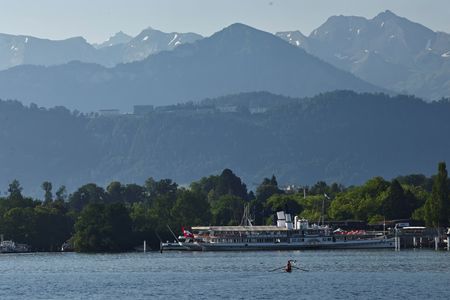

Hopes for a lasting peace agreement between the United States and Iran took a hit Friday after Switzerland announced that scheduled talks between the two nations would not go forward as planned, and Vice President JD Vance canceled his trip to the Swiss resort of Burgenstock where the negotiations were to be held.
“The logistics of these negotiations have never been simple or predictable,” a White House spokesperson said in a statement Thursday.
Vance and the American delegation had been prepared to leave for Switzerland as soon as final arrangements were confirmed. The Swiss foreign ministry confirmed the postponement in a statement, adding that Switzerland remains willing to host the discussions and that preparatory work at Burgenstock is ongoing.
Iran, which had signaled its readiness to begin technical discussions following Wednesday’s 14-point accord that extended a shaky ceasefire by at least 60 days, did not immediately respond to the news. Before the U.S. announcement, Iran’s semi-official Tasnim news agency reported that Iranian negotiators first needed to see evidence that the U.S. was following through on the interim deal before any delegation would head to Switzerland.
U.S. officials had spoken of holding a formal signing ceremony for the agreement in Switzerland, but Iran’s foreign ministry pushed back on that idea, calling it unnecessary since both nations’ presidents had already signed the pact.
The conflict, which erupted on February 28 when the U.S. and Israel launched air strikes against Iran, has now claimed at least 7,000 lives, driven energy prices sharply higher, and rattled financial markets worldwide.
Israel, which was not included in the peace negotiations, has kept its distance from the U.S.-Iran agreement and continued its military operations against the Iranian-backed Hezbollah militant group in Lebanon — adding further uncertainty about whether the deal will hold.
Back in Washington, some Republican allies of President Donald Trump in Congress have raised concerns that he gave away too much to bring the conflict to a close, particularly with mid-term elections approaching in November and the war broadly unpopular among Americans.
Trump had vowed as recently as March to end the war only through Iran’s “UNCONDITIONAL SURRENDER.” However, the memorandum ultimately signed with Iran offers sanctions relief, unfreezes tens of billions of dollars in Iranian assets, and grants immediate U.S. waivers allowing Iran to export oil.
Iran’s Supreme Leader Ayatollah Mojtaba Khamenei said Trump had agreed to the deal “out of desperation” and warned that upcoming talks over Iran’s nuclear program — one of Trump’s stated justifications for the war — would not be straightforward. “If the American side wants to be too demanding, we will not accept it,” Khamenei said.
Iran’s Supreme National Security Council also pledged to respond in kind to any violation by what it called the “untrustworthy” American side, saying it would show “no leniency” until Iran’s full rights were secured.
The agreement gives negotiators 60 days to reach a decision on Iran’s nuclear program, with the possibility of an extension, and establishes a $300 billion reconstruction fund for Iran along with other financial incentives. Vance indicated the U.S. would also push to place limits on Iran’s long-range missile capabilities.
The mounting financial toll of the war also drew attention this week, with the U.S. defense department reportedly telling lawmakers it needed $80 billion to cover war costs and other expenses, according to the Wall Street Journal.
When the U.S. and Israel launched the war nearly four months ago, Trump stated his goals included dismantling Iran’s nuclear capabilities to prevent it from ever building such weapons. He also aimed to eliminate Tehran’s ability to threaten neighboring countries, cut off its support for anti-Israel militant groups in the region, and create conditions for Iranians to overthrow their theocratic government.
None of those objectives had been achieved when Trump put his signature on the agreement. In the deal, Iran restated its long-standing position — held for decades — that it does not seek to build or acquire nuclear weapons, a claim that multiple U.S. administrations have doubted. Iran also agreed to on-site “down blending” of its highly enriched uranium and inspections by the International Atomic Energy Agency as a member of the Non-Proliferation Treaty, but rejected Trump’s demand that the material be removed from the country.
U.S. officials maintain that ongoing negotiations could still produce a strong agreement on Iran’s nuclear program, potentially surpassing a 2015 deal between Iran, the U.S., and other nations that Trump abandoned during his first term in office. Critics, however, argue that Iran now holds a stronger hand — having survived an attack by a superpower, demonstrated its control over the Strait of Hormuz, and secured valuable financial concessions.
Iran has stated it will continue to exercise control over the Strait of Hormuz in partnership with neighboring Oman, and plans to charge ships service fees that did not exist before the war — though not during the 60-day negotiating period. Oil prices edged lower Friday as tankers began moving again through the reopening strait, which before the war had carried nearly one-fifth of the world’s crude oil and liquefied natural gas supplies.
In Lebanon, where more than a million people have been displaced by the ongoing conflict, fresh Israeli airstrikes on Friday killed at least 18 people, according to the state news agency NNA. Israel said the strikes were aimed at Hezbollah targets. The continued fighting raised questions about how far Trump is willing to go to pressure his wartime ally to stand down from an offensive he has now pledged to end.
While the agreement calls for the “permanent termination” of the war in Lebanon, Israel has said it has no plans to withdraw, and has instead released a new map depicting an expanded occupation zone. Trump has grown increasingly critical of Israel’s operations in Lebanon, creating one of the most significant rifts between the two countries in decades.