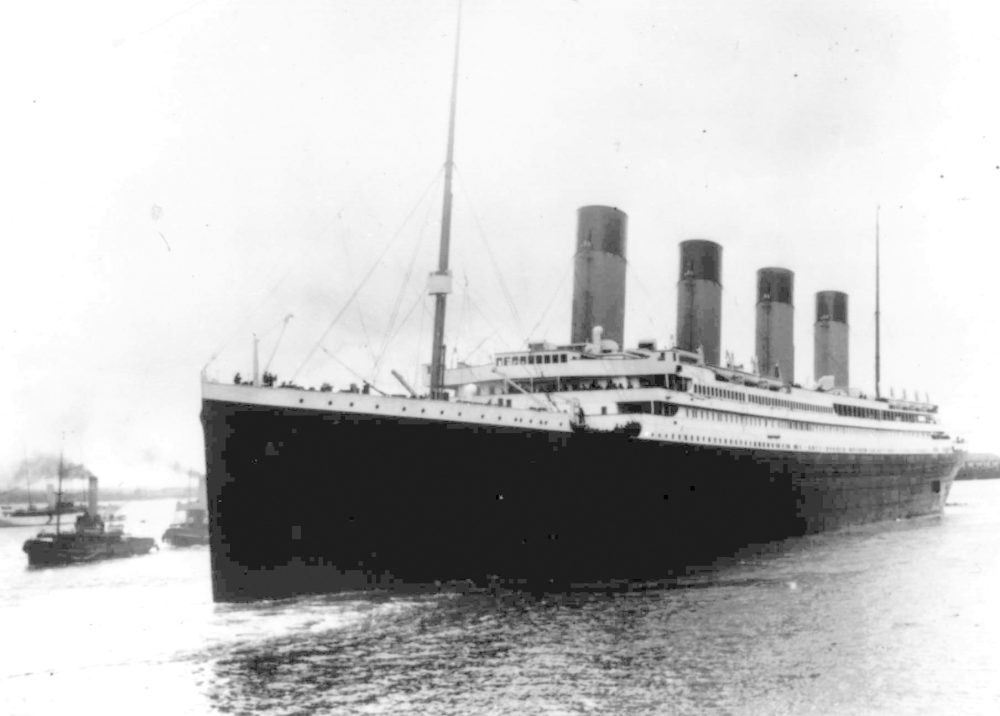

Newly unsealed court documents show the U.S. government is opposing a proposal to put more than 100 artifacts recovered from the Titanic wreck up for auction — items that include personal belongings, currency, kitchen goods, and decorative pieces.
RMS Titanic Inc., a Georgia-based company that holds exclusive rights to salvage the famous North Atlantic wreck, is seeking to sell the items for the first time. This would mark a significant departure from prior agreements that limited the artifacts to museum displays and traveling exhibitions.
The company has proposed auctioning the pieces while also featuring them on a world tour across four cities, though those locations have not been made public. Court filings reference specific items slated for potential sale, including a bronze cherub, a necklace made of gold nuggets, and a heart-shaped pendant.
The National Oceanic and Atmospheric Administration, which oversees U.S. interests at the wreck site, argues that going through with the auction would put RMS Titanic in violation of its legal obligations. A judge ordered the relevant court documents unsealed earlier this month.
In its legal argument against the auction, the government stated that the company “does not seek the Court’s approval, does not believe that approval is required, and asserts that it is not restricted in its ability to sell” the artifacts.
RMS Titanic’s representatives did not respond to requests for comment. However, the company’s attorneys had previously stated in federal court filings that the proposed auction would not run afoul of existing court orders or agreements governing the artifacts.
Salvage operations at the Titanic wreck site have been ongoing since 1987, bringing up thousands of items and even sections of the ship’s hull. RMS Titanic has built its revenue model around exhibiting those recovered pieces.
Over the years, the company has made multiple attempts to sell artifacts — often citing the need to fund future exploration efforts or address financial difficulties. Each time, those efforts were blocked by U.S. courts, preservation organizations, and families of those who perished. Some of the recovered items once belonged to passengers on the doomed vessel.
There is an important distinction, however: items rescued by survivors or pulled from the water by rescue crews can legally be sold, and they regularly command enormous prices. A life jacket worn by a passenger sold for just over $900,000 in April, and a gold pocket watch that was given to the captain who rescued survivors fetched nearly $2 million in 2024.
Auction experts point to the enduring public fascination with the Titanic — which went down in 1912 after striking an iceberg during its maiden voyage from Europe to New York, claiming more than 1,500 lives — as a driver of intense demand and sky-high prices for related items.
RMS Titanic is specifically seeking to sell some of the earliest artifacts pulled from the wreck. Those items were initially taken to France, where a French authority granted ownership to the salvager. French oceanographic institute IFREMER had partnered with Woods Hole Oceanographic Institution on the original discovery of the wreck.
Artifacts recovered during later expeditions were the subject of a salvage claim filed in a U.S. District Court in Norfolk, Virginia.
NOAA’s position is that all roughly 5,000 recovered items — whether originally claimed in France or the United States — must be kept together as a single collection, as required by the U.S. court. NOAA also notes on its website that French court conditions similarly prohibited the individual sale of artifacts and required the collection remain intact.
RMS Titanic has countered, in part, that the U.S. court has no jurisdiction over the items originally claimed in France. Representatives for the French government did not respond to requests for comment.
Some ocean exploration professionals have voiced opposition to the idea of selling off Titanic artifacts, arguing they belong in the public sphere.
“I don’t have a problem with people recovering artifacts from the Titanic as long as it’s done careful, with proper archaeological techniques,” said Greg Stone, a veteran ocean explorer and ocean scientist. “I’d feel better if it was a nonprofit enterprise.”
Richard Daynard, a law professor at Northeastern University School of Law in Boston who focuses on public interest advocacy, said the rules governing Titanic artifacts exist to ensure the wreck benefits the public — not so the items can be “picked up by billionaires for further display of their wealth and power.”
“If it’s something where someone can walk through their house and say ‘Yes, I bought this for $5 million and it’s original from the Titanic,’ that’s not a good thing,” he said.