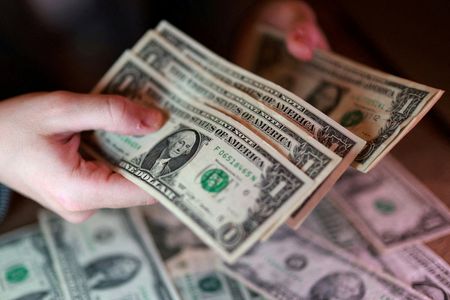

The American dollar maintained its position close to a two-month peak on Tuesday, strengthening against most major currencies as ongoing Middle East tensions dampened investor risk appetite while traders increased their expectations for a Federal Reserve interest rate increase later this year.
Following an appeal from U.S. President Donald Trump, Iran and Israel ceased their attacks against one another on Monday, though tensions remained elevated as Tehran issued warnings to restart strikes should Israel continue targeting Iran-backed Hezbollah forces in Lebanon.
American diplomatic efforts aimed at securing a permanent resolution with Iranian officials to conclude their conflict, which has lasted more than three months, have shown minimal progress, keeping oil prices high and strengthening safe-haven demand for the dollar.
The euro traded at $1.1528 while the British pound reached $1.3335, with both currencies declining approximately 0.05% during Asian trading hours after reaching two-month lows in the prior session.
Risk-sensitive currencies also declined, with the Australian dollar dropping 0.1% to $0.7039 and the New Zealand dollar trading at $0.5804.
The Japanese yen continued its weakness, falling to as much as 160.295, remaining near the 160 level that market observers widely consider a threshold for potential official intervention.
The dollar index, which tracks the greenback’s performance against a collection of currencies including the yen and euro, showed little movement at 100.03, staying close to Monday’s two-month high of 100.21.
“When you think about this idea of a peace deal or some sort of truce… what have we achieved in the past couple of weeks? Not a great deal,” NAB’s senior FX strategist Rodrigo Catril said in a podcast.
“We’ve seen the dollar being stronger because of this uncertainty, but also because of strong data in the U.S.”
The offshore yuan remained steady at 6.7857 per dollar, with traders awaiting trade data scheduled for release later in the day that economists expect will demonstrate strengthened Chinese export growth during May.
Financial markets are closely monitoring Wednesday’s U.S. inflation data for insights into the Federal Reserve’s future policy direction, particularly after last week’s strong employment report increased speculation about a rate increase this year. According to CME FedWatch, Fed funds futures traders now assign a 70% probability to a rate hike by December.
Treasury yields stayed broadly elevated due to rate hike expectations, with two-year note yields remaining near a 15-month high while the benchmark 10-year Treasury yield held firmly above 4.5%.
“Coming hot on the heels of Friday’s robust non-farm payrolls report, a hotter-than-expected CPI print would undoubtedly add to mounting fears of a Fed rate hike before year-end,” said Tony Sycamore, market analyst at IG.
“This scenario would provide fresh support for the U.S. dollar while putting renewed downward pressure on U.S. equities.”
Meanwhile, the European Central Bank is widely anticipated to implement a rate increase this week, with another boost likely in September, as officials work to balance energy-driven inflation pressures against a weakening economic environment.