
The bond between President Donald Trump and French President Emmanuel Macron began with an extended handshake almost ten years ago, but their connection has evolved into a series of public disputes that may take center stage at next week’s G7 gathering in France.
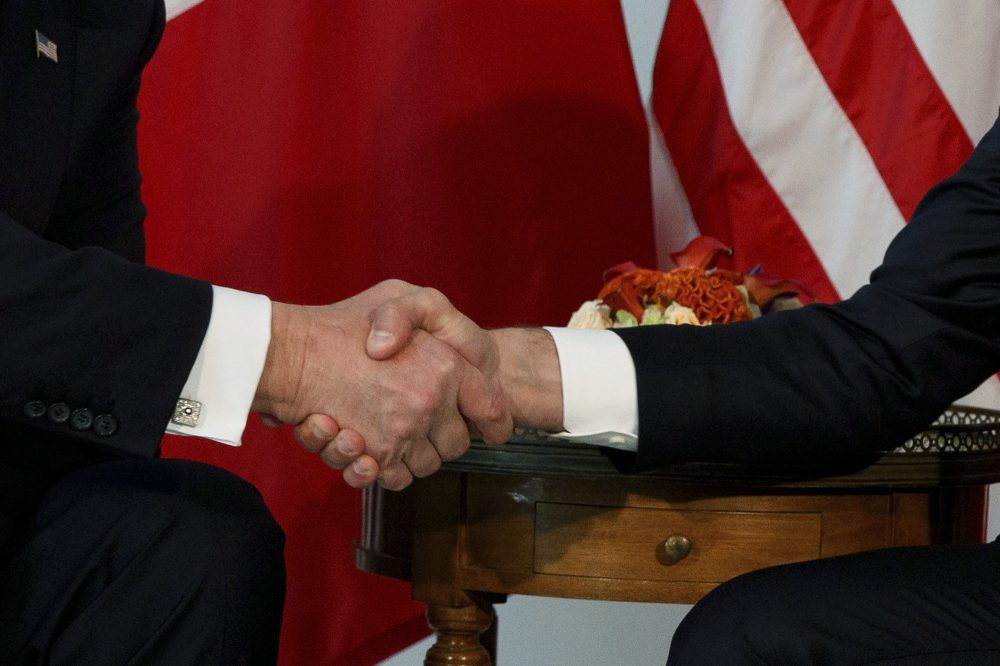
Their initial meeting in 2017 revealed early tension signs that could become prominent during the upcoming summit. Trump, then a bold businessman newly elected to the nation’s highest office, met Macron, an emerging politician who had secured a decisive electoral victory. During a NATO meeting in Brussels, their handshake lasted unusually long, with neither leader willing to release their grip first, creating such pressure that their knuckles turned white.
Despite this, a partnership developed. Initially, Macron appeared uniquely skilled at handling his unpredictable counterpart, who was three decades his senior.
The French leader extended an invitation to the Republican president for Bastille Day festivities in July 2017, featuring an Eiffel Tower dinner with their spouses. Trump returned the gesture by hosting Macron as the honored guest at his inaugural White House state dinner the next year, representing America’s most prestigious diplomatic recognition for an ally.
However, by Trump’s first term’s conclusion, their close relationship had deteriorated. During his second term, the leaders now exchange public criticisms, clashing over tariffs, Ukraine policy, and the Iran conflict. This tension will face examination next week when Trump joins leaders from Britain, Canada, Germany, Italy, and Japan alongside Macron at the French lakeside location of Evian-les-Bains for the G7 summit.
Uncomfortable exchanges between Trump and Macron may occur, along with friction between Trump and other G7 leaders he has criticized for refusing to support him regarding Iran.
“But I also think European leaders are quite professionals when it comes to politics, and in some ways diplomacy at this point, and will maybe see it as an opportunity as well,” Max Bergmann, director of the Europe, Russia, and Eurasia Program at the Center for Strategic and International Studies, said in an interview.
Kurt Volker, a former U.S. ambassador to NATO, explained that the Trump-Macron dynamic has become more complex due to the Iran conflict and Trump’s grievances “that Europeans weren’t helping, when they hadn’t been consulted, and their interests are very much affected by this.”
“I think that was a negative for Macron,” Volker said.
Trump entered a conflict alongside Israel against Iran concerning its nuclear activities in February without seeking input from other U.S. partners. He subsequently criticized European nations publicly when they rejected his appeals for assistance.
Declining American support for Ukraine’s conflict with Russia under the Trump administration “has really irritated the French,” Volker noted. “They feel this is important and we’re not paying attention to it.” Macron has invited Ukrainian President Volodymyr Zelenskyy to participate in Tuesday’s leadership discussions.
During Trump’s initial presidency, Macron seemed assured he could sway and guide the American leader, but their association has increasingly become characterized by their conflicts.
Macron now describes himself as “careful” regarding Trump’s declarations, indicating he no longer accepts them without question. Their connection remains polite as both refer to each other as “my friend.” However, their relationship has experienced various fluctuations.
As president-elect, Trump accepted Macron’s invitation to attend Notre Dame Cathedral’s reopening ceremony in Paris during late 2024. Following Trump’s second-term inauguration in 2025, Macron became an early White House visitor. The president posted on social media expressing his pleasure at welcoming Macron back and described the French relationship as “very special.”
During their meeting, however, the French president publicly corrected Trump after he incorrectly implied that Europe would recover funds it had contributed for Ukraine support. Smiling while touching Trump’s arm, Macron responded, “We provided real money.”
Macron also criticized as “brutal and unfounded” additional tariffs Trump imposed on steel, aluminum, and various European products in early 2025.
Yet some lighthearted instances have occurred amid the strain.
French television broadcast a documentary last year showing Macron informing Trump during a phone conversation that Zelenskyy had accepted a U.S.-supported ceasefire agreement. Trump responded, “You’re the greatest.”
Macron frequently claims he can contact Trump directly when necessary — demonstrating this during last year’s U.N. General Assembly in New York. When police prevented the French leader from crossing a street due to traffic being stopped for Trump’s motorcade, Macron retrieved his phone and called the American president.
“How are you?” Macron said. “Guess what? I’m waiting in the street because everything is frozen for you!”
Macron has contended that Trump’s “America first” approach strengthened his argument for enhanced European defense capabilities that would reduce dependence on the United States.
This April, as Trump sent conflicting messages about Washington’s NATO dedication following the Iran war’s beginning, Macron delivered some of his harshest criticism of the American president.
“There is too much talk, and it’s going in all directions,” Macron said. “We all need stability, calm and a return to peace. This is not a show.”
“You have to be serious, and when you want to be serious, you don’t say the opposite every day of what you said the day before,” he said.
Trump has recently begun imitating a French accent while recreating a discussion he claims occurred with Macron about drug prices and tariffs. Trump also targeted Macron by telling a private April luncheon that his wife, Brigitte Macron, treats her husband poorly. These remarks appeared in a White House YouTube video before access was restricted.
Macron found no amusement in Trump’s statements. “The remarks I heard were neither elegant nor appropriate,” he said. “They do not deserve a response.”
Still, Macron has attempted to work around Trump’s schedule to guarantee his summit attendance in Evian-les-Bains, understanding his tendency to depart such events prematurely.
Macron initially scheduled Sunday, Trump’s 80th birthday, as the summit’s opening day, but delayed the start by one day because Trump is marking the milestone with a UFC event held on White House grounds.