
WASHINGTON — President Donald Trump is claiming he has left standing military orders to strike Iran at unprecedented levels if Tehran acts on its longstanding threats to kill him. But national security experts say no such automatic trigger mechanism actually exists within the U.S. government.
In reality, if Trump were to be killed, the transfer of presidential power would be governed by the 25th Amendment and the Presidential Succession Act of 1947. That means Vice President JD Vance would instantly become commander in chief and hold sole authority over any military response.
Under that scenario, Vance could choose to carry out exactly what Trump has called for — but he would also have the option to ignore his predecessor’s orders or respond in an entirely different manner.
Author Garrett M. Graff, who wrote “Raven Rock: The Story of the U.S. Government’s Secret Plan to Save Itself — While the Rest of Us Die,” explained the situation plainly: “The U.S. has, for a whole variety of reasons, never utilized a technical ‘dead man’s switch.’”
The United States does maintain detailed contingency plans for keeping the government functioning in the event of a nuclear strike or catastrophic attack on Washington. However, those plans do not allow for automatic retaliatory strikes to be launched upon a president’s death, even if that president had previously ordered the military to be prepared to do so.
Despite this, Trump posted on his social media platform Saturday that Iran had made threats “to assassinate, or attempt to assassinate” him, and he declared that 1,000 “missiles are Locked and Loaded and aimed at the Islamic Republic of Iran, with thousands more to immediately follow, should the Iranian Government act on its threat.”
Hours after Trump’s post, Iran’s supreme leader Mojtaba Khamenei said Iranians would continue seeking revenge for the death of his father, Ayatollah Ali Khamenei, who died during the initial U.S. and Israeli strikes that began the war in late February. Funeral ceremonies for the elder Khamenei were held throughout Iran this week. The son declared that retaliation “is the will of our nation and must certainly be carried out.”
“We pledge to take revenge for the pure blood of you and all the martyrs of these two wars from the criminal and disgraceful killers,” Mojtaba Khamenei said in remarks broadcast on state television. “This revenge is the will of our nation and must certainly be carried out.”
The White House did not respond Saturday to questions about what would happen to Trump’s military directives if he were killed.
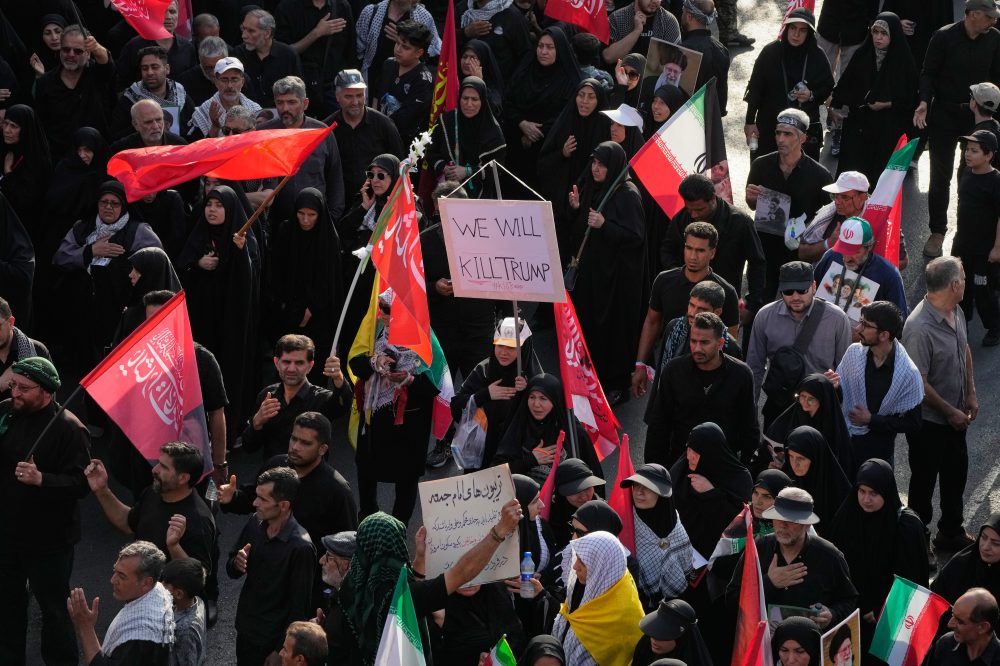
During the recent funeral proceedings in Iran, mourners were seen holding signs and banners calling for the deaths of both Trump and Israeli Prime Minister Benjamin Netanyahu.
The Wall Street Journal reported this week that Israel had alerted U.S. officials to new Iranian plots targeting Trump’s life. The White House declined to comment on the report, but Trump appeared to reference those threats during this week’s NATO summit in Turkey, telling reporters, “They want to take out the U.S. leader — me.”
Sabrina Singh, who served as deputy Pentagon press secretary under the Biden administration, said “Iran wanting to target senior American leaders is something that we know is happening.” She added, “You have to take these as credible threats.”
Trump has already survived two domestic assassination attempts during the 2024 presidential campaign and was present when a gunman stormed the White House Correspondents’ Association dinner he attended in April.
Adding to security concerns, Trump flew part of the return trip from Turkey this week aboard an older Air Force One aircraft rather than the newer Qatari-gifted plane. Images of the newer jet — which was retrofitted at an estimated cost of $400 million — show it lacks some of the missile detection and countermeasure systems found on earlier versions of the aircraft.
The travel decision came as the U.S. and Iran resumed trading military strikes, threatening the fragile deal reached last month to end the conflict. When asked about Iranian threats aboard Air Force One, Trump told reporters, “I’m No. 1 on their list.”
Graff noted that the U.S. spent decades developing plans for how nuclear launch authority would transfer in the event of a surprise attack, including keeping airborne command posts flying around the clock during 30 years of the Cold War, with a general aboard capable of authorizing nuclear strikes if Washington were destroyed.
“What I believe Trump is saying is that he’s left standing orders to attack if he’s killed, e.g., that the Pentagon should proceed with standard launch protocols,” Graff said. “There’s a lot of reason to doubt the legality of such standing orders, since in the event of a president’s death, the nuclear launch authority would immediately pass to the vice president or designated successor — and ultimately it would be up to him or her to determine whether to proceed.”
It should be noted that Trump’s social media post referred only to firing conventional missiles at Iran — something the U.S. has done many times since the conflict began. He did not explicitly mention nuclear weapons.
Graff added that Trump could also simply instruct Vance directly — saying something like “If I’m killed, nuke Iran” — which Graff said “would make more sense and would be absolutely legal.”
While U.S. officials regularly receive classified briefings about threats against the president and senior leaders from Iran and other adversaries, it is far less common for a sitting president to publicly declare that he personally has been targeted.
This is not, however, the first time Washington has issued warnings to Iran over threats against Trump. In 2022, the Biden administration warned Iran against attacking U.S. citizens after the Justice Department revealed that a member of Iran’s Islamic Revolutionary Guard Corps had plotted to assassinate John Bolton, Trump’s first-term national security adviser. Bolton, now a Trump critic, pleaded guilty last month to illegally retaining classified documents in a case pursued by Trump’s Justice Department.
Then-national security adviser Jake Sullivan said in 2022 that “should Iran attack any of our citizens, to include those who continue to serve the United States or those who formerly served, Iran will face severe consequences.”
Two years later, amid Trump’s 2024 presidential campaign against Democrat Kamala Harris, the Biden administration again quietly warned Iran — this time making clear that any attack on Trump would be treated as an act of war.