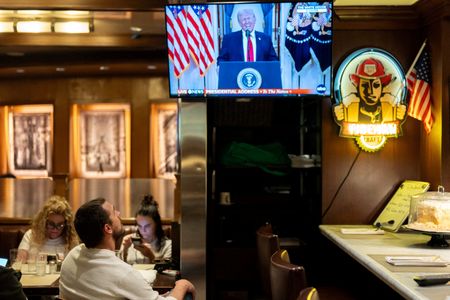

President Donald Trump used a nationally televised address Wednesday evening to justify his administration’s approach to the ongoing U.S.-Israeli military conflict with Iran, claiming American forces were close to achieving their objectives while continuing to threaten further military action against the Islamic Republic.
The 19-minute prime-time speech came as Trump faces mounting pressure from rising global oil prices and declining public support for his handling of the month-long conflict.
Several key themes emerged from the president’s remarks:
SEEKING AN EXIT STRATEGY
Addressing a war-weary American public and declining poll numbers, Trump claimed U.S. forces had eliminated Iran’s naval and air capabilities, severely damaged its missile and nuclear programs, and would continue striking targets “extremely hard” for the next two to three weeks.
However, despite stating that American military forces were close to achieving their goals “very shortly,” the president avoided providing a specific timeline for concluding the military operations.
Trump’s decision to continue issuing threats while sending contradictory signals is unlikely to reassure nervous financial markets or address concerns from an American public that has shown minimal enthusiasm for the largest U.S. military engagement since the 2003 Iraq invasion.
The president’s inconsistent messaging throughout the conflict has increased uncertainty, with Trump alternating between calls for diplomatic solutions and threats of additional military strikes while U.S. forces continue building up in the region.
HORMUZ STRAIT CONCERNS
Trump’s Wednesday remarks left unclear whether U.S. military involvement might conclude before Iran reopens the Strait of Hormuz, the crucial shipping lane that Iran currently controls, creating what experts call the most severe global energy crisis in recent memory.
Instead, he reiterated his position that nations dependent on Persian Gulf oil should bear responsibility for reopening and protecting the waterway, arguing the U.S. doesn’t require energy imports from that region. However, Western partners have been reluctant to join a conflict that Trump and Israeli Prime Minister Benjamin Netanyahu initiated without prior consultation.
Security experts warn this approach could leave Iran maintaining substantial control over the strait, through which one-fifth of global oil and natural gas shipments pass.
Gulf region allies may also oppose a rapid American withdrawal, potentially leaving them facing a damaged but still hostile neighboring country.
OBJECTIVES ACHIEVED?
While Trump highlighted U.S. military achievements in the conflict, uncertainty remains about whether he has accomplished his primary stated objective: preventing Iran from developing nuclear weapons.
More than a month into the conflict, Iran continues to possess enriched uranium stockpiles that could potentially be processed into weapons-grade material, though most is believed buried underground following U.S.-Israeli bombing campaigns in June.
In a notable policy shift, Trump told Reuters earlier Wednesday that he no longer prioritized securing Iran’s enriched uranium because it was “so far underground” and could be monitored through satellite surveillance. Iran has consistently denied pursuing nuclear weapons.
Despite Trump’s assertions about destroying Iran’s conventional military strength, the country has shown its remaining missile and drone capabilities can still threaten Israel, U.S. Gulf partners, and American military facilities in those nations.
Trump’s previous demands for overthrowing Iran’s religious leadership have not materialized. While U.S.-Israeli airstrikes eliminated numerous top officials, including Supreme Leader Ayatollah Ali Khamenei, they have been succeeded by even more hardline replacements, including Khamenei’s son. U.S. intelligence assessments indicate Iran’s government structure remains largely functional.
POLITICAL IMPLICATIONS
Trump’s address, his first prime-time speech since the conflict began February 28, was initially expected to address American concerns about the interventionist policies of a president who campaigned for re-election promising to avoid “stupid” military interventions.
However, Trump, whose advisors have urged him to prioritize domestic economic concerns, only briefly acknowledged Americans’ worries and seemed to dismiss their financial hardships as temporary problems that would resolve once fighting ends.
“Many Americans have been concerned to see the recent rise in gasoline prices here at home,” he said. “This short-term increase has been entirely the result of the Iranian regime launching deranged terror attacks against commercial oil tankers of neighboring countries that have nothing to do with the conflict.”
While Trump’s MAGA supporters have largely remained loyal, his hold on his political base could erode if economic consequences, including elevated gas prices, continue as his Republican Party fights to maintain Congressional control in November’s midterm elections.
Trump’s overall approval rating has dropped to 36%, marking his lowest level since returning to the White House, according to a Reuters/Ipsos poll completed Monday.