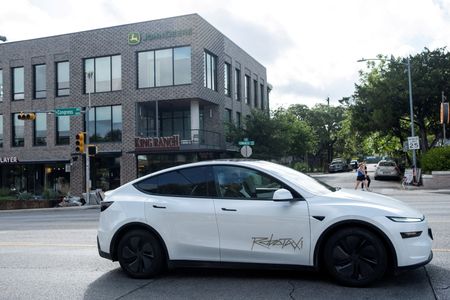

As Tesla pushes to gain regulatory approval for its “Full Self-Driving” (FSD) technology across Europe, the electric vehicle company has been sharing its own safety statistics with regulators in Sweden and the Netherlands — figures that independent traffic-safety researchers describe as little more than misleading marketing material.
A Reuters investigation published last month revealed that Tesla CEO Elon Musk and other company leaders have repeatedly cited statistics over the past year claiming FSD is up to 10 times safer than human drivers. However, the news agency’s review uncovered several faulty data comparisons at the heart of those claims that significantly overstate the system’s safety record.
According to correspondence obtained by Reuters through public records requests, Tesla has shared this inflated safety data with European regulators as it works to expand FSD’s footprint in a market where it is fighting to win back lost ground. The company approached RDW, the Dutch road regulator, in late 2024 to kick off the approval process.
In a letter sent to RDW in November 2024, Tesla included a link to its safety report and asserted that greater use of FSD “leads to safer roads.” The company sells access to FSD through a monthly subscription. While the system can handle driving under certain conditions, it still requires the human behind the wheel to remain attentive.
Following more than a year of testing and back-and-forth with Tesla, RDW gave FSD the green light for use in the Netherlands in April. The Dutch agency is now pursuing EU-wide approval on Tesla’s behalf.
RDW declined to address the specific problems Reuters identified with Tesla’s safety figures, but released a statement saying the agency “does not rely on marketing claims or external statistics” when making regulatory decisions, and instead conducts its own “tests, analyses and verifications” of the system on both public roads and test tracks. The agency did not clarify whether it evaluated Tesla’s U.S.-based safety statistics directly.
RDW noted that Tesla “collected a lot of data” throughout the testing period and that the agency “validated, tested and audited all of this data,” though it did not specify what type of data was gathered or what it measured. Tesla did not respond to requests for comment.
Shortly after the Netherlands announced its approval on April 10, a Tesla policy manager named Ivan Komusanac sent an email to Swedish regulators requesting similar approval for FSD. Attached to the email was a slide presentation featuring the disputed claim that Teslas operating with FSD can travel more than seven times farther between crashes compared to the average American human driver.
The presentation went further, suggesting FSD could have potentially saved 32,000 lives and prevented 1.9 million injuries.
Researchers who spoke with Reuters called those figures deeply misleading. They said the numbers rest on an unrealistic assumption — that every vehicle on U.S. roads, including freight trucks and crash-prone motorcycles, would be replaced by an FSD-equipped Tesla, and that each of those Teslas would be at least seven times safer than the vehicle it replaced.
Reuters also found that Tesla inflates its safety record by comparing the rate of crashes in FSD-operated vehicles that triggered airbag deployments against a broader U.S. crash rate that includes far less serious incidents. Additionally, Tesla compares its vehicles to the average American car, which is considerably older than the typical Tesla — a distortion that matters because newer vehicles come equipped with modern safety technology that reduces crashes.
Anders Eriksson, an investigator at the Swedish Transport Agency, declined to speak specifically about the data Tesla submitted but said Swedish regulators “look beyond headline figures” and that any evaluation of such a system would not be based “solely on aggregated safety claims, but on the overall evidence presented.” The agency did not respond to questions about what additional evidence Tesla provided.
Dudley Curtis, a spokesperson for the watchdog group European Transport Safety Council, said his organization is “certainly concerned” after Reuters informed the group about the correspondence showing Tesla had submitted what he called “unreliable safety data” from the United States to regulators in Sweden.
Curtis added that if Tesla wants to make safety claims, the company should “give the data to a university, have it independently verified by a qualified researcher, and then let’s talk.”
Tesla has stated that gaining FSD approval in Europe is critical to growing vehicle sales there. The company has been working to recover lost market share after sales dropped sharply last year amid public backlash over Musk’s political activities, including his alignment with far-right European political movements.
Without approval, Tesla could find it increasingly difficult to compete in a region where Chinese electric vehicle manufacturers are steadily gaining ground.
In the months ahead, representatives of member states accounting for 55% of EU membership and 65% of the bloc’s population must vote in favor for FSD to become legal across the entire European Union. In the meantime, individual countries can approve the technology on their own.
A regulator in Greece, which announced last month that it aims to approve FSD, cited data “from the other side of the Atlantic” showing “this system ultimately leads to a very significant drop in accidents.” The Greek transport ministry declined to answer questions about whether that data came from Tesla’s own safety report.
Regulators in other European countries have also been flooded with messages from Tesla drivers citing the company’s safety statistics and pushing for quick FSD approval. Several Tesla owners wrote to Norwegian road regulators last autumn referencing Tesla’s vehicle safety report, with one arguing the technology is “significantly safer than average manual driving” and could “reduce traffic accidents by up to 90% and thus save lives on Norwegian roads.”
Stein-Helge Mundal of the Norwegian Public Roads Administration responded to several of those Tesla enthusiasts, noting that Tesla’s figures “are self-produced,” which makes it “difficult to find correlation with the authorities’ accident statistics.”