
LONDON (AP) — Simon Boyd builds prefabricated steel structures on England’s south coast and exports them to clients in places like Ghana and Barbados. Mike Hawes leads the Society of Motor Manufacturers and Traders, representing the country’s automotive industry. The two business figures stood on opposite sides when the Brexit debate raged a decade ago — yet today, both share the same frustration over how things have turned out.
Ten years ago, supporters of leaving the European Union promised a bold new era for Britain — one where the country would reclaim authority over its own laws and borders, free from Brussels bureaucrats, and where the economy would thrive. That vision has not materialized. Instead, Britain has struggled to find its footing after losing seamless access to the EU’s single market, which encompasses 27 nations and roughly 450 million consumers.
The country’s economic growth has been sluggish at best. Taxes are elevated, public services are under strain, and government after government has failed to stop the steady stream of migrants crossing the English Channel in small inflatable boats. In short, there is little cause for celebration on this anniversary.
Boyd, who still supports the original Brexit decision, acknowledged the shortcomings. “No, it’s not delivered everything that was said it would deliver on the tin, but it is delivering,” he told The Associated Press. “It’s very sluggish. You only need to look at the statistics to see that.”
As managing director of REIDSteel — a company with around 130 employees based in Christchurch, England — Boyd places the blame for poor results on politicians who lacked the commitment to follow through. He also points to a series of unforeseen crises over the past decade, including the COVID-19 pandemic and the conflicts in Ukraine and the Middle East.
The fallout from the Brexit vote began almost immediately, as businesses braced for an uncertain future during years of drawn-out negotiations over the U.K.’s new terms with the EU. When Britain formally departed the bloc on January 31, 2020, newly established trade rules made conducting business with European partners more expensive and time-consuming than before.
Creon Butler, who oversees the global economy and finance program at Chatham House, a London-based think tank, said the consequences of leaving the European single market have been far-reaching. “Whatever was promised, whatever one hoped for, (you have) to accept that it has been a major loss of wealth and prosperity for us through the choice we made to leave,” he said. “That’s a decision the British public have made, and they’re entitled to make it, but it does make us poorer.”
A recently published report from the National Bureau of Economic Research in Cambridge, Massachusetts, backs up that assessment. Compiled by researchers from Britain, Germany, and the United States, the report measured the U.K. economy’s performance against 33 other countries, including European neighbors, the U.S., Canada, and Japan. The findings concluded that Brexit has shrunk Britain’s gross domestic product — a key measure of economic output — by 6% to 8%, cut investment by 12% to 13%, and reduced productivity by 3% to 4%.
The automotive sector was among the loudest voices against Brexit from the start, warning that the added red tape around parts shipments and finished vehicles would hurt an industry built on cross-border supply chains spanning multiple European countries. Those warnings proved well-founded. International automakers became less inclined to view Britain as an attractive gateway to European consumers, dampening investment. The industry is now looking to international trade agreements to help pick up the slack.
“We have been able to move with the times, so to speak, but undoubtedly it’s putting us at more cost into the industry, more pressure,” said Hawes.
Brexit backers frequently cited the ability to strike independent trade deals as one of the biggest upsides of leaving the EU, and Britain has since reached agreements with dozens of countries, including Australia, India, and the United States. Even so, EU nations still account for 41% of Britain’s exports and half of its imports, according to the latest government data.
Over more than five decades as an EU member, British businesses also grew accustomed to drawing workers from across Europe — particularly after the bloc expanded eastward in 2004. That access ended when Brexit eliminated the free movement of labor.
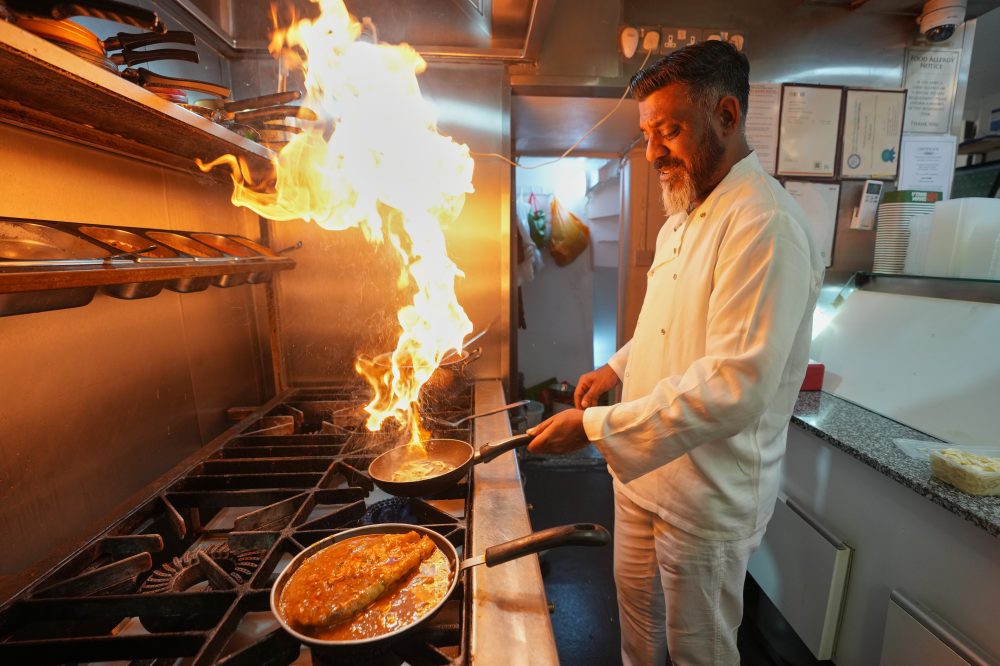
Few industries have felt that loss more acutely than Britain’s curry restaurant sector. Owners across the country — from Aberdeen in Scotland to Aberystwyth in Wales — have struggled after Eastern European workers returned home rather than navigate complex new visa requirements. Adding to their frustration, many in the industry had supported Brexit after being told it would open the door to more visas for South Asian cooks — a promise that was never kept.
“We feel betrayed,” said Oli Khan, president of the Bangladesh Caterers Association UK, who runs a restaurant in Stevenage, north of London, serving dishes like tandoori lamb chops, vegetable biryani, and chili paneer.
Prime Minister Keir Starmer has responded to the economic stagnation by opening talks with the EU aimed at forging a closer relationship, hoping to inject new life into Britain’s sluggish economy.
Those efforts come as new polling data suggests public disillusionment with Brexit is deepening. A survey of 2,245 Britons aged 18 and older, conducted in May by Ipsos, the Policy Institute at King’s College London, and the think tank UK in a Changing Europe, found that 48% of respondents said Brexit was going worse than they had anticipated — up sharply from 28% in March 2021. Only about 9% said it was going better than expected, while roughly one in three said it was going about as they had foreseen.
Boyd, however, maintains that the most meaningful vote was the one cast on June 23, 2016, when 51.9% of voters — totaling 17.4 million people — chose to leave the EU. He remains convinced that Britain’s best days lie ahead outside the bloc, arguing that entrenched political and corporate interests sabotaged a genuine Brexit by keeping the country too closely aligned with the EU. That, he says, prevented Britain from unlocking its full potential as an entrepreneurial, innovative nation.
And he is firm that there is no turning back. “Imagine if we were to rejoin … today. The conditions upon which we would be allowed back in would be akin to us re-boarding the Titanic on the condition that we surrender our life vests first,” he said. “Need I say any more?”