
DEIR EL-ZOUR, Syria (AP) — In a heartbreaking return to his homeland, a Syrian father laid his wife and four children to rest Saturday after they were killed in this week’s devastating Israeli bombardment of Beirut.
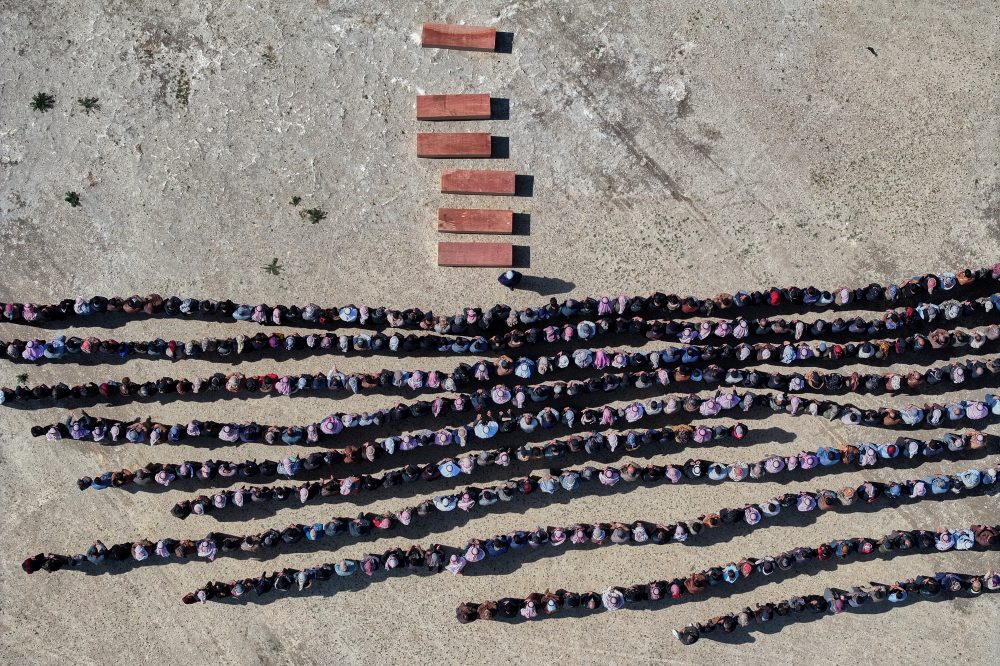
The family’s wooden coffins arrived by bus from Lebanon to Deir el-Zour province in northeastern Syria, with their names written on the sides. Mourners wept as they gathered for the funeral procession in al-Sour town — a tragic homecoming for a family that had sought refuge in Lebanon six years earlier.
Hamad al-Jalib lost nearly his entire family when Israeli forces launched approximately 100 strikes across Beirut and other Lebanese areas on Wednesday. The coordinated assault targeted what Israeli military officials described as Hezbollah-connected locations, resulting in more than 350 deaths that day — one-third of them women and children. It marked the deadliest single day in nearly six weeks of warfare.
Al-Jalib survived the attack only because he had stepped out to retrieve a gas canister while working as his building’s superintendent. Upon hearing that strikes had hit the Ain Mreisseh district where his family lived, he raced back to discover smoke billowing from a structure near a mosque, close to Beirut’s popular waterfront walkway.
“The Israeli attack killed my girls, they are innocent, just sitting at home,” al-Jalib said. “They were having lunch.”
Recovery teams spent three days pulling his family members from the debris. The bodies included his pregnant daughter-in-law, who was six months along. One daughter remains unaccounted for — 10-year-old Fatima Hamad al-Jalib — with searchers believing she’s still trapped beneath the rubble as rescue operations ended Saturday. His other children were ages 12, 13, 14, and 17.
The Wednesday bombardment struck commercial districts and crowded residential areas in central Beirut, well outside traditional conflict zones. These neighborhoods have been subject to repeated Israeli evacuation notices since early March, when Iran-supported Hezbollah militants launched rockets into Israel following U.S.-Israeli operations against Iran.
Al-Jalib’s brother Jomaa, who also resided in Lebanon, was working about 500 feet away when the initial explosion occurred. “We ran and we ran, then the second strike happened,” he recalled. As he reached the building, it began crumbling. “It was too late to get anyone out. We yelled for them, but no one answered.”
The family had relocated to Lebanon in 2020 due to escalating local conflicts involving tribal factions and Kurdish-led Syrian Democratic Forces in their home region.
Three additional Syrian relatives perished in the same Ain Mreisseh attack and were also interred Saturday in al-Shuhail town within Deir el-Zour province.
Lebanon’s Health Ministry reports that the ongoing month-long conflict between Israel and Hezbollah has claimed over 1,950 lives and injured more than 6,300 people. Among the casualties are at least 315 Syrians. Ministry officials noted that 39 Syrians were confirmed among Wednesday’s fatalities, though the complete breakdown by nationality remains unavailable.
According to U.N. refugee agency spokesperson Dalal Harb, the family killed in Ain Mreisseh was not officially registered with UNHCR. Lebanon hosts approximately 530,000 registered Syrian refugees through the agency, with hundreds of thousands more living there without formal registration.
Despite hundreds of thousands of Syrians returning home from Lebanon following former President Bashar Assad’s removal in December 2024, many continue to hesitate due to limited employment opportunities and persistent violence.
Following Saturday’s burial ceremony, mourners stood together in prayer over the newly covered graves.