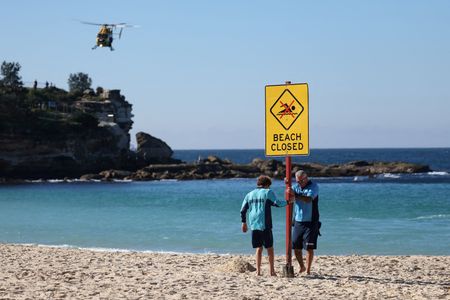

SYDNEY — Coogee Beach in Sydney reopened its shores to the public Monday, but with significantly heightened security measures in place, following a shark attack Saturday that left a woman with life-threatening injuries.
The victim, 35 years old, was swimming roughly 30 metres — about 100 feet — from the shoreline Saturday morning when a shark estimated to be between three and four metres long attacked her. She suffered serious wounds to both arms and her lower left leg. As of Monday, she remained hospitalized in stable condition.
Authorities are urging anyone entering the water to exercise extra caution in the coming days.
“Our Lifeguards will continue JetSki patrols throughout the day, and Surf Life Saving NSW is operating a shark-spotting drone at Coogee Beach,” Randwick City Council announced in an official statement.
The council also announced plans to hold a community meeting about the incident this coming Saturday.
Coogee Beach sits just south of the world-famous Bondi Beach and is considered a defining symbol of Sydney’s beach culture. Located on the eastern edge of the city, the area is renowned for its golden sand and striking coastal cliffs, attracting millions of visitors from across the globe each year — making water safety a critical concern for local officials.
Saturday’s mauling is part of a troubling pattern of shark encounters along Australian coastlines in recent months. Just the week prior, a man lost his life after being attacked by a shark while fishing off the coast of Western Australia.
The month before that, a 39-year-old man died following a shark attack while fishing on Queensland’s Great Barrier Reef. Just ten days earlier, a 38-year-old was fatally attacked near an island off Perth in Western Australia.
In January, dozens of beaches along Australia’s east coast — including several in Sydney — were forced to close after four separate shark attacks occurred within a two-day span. Those incidents followed heavy rainfall that left the water murky, conditions believed to attract sharks while limiting their ability to see clearly.
Although shark encounters are considered statistically uncommon, a Reuters analysis of data from the Australian Shark Incident Database reveals a slow but steady increase in incidents. Over the past decade, Australia has averaged nearly 29 shark encounters per year — a notable jump from the roughly 16 incidents per year recorded during the 2000s.
The Saturday attack has also triggered a review of aerial surveillance protocols. While emergency drones were put into service Monday, Coogee Beach typically operates under strict restrictions on drone flights due to its location directly beneath the flight path serving Sydney’s airport.
New South Wales Agriculture Minister Tara Moriarty addressed the situation Monday, acknowledging that it had been an especially difficult summer when it comes to shark activity. She indicated that no options were being ruled out as the state evaluates potential safety responses, though she emphasized that technology-based solutions — such as drones — would be the priority.
Some experts believe the Saturday attack was carried out by a white shark, a species classified as vulnerable and protected under environmental legislation that prohibits targeting, capturing, or killing the animal without specific authorization.
Despite those protections, the attack has reignited debate over whether a shark cull should be considered — a deeply divisive topic in Australia.
“It’s so wrong that we don’t cull sharks after attacks,” said former conservative Prime Minister Tony Abbott, expressing his view in a video shared to his Facebook page.