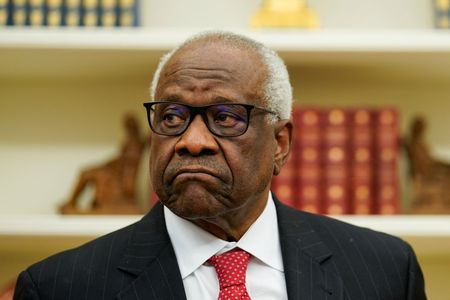

Supreme Court Justice Clarence Thomas will achieve a historic milestone this week, securing his position as the second longest-serving justice in the nation’s history. The 77-year-old conservative has wielded considerable influence in steering the high court toward more conservative positions throughout his decades-long tenure.
Thomas joined the Supreme Court in October 1991 after President George H.W. Bush appointed him at just 43 years old to fill the seat left by liberal icon Thurgood Marshall. Marshall had broken barriers as the court’s first Black justice, while Thomas became the second following a heated Senate confirmation process.
According to the Supreme Court Historical Society, Thomas will surpass Justice Stephen J. Field’s tenure record on Monday, who served from 1863 to 1897. By Thursday, he’ll move ahead of his former colleague Justice John Paul Stevens, who sat on the bench from 1975 to 2010.
Should Thomas continue serving until May 20, 2028, he would break the all-time record currently held by Justice William O. Douglas, who served from 1939 to 1975.
Thomas has made an indelible mark on American jurisprudence, though his role has transformed significantly over the years.
“He began his time on the court often in dissent, and he stood his ground,” explained Haley Proctor, a Notre Dame law professor who previously clerked for Thomas.
“The justice’s influence on the law has been profound,” Proctor noted. “And that is a consequence, not only of his many years on the court, but also of his persistence.”
Thomas has been instrumental in helping the court’s current 6-3 conservative majority, established in 2020, take bold action. In June 2022, he authored a groundbreaking decision that expanded Second Amendment gun rights and joined his conservative colleagues in dismantling Roe v. Wade, the 1973 ruling that had protected abortion access nationwide.
His judicial philosophy has consistently favored broad religious freedom protections, opposed same-sex marriage, challenged affirmative action programs in education and employment, supported capital punishment and expansive executive authority, and reduced campaign finance regulations.
“Justice Thomas is the most radically conservative justice to serve on the Supreme Court in modern times,” stated Erwin Chemerinsky, dean of UC Berkeley School of Law. “I say this because in addition to being conservative he has taken positions that would dramatically change the law that the court never has accepted.”
Chemerinsky highlighted Thomas’s desire to overturn precedents protecting access to contraceptives and striking down laws criminalizing gay relationships. He also noted the justice’s opposition to press freedom protections and his criticism of requirements that states provide public defenders for indigent criminal defendants.
“In some areas, he succeeded in changing the law, such as the Second Amendment, overruling Roe v. Wade and ending affirmative action,” Chemerinsky observed. “But in most places his calls for a radical change in a conservative direction have not gained support from a majority of the court.”
Thomas has consistently supported former President Donald Trump’s policies when lower courts have blocked them. When the Supreme Court dealt Trump a rare defeat in February by rejecting his comprehensive tariff program, Thomas joined two other conservative justices in dissent, earning praise from the former president.
Ken Masugi, a scholar at the conservative Claremont Institute, noted that Thomas inspires deep loyalty among those who work with him, particularly former law clerks who have gone on to become federal judges. Masugi worked under Thomas at the Equal Employment Opportunity Commission before his Supreme Court appointment.
“One notices that his clerks are incredibly loyal to him, even the ones who disagree with him,” Masugi said. “That’s proof of the influence he has on the people within the court.”
Thomas was serving as a federal appeals court judge when Bush nominated him for the lifetime Supreme Court position. The Senate narrowly confirmed him 52-48 after a contentious battle that included sexual harassment allegations from law professor Anita Hill, a former EEOC colleague. Thomas denied the accusations.
Future President Joe Biden, then a Democratic senator, chaired the Senate Judiciary Committee during those hearings, which Thomas condemned as “a high-tech lynching for uppity Blacks.” He told senators: “It is a message that unless you kowtow to an old order … you will be lynched, destroyed, caricatured by a committee of the U.S. Senate rather than hung from a tree.”
Thomas continues to speak forcefully in public appearances. During an April 15 event at the University of Texas, he characterized progressivism as a political movement that threatens America’s foundational principles.
Thomas argued that progressivism “seeks to replace the basic premises of the Declaration of Independence, and hence our form of government. It holds that our rights and our dignities come not from God, but from government. It requires of the people a subservience and weakness incompatible with a Constitution premised on the transcendent origin of our rights.”
American University law professor Stephen Wermiel observed, “I understand that he’s a very gregarious guy and that people at the court like him, but he does often come across as sort of an angry, bitter justice. There are times when you feel like he’s still not over the Anita Hill episode, and still has a kind of simmering anger about that.”
While Bush’s other Supreme Court nominee, Justice David Souter, disappointed conservatives by moving leftward, Thomas became a conservative favorite, though sometimes overshadowed by his contemporary Justice Antonin Scalia, who died in 2016.
During his first complete term in 1992, Thomas joined a dissenting opinion arguing that states should decide abortion policy and that Roe v. Wade should be overturned. This marked the beginning of his willingness to challenge established precedents.
In 1995, Thomas authored a concurring opinion criticizing affirmative action initiatives, arguing they perpetuate beliefs that racial minorities need assistance to compete successfully.
These once-minority positions have now become Supreme Court law.
“If Thomas believes there were bad precedents set in the past, he doesn’t feel any fidelity to them,” explained Ralph Rossum, a Claremont McKenna College professor who authored a book about Thomas.
Thomas has also modified one notable habit. For nearly three decades, he rarely asked questions during oral arguments. This changed when the court shifted to telephone hearings during the 2020 COVID pandemic, and he has remained an active questioner since then.
At 77, with his 78th birthday approaching on June 23, Thomas has shown no signs of retirement plans. Trump, who could make a fourth Supreme Court appointment if any vacancy occurs, has expressed hope that Thomas and fellow conservative Justice Samuel Alito, 76, will continue serving.
“It’s hard for me to imagine that becoming the longest-serving justice is not of some importance to him,” Wermiel suggested.
Thomas has previously hinted at a lengthy tenure. During a 2019 appearance at Pepperdine University in California, when asked about potential retirement remarks in 20 years, Thomas responded simply.
“But I’m not retiring,” Thomas told the interviewer, who followed up: “Not in 20 years?”
“No,” replied Thomas.
“Not in 30 years?” the interviewer continued.
“No,” Thomas answered.