
The most lasting memories that Clark and Dan Hunt carry of their late father, sports magnate Lamar Hunt, center not on the countless World Cup matches they witnessed together, but rather on the winding, peculiar journeys they embarked upon to reach those stadiums.
There were van trips across Europe alongside an eclectic group of journalists, including a young CBS announcer named Verne Lundquist. Adventures seeking the finest wienerschnitzel and gelato. Climbing over barriers to swim in Italian hotel pools that had closed hours earlier. And that infamous Mexican eatery that became their collective undoing.
“My dad, he could eat anything,” Dan Hunt remembered, recalling that evening during the 1986 World Cup. “I mean, he had a cast-iron stomach. He never got sick. And that about killed him. That was the food that took down the Hunt family.”
During extensive conversations with The Associated Press, the Hunt siblings — Clark, who chairs the NFL’s Kansas City Chiefs, and Dan, who leads Major League Soccer’s FC Dallas — looked back on the significant soccer heritage their departed father established.
America might very well be watching the World Cup unfold in another nation next month instead of serving as host, were it not for his contributions.
Lamar Hunt was instrumental in establishing professional soccer’s presence in America through his backing of the North American Soccer League. When that venture collapsed in the 1980s, an unwavering Hunt played a crucial role in creating MLS, which FIFA required as a condition for allowing the United States to stage the 1994 World Cup.
During that tournament, Lamar Hunt acted as co-chairman of the organizing committee for Dallas matches. Three decades later, Clark Hunt holds the same position for Kansas City games while Dan has assumed that responsibility in Dallas.
However, unlike America’s previous World Cup hosting duties, this time four group matches and two elimination contests will take place at Arrowhead Stadium, where the Chiefs play, and a venue Lamar Hunt often described as his most beloved location on Earth.
“It’s going to be special,” Clark Hunt expressed, “and I think it goes back to thinking about my dad a lot. That’s what I’m going to do during those games, just think about how excited he would be to see the World Cup in Arrowhead Stadium.”
Describing soccer as emerging in 1950s America would be generous. No meaningful professional competitions existed, and following a poor showing at the 1950 World Cup where they lost two of three matches, Americans wouldn’t qualify again for four decades.
Lamar Hunt’s passion for the sport began during a transatlantic journey.
His future spouse, Norma Hunt, was studying at University College Dublin as a Rotary scholar in the early 1960s, and the oil magnate H.L. Hunt’s son had traveled to see her. They attended a Shamrock Rovers contest, standing on a terrace during a chilly evening, and became captivated by the intense, passionate atmosphere of European football.
“I think,” Clark Hunt noted, “that may have been my dad’s first professional soccer game.”
That encounter left a lasting impression on Lamar Hunt, even after returning home and dedicating himself to American football, helping establish the American Football League — which eventually merged with the NFL — and the Dallas Texans, who became the Chiefs.
Several years afterward, Hunt traveled back to Europe for his inaugural World Cup experience. In 1966, he witnessed host nation England defeat West Germany in a memorable Wembley Stadium final for what remains their sole championship.
That same year, a collection of businessmen including Hunt and Jack Kent Cooke formed the United Soccer Association, which later combined with the National Professional Soccer League to establish the North American Soccer League. For almost twenty years, the NASL advanced American soccer, attracting legends like Pele, Franz Beckenbauer and Carlos Alberto to North America, and establishing foundations for future American talent.
“We know from his ventures into professional football that he was not afraid of a challenge,” Clark Hunt observed, “and he was always an optimist, too, and many of his ventures probably had long odds. But he had tremendous perseverence and tremendous work ethic, and he had a vision and a belief for what he was doing.”
The NASL expanded rapidly during the 1970s — perhaps too rapidly. Many new franchise owners lacked sufficient resources to absorb early losses while establishing their teams, leading to closures and several years of league contraction.
Following the 1984 season, with declining attendance and no television coverage, the league ceased operations.
“My dad was always great about not sharing his negative feelings, but I’m sure he had them,” Clark Hunt reflected. “I remember as a high school and college student being very upset about it, even though I didn’t have any real, you know, direct nexus to the team. But I just knew how disappointing it was for him, and sad that a sport I had come to love had really disappeared.”
However, professional soccer’s absence proved temporary.
Lamar Hunt possessed remarkable persistence, treating each setback as an educational experience. Therefore, when FIFA informed 1994 World Cup organizers that hosting required a premier domestic league, Hunt applied lessons from the NASL experience while helping create Major League Soccer.
“You knew that if Lamar Hunt was part of it,” explained Thom Meredith, his longtime associate, “it meant something. You had Robert Kraft and all these other guys, but when it came down to it, you had Lamar Hunt in the room.”
Hunt provided financial backing for the league and owned three founding franchises; the family retains FC Dallas ownership but sold clubs in Columbus and Kansas City. The league has since expanded to 30 teams across the United States and Canada, welcomed stars including David Beckham and Lionel Messi, and supported comprehensive youth soccer development nationwide.
“My dad would be so pleased to see where MLS is today,” Clark Hunt said, “and he would be so excited about where it’s going.”
While domestic soccer mattered to Hunt, the World Cup truly fascinated him, starting with that 1966 classic through the 2002 tournament in South Korea and Japan, which accelerated the sport’s Asian growth.
Most tournaments found Hunt loading his family into rental vehicles and traveling throughout host nations to attend as many matches as possible.
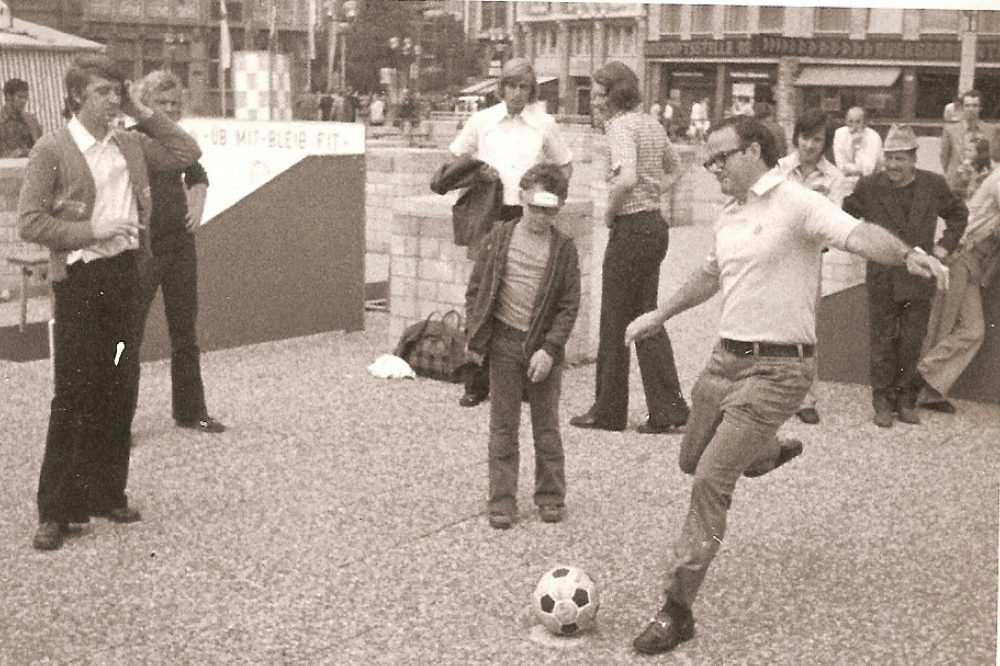
Clark Hunt, who later played college soccer at SMU, experienced his first World Cup in 1978. Rather than the games themselves, his clearest memory involves a plaza outside a Düsseldorf stadium featuring activities for children. One challenge involved kicking a ball through a wooden target, and Lamar Hunt enjoyed the attempt as much as his 9-year-old son.
Dan Hunt’s inaugural World Cup came in Mexico during 1986. The low point was that devastating meal that sickened the entire family, but the highlight was certainly the final, when Diego Maradona led Argentina past West Germany in Mexico City.
“We had seats at about the 40-yard line, you know? Great seats. And we were there with our tickets and people were stitting there, and they were unwilling to move. Security was unwilling to move them. So we had no seats,” Dan Hunt remembered. “So my dad, true to form, solved the problem by buying more tickets, and we were right behind the goal for the penalty-kick shootout.”
Both brothers had commitments at the 2002 tournament’s start, so Lamar Hunt — who passed away four years later at age 74 — ventured to Asia alone. Early in his trip, thieves stole his briefcase containing money, tickets and travel papers, forcing the billionaire businessman to navigate foreign ATM machines.
“He stuck is best card in and started to push buttons,” Dan Hunt recalled, “and he panicked and it shredded his card. So we’d send him cash. And then he was in South Korea, headed back to Japan, and they confiscated it all because he was over the legal limit.
“I just remember thinking, ‘My dad is totally going to get kidnapped.’”
When the United States received World Cup hosting rights alongside Mexico and Canada in June 2018, Kansas City organizers and Chiefs executives immediately began preparations. The city had been excluded from 1994 hosting after FIFA determined Arrowhead Stadium couldn’t accommodate the required field dimensions, and they refused to repeat that disappointment.
Over several years, costing nearly $20 million, lower bowl seating was removed from the NFL stadium and additional changes were implemented to prepare for its World Cup debut, now just days away. The opening match features Messi and defending champion Argentina facing Algeria on June 16.
Kansas City will stage six total matches, including a quarterfinal, with the metropolitan area serving as headquarters for Argentina and Algeria, plus traditional powers England and the Netherlands, a longtime Hunt family favorite.
Meanwhile, AT&T Stadium in Dallas, near Lamar Hunt’s former residence, will host five group-stage contests. The Cowboys’ venue will also stage four knockout round games, including a July 14 semifinal.
“I think this is one of the final pegs of fulfilling dad’s legacy,” Dan Hunt said. “He called Arrowhead Stadium his favorite place on earth, and it’s just so cool to have games there. And you know, Dallas was his hometown, and he loved it so much. So I think he would be just excited that we’re back here. I think he would be over the moon.”