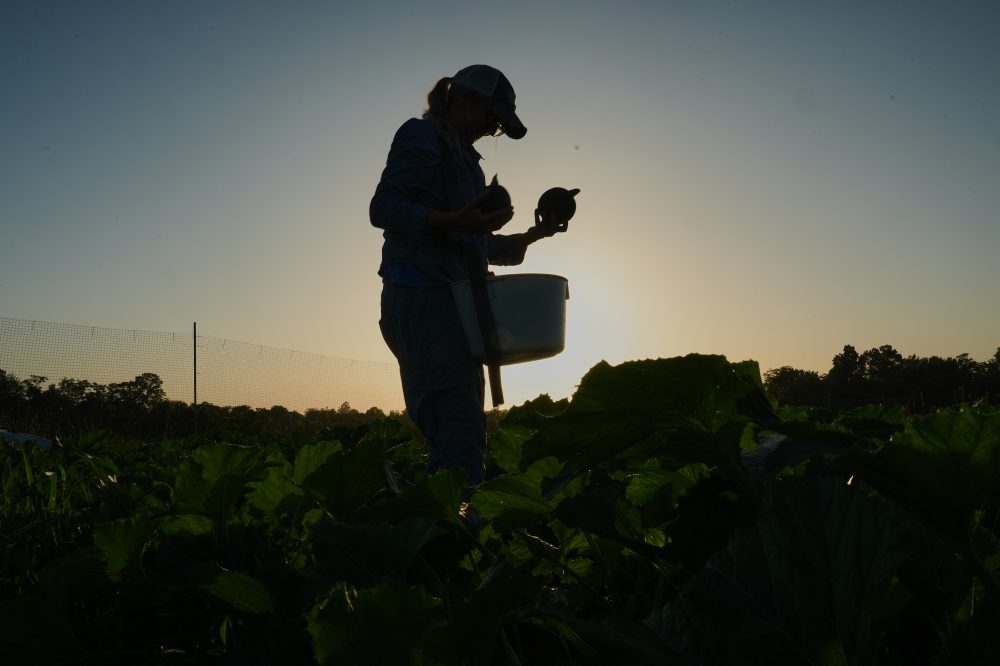

BROOKSVILLE, Ky. — Even as the sun began to dip toward the horizon, the heat of the day still hung heavy in the air as Annie Woods headed back out to gather squash and zucchini from her 50-acre farm.
Prolonged, intense heat — part of a broader pattern of climate change-driven weather extremes that also includes severe flooding and extended drought — is creating real challenges for farmers. Shorter planting windows and the risk of crop loss from early-season heat followed by a sudden freeze are becoming more common concerns.
“I think it’s pretty safe to assume these kind of heat waves aren’t going away or they’re not freak occurrences,” Woods said.
A recent heat dome — a high-pressure weather system that traps heat and humidity over a large area — took a toll on specialty farmers who grow fruits and vegetables. Scientists link these increasingly intense heat events to human-driven climate change.
Many specialty farmers have found ways to cope, largely by rescheduling their work to avoid the most dangerous parts of the day. However, experts point out that these growers don’t have access to the same financial safety nets available to farmers who grow traditional commodity crops like corn and soybeans.
The combination of heat and humidity that accompanies a heat dome is dangerous for farmworkers and represents a “serious threat to human health,” according to Melissa Widhalm, the associate director at the Midwest Regional Climate Center in West Lafayette, Indiana.
Woods now limits her fieldwork to the cooler morning and evening hours, taking frequent water breaks throughout. She plants and harvests everything by hand — unlike larger operations that depend on machinery. When the heat forces her to work in the fields during peak temperatures, she sets up the same tent she uses at farmer’s markets to create a patch of shade.
Extreme heat combined with rain and high humidity can also invite crop diseases and pests that devastate harvests. Her current focus is getting the most vulnerable crops — like delicate salad greens — out of the fields quickly. Woods supplies vegetables and culinary herbs to area restaurants and runs a community supported agriculture program. She noted that harvesting in excessive heat can damage the quality of the produce.
She’s also worried about the health of seedlings that will eventually become her fall crops. To protect them, she currently keeps the seedlings inside an enclosed cabinet in a barn where temperatures stay cooler. Once they sprout, she moves them to a greenhouse equipped with fans to keep conditions manageable.
“We have to do a lot checking on the greenhouse and watering frequently to keep those teeny tiny plants alive,” Woods said.
For some growers, the recent heat has dramatically shrunk the window for harvesting certain specialty crops.
Paul Rasch, who owns and runs several fruit orchards in central Iowa, said the heat has pushed his crew of eight to rush through the raspberry harvest. Under normal conditions, they’d have roughly three weeks to pick the perishable fruit, but “we’re scrambling to pick as many as we can,” he said.
His team has been starting as early as 6 a.m. some days to wrap up before noon, when temperatures become too dangerous to keep working. Rasch has also added air conditioning inside his farm buildings and is planting trees and installing covered pavilions outdoors so customers who come to pick their own fruit have somewhere cool to rest. He’s also experimenting with high tunnels to better control growing conditions for select crops.
Rasch said these extreme heat events seem to be growing more frequent, more intense, and longer-lasting. Combined with flooding, drought, and late-spring frosts, these weather patterns can cause damage throughout the entire growing season.
“We don’t ever seem to have a typical year anymore,” he said.
Smaller operations like those run by Woods and Rasch typically grow a wide variety of crops year-round. That’s partly a business strategy — but it also serves as a buffer, so that a loss in one crop doesn’t wipe out the whole farm.
“You’re always gonna have something that will thrive while other things might be more challenged,” Woods said.
Rasch also pointed out that crop insurance for specialty farmers works very differently than it does for commodity farmers. Specialty growers face greater exposure to extreme weather but have far less protection, he said. Woods, who also works with the Organic Association of Kentucky, agrees — and said she knows farmers in similar situations who struggle to get coverage because they grow so many different crops across small acreage.
The reason, according to Duncan Orlander, a policy specialist with the National Sustainable Agriculture Coalition, is that federal crop insurance programs are built around single crops with a single growing season — like corn, soybeans, and wheat.
For smaller specialty growers, the paperwork required to insure a wide range of crops on limited acreage can be overwhelming, and coverage for certain specialty crops may not even be offered in some areas. Insurance companies are also discouraged from selling policies with small premiums and limited potential payouts, Orlander added.
While some federal programs cover a farm’s overall revenue rather than individual crops, Orlander said those policies are complex and rarely used.
“We’re not keeping up with the losses and the extreme weather that we’re seeing,” he said. “And we have to think a little bit differently about how we are going to mitigate risk and cover losses into the future when these things occur.”
For Woods, the community supported agriculture program she operates provides a financial cushion if a crop fails — her customers commit to supporting the farm for the whole season, no matter what ends up in their weekly boxes. That program, combined with the variety of crops she grows, is how she “hedges our bets” against heat, flooding, and drought.
“It’s something you have to be aware of and plan for and have a plan to be resilient in the face of these kind of events,” Woods said.