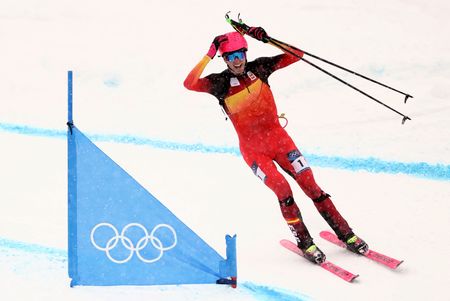

BORMIO, Italy – Spanish athlete Oriol Cardona Coll ended his country’s 54-year Winter Olympic gold medal drought Thursday by capturing first place in the men’s ski mountaineering sprint competition, a brand-new event making its Olympic debut.
Switzerland’s Marianne Fatton also etched her name in Olympic history just minutes before, defeating heavily favored French competitor Emily Harrop to become the first-ever Olympic champion in the multi-faceted sport at the Milano-Cortina Games in Bormio.
Despite battling through qualifying rounds and semifinals in harsh snowstorm conditions, Cardona Coll controlled the six-athlete final from start to finish. He executed flawless transitions throughout the challenging uphill and downhill course to defeat Russian competitor Nikita Filippov, while France’s Thibault Anselmet earned the bronze medal.
The victory marked Spain’s first Winter Olympic gold since Alpine skier Francisco Fernandez Ochoa’s triumph at the 1972 Sapporo Games. Spain had not earned any medals at these Milano-Cortina Olympics prior to Thursday’s competition.
Filippov competed without national representation, as the International Olympic Committee prohibited Russian and Belarusian athletes from displaying their flags or hearing their anthems following Russia’s February 2022 invasion of Ukraine.
Harrop entered the competition as the overwhelming gold medal favorite, having claimed four SkiMo overall championships. However, she lost crucial time during the staircase portion of the course and couldn’t recover to catch the surging Fatton, settling for silver instead.
Spain’s Ana Alonso Rodriguez captured bronze in the women’s event, giving the country its first medal of these Games before Cardona Coll improved on that achievement with his commanding gold medal performance.
The world’s top ski mountaineering athletes waited until near the Games’ conclusion to showcase their skills, but they delivered an captivating spectacle for spectators who braved the severe weather conditions.
While traditional ski touring from the 1800s provided the sport’s foundation, the Olympic sprint format delivers an adrenaline-fueled competition with qualifying heats lasting just over three minutes.
Competitors race head-to-head, beginning with an uphill ski climb on a 60-meter slope using grip-enhancing skins, followed by navigating a 10-meter staircase on foot while carrying skis on their backs.
Athletes then complete a brief flat skiing segment before finishing with a slalom descent back to the base of the Stelvio course.
The transition phases – removing and reattaching skis and skins – proved critical for determining winners, and likely cost Harrop the gold medal she sought.
Known as the “Queen of Sprint,” the former Alpine skiing competitor controlled the initial climb and powered up the staircase. However, she spent too much time reattaching her skis, allowing world champion Fatton to take the lead and maintain it through the finish.
Cardona Coll maintained his advantage throughout nearly the entire race, and once he removed his ski skins for the final downhill section, he could begin celebrating before crossing the finish line.