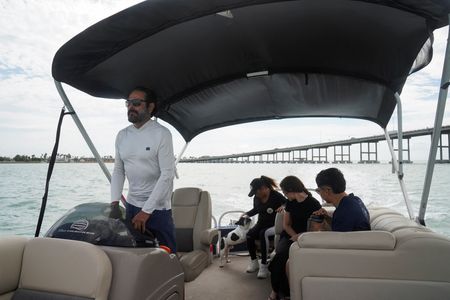

STARBASE, Texas, June 10 – During the most recent rocket launch by the space company in South Texas, charter boat operator Eddie Reyes positioned his pontoon vessel with paying customers less than 2 miles from the launch site. Flames burst skyward as shock waves jolted the watercraft while the massive rocket ascended.
The space company’s presence has generated significant revenue for Reyes and his relatives. Following the creation of the company town, his charter operation has flourished as enthusiasts travel to witness launches. His nephew has secured employment as a welder with the company and drives a Tesla Cybertruck.
However, the same launches that have elevated his family’s economic prospects are causing structural damage to his mother’s residence. Launch vibrations have created ceiling cracks, compromised window seals, and caused foundation settling. She joins dozens of other residents pursuing legal action against the company for property damage.
“You can’t stop progress,” Reyes said.
Numerous residents throughout the Rio Grande Valley area surrounding the company town – which centers on the rocket manufacturing and launch operations – have reached similar conclusions. They’ve chosen to embrace the wave of interplanetary aspirations while accepting the accompanying challenges.
Though the rapid expansion has delivered employment opportunities, tourism, and international recognition, it has also generated litigation, environmental issues, and increasing divisions among the region’s 1.4 million inhabitants.
Following the company’s record-breaking $1.75 trillion public offering on Friday – designed to raise $75 billion partially for scaling operations from occasional test flights to potentially weekly launches – the challenges facing area residents are expected to grow.
“This company is literally shaking the earth,” said Tino Villarreal, city commissioner of Brownsville, a city of 185,000 people that borders the company town. “By the amount of workforce it wants to produce, by the actual wavelengths that are shaking our soil.”
The space company declined to provide comments for this report.
The conflicting realities became evident before last month’s rocket launch – featuring the largest rocket takeoff and landing in the Indian Ocean – when contract employee Jose Bautista, 25, died in a fall at a nearby facility, initially reported by the San Antonio Express-News. He represents the latest worker fatality or serious injury during the rush toward Mars colonization.
On TikTok, local policy researcher Etienne Rosas posted a video calling for corporate accountability that received thousands of likes. One of Bautista’s cousins responded with gratitude, writing “my family is in need of prayers.”
Others defended the company in response to Rosas, arguing the organization bore no responsibility for the death. One commenter suggested that Bautista, even posthumously, would recognize “an accident for what it is.” The individual, who ignored interview requests, added: “Projects of magnitude like the Hoover Dam for example always claim many lives and the project continues. It’s the American way.”
A city spokesperson declined comment. The Occupational Safety and Health Administration, conducting an investigation, also declined comment. A family representative declined to speak.
The Cameron County Sheriff’s office referred comment requests to the space company.
The company, which remained silent, has not publicly acknowledged Bautista’s death.
A ROCKET LAUNCHPAD IN THE BACKYARD
When construction commenced at the site in 2014, Boca Chica consisted of a small residential cluster along the Mexico border and a favored beach destination for Brownsville residents. Currently, two launch structures rise nearly 500 feet above the beach alongside expanding neighborhoods featuring Airstream trailers, compact homes, and luxury residences.
The company envisions eventually producing components for up to 1,000 rockets in the town’s manufacturing facility – a 1 million square-foot advanced production center – and assembly building, a 380-foot-tall rocket construction structure.
The community has unique characteristics. Company employee Bobby Peden won election as mayor last year shortly after incorporation. The town is establishing a police department and has considered creating a municipal court – where Peden would serve as temporary judge.
At the local school, Ad Astra, young students learn to work “with numbers into the thousands – far beyond kindergarten standards,” according to the institution’s website. The neighborhood bar, Astropub, restricts access to company employees only.
“When I showed up, we had one street with houses, we were building rockets in tents, and we didn’t have water or a sewer system,” said Kathryn Leuders, who served as general manager before incorporation. Now “you’re raising families, and you’re raising children in this community that is Starbase, that’s also got a launchpad in its back yard. It’s a really cool thing.”
Similar to the Mars settlement illustrated in a large mural on the assembly building’s exterior, the community represents a potential blueprint for future interplanetary settlements. During a recent evening before the rocket launch, streets filled at 5 p.m. with employees departing company buildings on bicycles while Cybertruck convoys traveled the highway to Brownsville, passing sculptures and a sign reading, “Mars Embassy. Future Location.”
“I’ve been to NASA, and you don’t get anywhere near something like this,” said Nicholas Poindexter, a pest control worker and space enthusiast who traveled from Indiana to observe the launch. “Last time I was here I thought, holy cow, you could throw a rock and hit” a rocket.
STARBASE BOON TO REGION
Many area officials have embraced the company town as beneficial to one of America’s most economically disadvantaged regions. An impact analysis by the Greater Brownsville Economic Development Corporation in March indicated the operation has generated 5,000 jobs and delivered $100 million in tourism revenue during the past year.
Wearing a company ‘Starship’ t-shirt, Brownsville city commissioner Villarreal highlighted new restaurants serving the increasingly prosperous workforce, situated between boarded storefronts and deteriorating homes.
The company founder “has moved at the speed of light, and I think that’s helped Brownsville also really move a lot faster in our growth and development,” said Villarreal. “It’s injected a steroid into Brownsville.”
Some area Rio Grande Valley residents initially embraced the company’s arrival. Maria Pointer had lived in the region for nearly two decades when she sold her property to the company in 2020 after meeting with the founder. “We were excited,” she said. “I really felt, at the time, that we deserved the moon as the gas station to wherever all the Elons of the world wanted to go in interstellar space.”
Over time, Pointer has grown less enthusiastic, describing the community as less welcoming. In April, she visited the manufacturing facility to record an interview with an Italian news team, beneath a massive “X” near the building entrance, where her kitchen previously existed. A security officer approached and ordered them to depart. “It was very military,” she said.
Other residents from surrounding communities – Laguna Vista, Port Isabel and South Padre Island – allege the rocket launches are harming their properties, according to a class-action lawsuit filed in April against the company.
One plaintiff, who declined on-record comments per her attorney’s guidance, showed her Port Isabel residence. Cabinets sit crooked, doors won’t shut properly, and chipboard covers damaged flooring she attributes to mold after a shower pipe broke following a rocket launch. She estimates foundation repairs at approximately $100,000, exceeding half the home’s worth.
“They’re wanting to get to Mars,” she said. “But what about us that are here? I’m here now. And nobody is thinking about us.”